Moldova
Mass Media Forum 2025

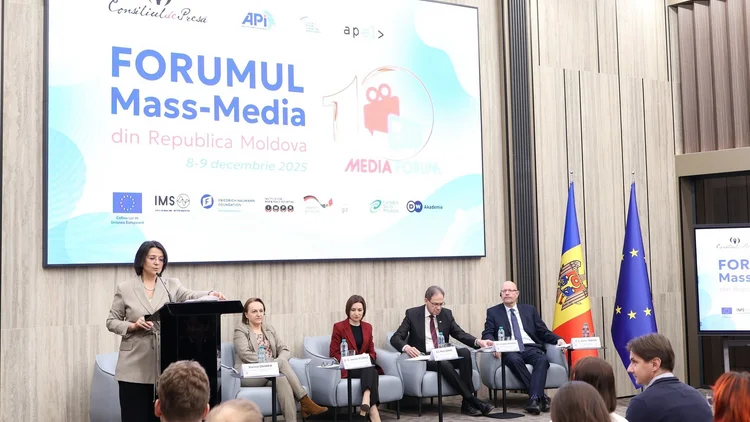
The Media Forum 2025 provided a detailed overview of the problems facing the press in the Republic of Moldova, in a context marked by unprecedented informational pressures, economic vulnerabilities, and legislative delays that affect the democratic functioning of the sector. Far from being a celebratory exercise, the tenth edition of the Forum highlighted the real tensions between the expectations of the journalistic community and the ability of the state, donors, and partners to respond to these challenges.
Thus, information attacks and disinformation, financial pressures, the insecurity of journalists, and loopholes in the harmonization of legislation with European standards are just some of the problems that have shaped the picture of a resilient but deeply vulnerable sector.
One of the most frequently mentioned problems was disinformation and external influences, amplified during election periods. Viorica Zaharia, president of the Press Council, stressed that the role of the independent press has become essential in exposing destabilisation networks, highlighting the contribution of journalistic investigations.
In 2025, marked by parliamentary elections, during which external pressure to spread disinformation and destabilise the country was unprecedented, the independent media reconfirmed its value and professionalism. The disclosure of the existence of networks seeking to destabilize the country, which began in 2024, the collection of evidence, and the exposure of methods of influence continued in 2025. Through other investigations carried out by several newsrooms, this finally made society feel that we have journalism. I believe that a large number of citizens of good faith felt pride in journalists and that such a press represents them. We will continue to live with misinformation for a long time to come, even though, of course, we do not want this. We will continue to have elections that need to be protected through investigations and transparency, just as corruption continues to exist and must be properly investigated by journalists.
A major issue, addressed at almost every edition of the Forum, remains the lack of a new press law, which has not yet been adopted, although the draft has been prepared and is to be registered in Parliament.
"I very much hope that next year we will finally have a modern law on media activity. We have had a press law since 1994, and that says a lot. Of course, there are many challenges before this document is adopted in its final reading in Parliament, but I encourage all participants in the room, as well as those watching us, to contribute. This law cannot be placed solely on the shoulders of two or three experts or, subsequently, only on those members of Parliament who will vote on it. We all know how to criticize, but let's contribute, because it is important not only for the profession, but also for citizens as media consumers," said Tatiana Puiu, lawyer and media expert.
The Minister of Culture, Cristian Jardan, pointed out that aligning the regulatory framework with European Union standards is one of the authorities' top priorities at this time. "This is our number one goal—to align ourselves, first and foremost, legislatively, with European Union requirements. The media sector is very important for any country," the minister said.
At the same time, he acknowledged that problems in the media sector have persisted for years. "Unfortunately, at least from my perspective, the problems remain the same," Cristian Jardan said, referring to inequalities in the media market, which is constantly shrinking and remains uncompetitive. According to the minister, as long as media institutions are not financially independent and prosperous, it is difficult to talk about real development in the sector. In this context, he mentioned that the state has a responsibility to provide tools for creating a competitive market, but also to contribute to solid economic development that allows for the existence of strong companies capable of investing in the media.
The president of the Parliamentary Committee on Culture, Education, Research, Youth, Sports, and Media, Liliana Nicolaescu-Onofrei, announced that the adoption of a new media law, which was worked on in the previous legislature, is a priority with a clear deadline, to be discussed and promoted by June 2026. The member of parliament noted that the process involves not only the adoption of a framework law, but also related adjustments to the Audiovisual Media Services Code, which are necessary for alignment with European directives and for the full participation of the Republic of Moldova in programs such as Creative Europe. According to Liliana Nicolaescu-Onofrei, the new legislation should focus on transparency of media ownership, strengthening co-regulation mechanisms, and correlating legal regulations with ethical standards, and these decisions should be made "following real discussions with the industry" so that the changes serve to develop the field, not just to tick off formal obligations.

The Media Forum 2025 panel speakers from left to right: Liliana Vițu (Chair of the Audiovisual Council), Tatiana Puiu (IWPR), Cristian Jardan, Minister of Culture, Liliana Nicolaescu-Onofrei (Chair of the Parliamentary Committee on Culture, Education, Research, Youth, Sport, and Media), Dumitru Țîra (Realitatea), and Ion Bunduchi (APEL).
© Press Council of the Republic of MoldovaThe president of the Audiovisual Council, Liliana Vițu, drew attention to problems related to the ill will of providers and distributors, which significantly reduce the volume of domestic production. "I am absolutely appalled by how stubborn TV and radio stations are in not producing their own content. I simply cannot understand how you can obtain a license and then, through various tricks and pressure, reduce the quotas for domestic products, produce nothing of your own, and thus avoid the law. My colleagues in monitoring and licensing are faced with contracts that exist only on paper, all designed to prevent local productions from being made."
At the same time, Vițu mentioned the problems related to the lack of transparency regarding media owners: "We really like intermediaries and hide behind them. We do not take direct responsibility and avoid acknowledging who is actually behind the media institutions. We had to come up with legislative changes because, in the first year, some did not want to disclose their sources of funding. I cannot understand how you can make news in a single studio and then reuse it on four or five stations, changing only the graphics, color, or banner, claiming that it is a 100% original product. As long as there is bad faith in the industry, additional regulations will be necessary," said the president of the Audiovisual Council.
Threats, harassment, and intimidation remain high, and the type of attacks has changed, becoming increasingly widespread in the online environment.
Lawyer and media expert Tatiana Puiu brought attention to global and local issues related to the safety of journalists. "Over the past ten years, more than 2,000 alerts have been reported worldwide regarding the safety of journalists. We are talking about murders, arrests, surveillance, and half of these alerts come from European Union member states. Each country has its own realities, but I can say with certainty that, in the Republic of Moldova, there is currently a sufficient legal framework for the normal activity of the media. Of course, there is still a lot to be done to improve economic and legal activity."
At the same time, the Forum highlighted the deep economic crisis in the media, particularly the collapse of the advertising market.
Dumitru Țîra, CEO of the Realitatea Media Group, drew attention to the problems related to the media market's dependence on foreign content and the need for a strategic plan for the development of regional media.
In the Republic of Moldova, we have 172 television stations retransmitted from the Russian Federation on our cable networks and another 56 that broadcast content in Russian, also based on products imported from Russia. Do the math: in total, we have 380 television stations on the country's cable networks. This highlights the vulnerability and dependence of our sector.
Țîra emphasized that regional media risks disappearing without a sustainable solution: "We need a strategic vision for the development and sustainability of media institutions. A clear concept is needed to enable regional media outlets to survive. No matter how much money is invested, without a development strategy, it will not last. The problem is not only the large number of institutions, but the lack of a functional formula for their survival and prosperity."
The problem is made worse by unfair competition and market monopolization, as well as the migration of advertising budgets to global platforms: "The media today depends on grants because our market is shrinking. Over the past 15 years, the advertising market in Moldova has declined by 75%. In contrast, Romania exceeded one billion last year, and Ukraine, even with the war, lost no more than 10% of its advertising market. The conclusion is clear: this decline is the result of artificial and circumstantial decisions, starting with the 2009 crisis and continuing in the following years, influenced by political factors, but also by the actions of some managers in the industry, which led to the deterioration of the media market. Advertising on YouTube brought zero lei to the state budget, but took over a million out of the national market."
Another hot topic at the Forum was online regulation, including influencers and digital platforms. Liliana Vițu explained that international experience can guide local measures: "From our talks with the European Commission, we understand that there's openness to setting minimum transparency requirements. It is important for the public to know whether content is paid for or not, whether it is advertising, advertorial, or journalistic content, and where the money comes from. This is much the same approach as with media ownership transparency and funding sources—a clear distinction between editorial content and paid content. At least we can start with that."
The president of the Audiovisual Council also spoke about the challenges posed by new technologies: "We can also begin to regulate the use of artificial intelligence, including deepfakes and impersonation using AI, to prevent the spread of false information."

The event also addressed a number of other pressing issues facing local and regional media, highlighting the financial, organisational and editorial challenges that have accumulated in recent years in a context marked by successive crises. Participants spoke openly about the heavy dependence of newsrooms on international grants, especially in the absence of a functioning advertising market capable of supporting independent media. The suspension or reduction of some external funding has demonstrated how vulnerable many media institutions are, with some unable to cover basic expenses such as salaries or rent.
Another frequently mentioned problem was the acute shortage of staff, both in national newsrooms and especially in local and regional ones, where journalists are forced to perform multiple roles simultaneously – from content production to distribution, reporting and fundraising. This constant pressure contributes to professional burnout, staff turnover, and difficulties in maintaining editorial standards. At the same time, media managers emphasized that financial sustainability remains one of the biggest challenges, as long-term planning has become nearly impossible and newsrooms are forced to adapt quickly to political, social, and technological changes.
The Media Forum was convened by the Press Council, in partnership with the Independent Press Association (API), the Center for Independent Journalism (CJI), and the Electronic Press Association (APEL), and was held with the support of the European Union, International Media Support (Denmark), the Friedrich Naumann Foundation for Freedom (Germany), the Institute for War and Peace Reporting, the German Agency for International Cooperation (GIZ), the Soros Foundation Moldova, and DW Akademie (Germany).