Political parallels in Central Europe
New axis in Central Europe: Babiš, Orbán, and Fico between Moscow and Brussels

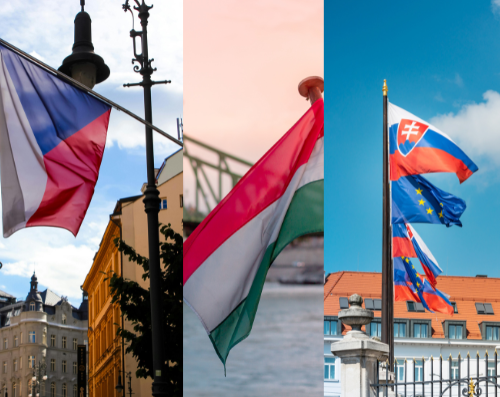
A new chapter of political renaissance is beginning in the heart of Europe. In Hungary, Slovakia, and the Czechia, three men are shaping politics, all of whom have previously held power and regained it: Viktor Orbán, Robert Fico, and Andrej Babiš. Their return, whether already completed or currently underway, will pose a challenge for the EU. Each of the three men has his own personal struggle with the EU, whether due to migration, climate policy, Russian aggression in Ukraine, or his own economic interests. This article examines the extent to which the heads of government's positions and motives overlap.
At the beginning of October 2025, Czechia elected a new chamber of deputies, in which an old acquaintance also returned to power. The ANO (Akce nespokojených občanů/Action of Dissatisfied Citizens) party of former Prime Minister Andrej Babiš won with 34.5% of the vote. Among the first to congratulate them were Hungarian Prime Minister Viktor Orbán and Slovak Prime Minister Robert Fico. Andrej Babiš had already served as Prime Minister of the Czechia from 2017 to 2021, and until a year ago, his party was part of ALDE- or Renew Europe in the EU. In 2024, Andrej Babiš, together with Viktor Orbán and other right-wing politicians, founded a new right to far-right group in the EU Parliament: the Patriots for Europe.
What connects the three heads of government of Hungary, Slovakia, and Czechia? Are there ideological overlaps, or is it merely a friendship of convenience? This article primarily aims to highlight the positions of the three men on Russian aggression in Ukraine and their stances toward the EU.
For more than three years, the Russians have been waging a relentless battle in Ukraine. While most European heads of state are distancing themselves from Putin and reducing oil supplies from Russia, two men in particular are disrupting the EU's course. Viktor Orbán, Hungary's continuous head of government for 15 years, regularly opposes sanctions against Russia or aid to Ukraine, only to agree at the last moment, but not without concessions from the EU. Robert Fico appears to be copying this stance. Both Fico and Orbán have ongoing gas supply contracts with Russia.
Orbán's attitude toward Ukraine is not only evident in blockades within the EU. The blockade of military aid is justified, for example, that it is pointless and prolongs the war. Just a few weeks ago, he denied Ukraine's independence; he is blocking progress in the EU accession process, arguing that the Ukrainian mafia is gaining unhindered access to the EU. He is financing the Russian war machine through Russian gas and oil supplies, opposes sanctions on the grounds that they are useless and bad for the economy, while claiming that the EU wants to drag Hungary into the war. To counter this, he portrayed himself as a peacemaker and therefore visited Russian President Vladimir Putin in 2024. The Hungarian Prime Minister is under domestic political pressure: mismanagement, corruption, and double standards are increasing discontent in the country. This could be dangerous for Orbán in next year's parliamentary elections, as his former party colleague, Peter Magyar, is leading in the polls. The anti-Ukraine propaganda is intended to distract from the country's poor state: hospitals and schools are dilapidated, and many Hungarians are struggling to survive economically. Instead of questioning one's own nepotism or luxury lifestyle, it is easier to blame the EU and Ukraine for everything.
Since Robert Fico's re-election, it seems as if he is copying Viktor Orbán. Both countries are dependent on Russian gas, so he too has blocked any EU initiative aimed at reducing this dependence. Like his Hungarian counterpart, he also visited Vladimir Putin several times after the start of the war of aggression. Fico blames Ukraine for the war of aggression against Ukraine, and in turn, he blames the EU for the continued fighting. He justified the halt to military aid to Ukraine by saying that it was not “our war”. Nevertheless, he does not completely distance himself from the West and Ukraine. For example, he supports Ukraine's accession to the EU, and his voters are in favor of the country remaining in NATO. The proximity to Russia is explained, among other things, by the dependence on gas supplies; moreover, the Soviet army liberated the country during World War II. Fico admires Putin and other autocrats because he considers them more efficient. Under the guise of being open to cooperation in all directions, he cooperates with them too. However, this political orientation could harm him: polls show that the FNF's partner party, the liberal Progresívne Slovensko, is ahead of Fico's Smer.
Although Andrej Babiš has been part of a Russian-friendly group in the EU Parliament since 2024 and announced during the election campaign that he intended to stop the Czech munitions initiative for Ukraine, as the money should instead be used for “our own citizens.” He has since backed down from this position and is now primarily demanding more transparency. Within the EU, he can be expected to support Orbán's and Fico's blockade stance, particularly on the issues of migration and climate protection. Nevertheless, he lacks the pro-Russian stance of his counterparts, as demonstrated, for example, by the expulsion of Russian diplomats during his first term in office. The expulsion followed two fatal explosions in Vrbětice, which were attributed to the Russian military intelligence service GRU. Furthermore, Czechia is not dependent on Russian gas and oil supplies. Babiš's first term in office was largely overshadowed by his conflict of interest and subsidy fraud in connection with his company Agrofert. He is a businessman; his company operates in over 20 European countries, and his country is heavily dependent on EU funding. This makes the question of who will form a government in Czechia after the election all the more tense. At the moment, it looks as if there will be a three-way alliance between Babiš's ANO party, the far-right SPD (Freedom and Direct Democracy), that called for a referendum on leaving the EU and NATO before the election, and the Eurosceptic Car Drivers' Party.
Conclusion
Viktor Orbán speaks out against support for Ukraine and regularly blocks sanctions or decisions in the EU. The Hungarian Prime Minister has been waging a years-long battle against the overly "woke" EU, which has cut off his funding due to the dismantling of the rule of law. While the Hungarian elite continues to bask in luxury, the rest of the population struggles to survive financially. To distract from this, Orbán rails against the EU and Ukraine.
Robert Fico does not see himself or his country as responsible for supporting Ukraine. He blocks decisions and sanctions and instead meets with the Russian president. He justifies his openness towards Russia with a foreign policy that is open to everyone.
Andrej Babiš is also expected to take a more confrontational stance towards the EU, but he is neither dependent on Russian gas nor has anything else connected to Russia. He is a businessman and, as in his last term in office, will primarily represent these interests.
The pro-Russian policies of Hungary and Slovakia risk undermining EU cohesion and the struggle for democracy being waged in Ukraine. Even if Czechs new head of government takes a different line on Russia, he makes it more difficult for Ukraine to receive support within the EU. The trio could therefore block crucial EU decisions in the future – with consequences for European unity.
Above all, the liberal forces should continue to stand united behind Ukraine and continue their fight for democracy and human rights despite authoritarian headwinds.