Dream Constitution
Youth Voices on Dream Constitution
Dream Constitution in Thammasat
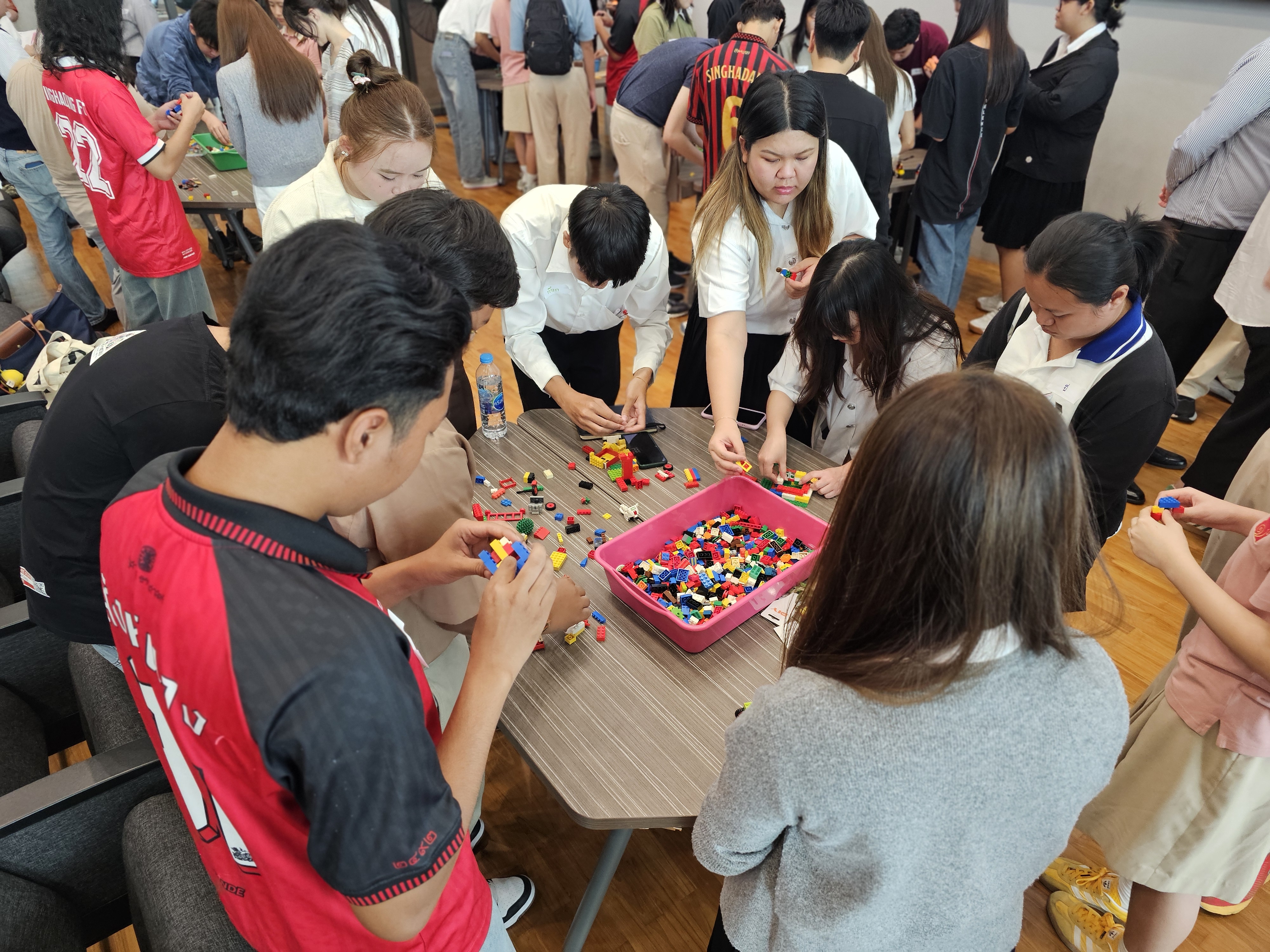
© FNF ThailandOver 60 youth came together to join forces to design a “Dream Constitution” at Thammasat university on 30th June 2025. Three participants reflect their thoughts, ideas, and impressions of the event.
compromise for peaceful resolution.

ณัฐวัตร กลับเกตุ (ผู้เขียน)
© FNF Thailand“Dream Constitution” is a concept I had personally thought about, heard of, and learned about in the media. In the past, I’ve participated in several activities related to this topic. Many of them were just events where we sat and listened to a few people talk before going back. Sometimes there were group discussions and idea exchanges, but there was often no record or assurance that those ideas would ever be taken forward.
This made me reflect on what I used to think a “Dream Constitution” should be—something that includes opinions, thoughts, and hopes from people who wish to see a constitution that reflects their needs and benefits both themselves and the country. But too often, it felt like we were only presenting ideas without any response. I began to question whether these kinds of activities were really what I had hoped for.
That was until I joined the Project Dream Con @ TU, organized by FNF Thailand, in collaboration with the Faculty of Political Science, Thammasat University, and WeVis. It gave me a new perspective on the idea of a “Dream Constitution.” As someone who is already interested in constitutionalism, I felt my worldview expand. I began to see constitutions through a new and more personal lens—one that offered greater clarity and depth.
The activity began with an introduction to the facilitators and partner organizations. Then, we broke into groups to discuss and share our ideas, starting with a reflection on Thailand’s past and our hopes for its future. Many participants shared similar views on past problems—inequality, extreme nationalism, and constitutions written by a handful of people but imposed on the whole nation.
Participants envisioned a future constitution that is flexible, equitable, free of loopholes, and amendable through democratic mechanisms. After presenting our individual ideas, we were asked to collaborate in our groups to design a “Dream Constitution.” Our group chose to base our dream on the Six Principles of the People’s Party (Khana Ratsadon)—independence, security, economy, equality, liberty, and education.
Of course, the more people involved, the more diverse the opinions. Creating a constitution in real life is no different—more voices mean more perspectives. Ultimately, all 50 participants had to work together to create one shared Dream Constitution. This process highlighted the need for spokespersons—voices to help synthesize everyone’s input into a unified vision. Dr. Vannapar Tirasangka said in her closing remarks: "In society, there are those who hold the microphone and speak loudly, and those who work behind the scenes supporting ideas. Neither is more important than the other. Everyone is equal, and compromise is essential for peaceful resolution."
When designing our shared model, we also discovered that the resources we had were limited—just like in the real world. We had to share and use them wisely. Only by uniting could we turn our dreams into reality. The final outcome was a Dream Constitution shaped by participants’ ideas around fundamental principles, social welfare, bureaucracy, economy, resource distribution, and even often-overlooked topics like technology. All of this came together successfully through the power of collaboration.
I almost forgot to mention one of the most fascinating parts of the workshop: using LEGO bricks to express our thoughts. A childhood toy—something so simple—turned out to be a powerful tool for visualizing and communicating ideas. For the first time, I was able to engage with a complex topic like the constitution in a way that was tangible and truly accessible.
This was also my first time participating in such a process—and it was incredibly exciting. I truly hope to join more activities like this in the future. They offer a rare chance to freely share our thoughts and truly be heard.
Thank you to FNF and all the partners involved in organizing this.
Natthawat Klapket
Second year Political Science student (Government Major),
Thammasat University
Opportunity to shape Thailand's future

กวิน วีระวนิชย์พัฒนา (ผู้เขียน)
© FNF ThailandI had the opportunity to attend the “Dream Constitution” workshop on 30th June 2025. When I first met the other participants at PUAY Park for the people, Thammasart University, the atmosphere was hopeful for change with a big display of ‘Dream Constitution,’ The participants were from diverse backgrounds; some were university students, some are from high school, some were graduates that are interested in amending the constitution, which makes it making for a more exciting discussion.
Despite the heat, everyone came with the same determination: to understand and imagine a better constitution for a better future. It started with a lecture. Speakers gave speeches about the importance of constitutions in our everyday lives. And, in Thailand since the start of democracy, our internal politics have never been stable. Thailand has more than 20 constitutions or one every five years. This has affected both the quality of life and ability to compete on the international stage. Without truly representative constitution, we cannot break the cycle of “new-constitution → almost-democracy → coup d’état → protests,” which has defined Thailand’s history of democratic triad.
Then, we took a short break. During the brake I have discussed with other participants about ‘What makes a good constitution?’ Together, we agreed on one thing: the 2017 constitution is a non-democratic document that does not stand for the people or democracy. Many participants shared that, in the past, Thailand once had a fully Democratic Constitution: ‘the People’s Constitution of 1997.’ This has become our minimum goal for the future amendments.
After the theory lecture, it was time to makes things. Breaking into five groups, each participant was asked to represent the current constitution using Lego bricks and giving the explanation of why we created such shapes. In my group, I chose to build a tank: represent for the undemocratic process and content of this constitution. Others built two people standing at opposite ends and at different heights: symbolizing the difference in power between the people and unconstitutional force. Some also created a Democracy Monument with various colors: standing for the fragmentation in Thailand’s political system and among its’ people.
Later, we engaged in a discussion about the society we want to live and what basic rights the constitution should guarantee, this discussion led to our shared ideas of the ideal constitution from youth. My team decided to build a Democracy Monument surrounded by people standing equally, symbolizing an equal representation and fair treatment for all citizens. Then we shared our ideas together on what should be added to the representation, connecting every part of the bricks, giving an explanation. As the bricks clicked together, so did our understanding of what ‘new people’s constitution’ should look like.
When all the groups reunited to create one combined model of our understanding for Dream Constitution. Each group shared their ideas, from the earlier presentations, I saw that some of these ideas had already existed in the current constitution such as free education until grade nine, universal healthcare, or the requirement that over 50% of yearly government budget must be allocated to local governances. But those sections are not enforced under the 2017’s constitution. At the end, I got to write a postcard addressing to the responsible for amending the constitution giving them my voice and my dream for a new constitution.
If you have ever felt that politics does not represent you, this is your chance to be heard. I warmly invite everyone especially youths to join the next workshop, to share your dreams, and to make your voice heard. Together, we can create a constitution worthy of attention we gave for Thailand’s future.
Kwin Veeravanichpattana,
Third Year student PPE program,
Thammasat University
Constitution for everyone

อัรฟาน ดอเลาะ (ผู้เขียน)
© FNF ThailandMy group had nine members. At first, when we gathered, everyone was silent—just introducing their names and institutions, likely because none of us had met before. When we received our first task—to use LEGO bricks to represent or reflect the current constitution—everyone became focused on building their models.
While I was putting together my LEGO creation, I felt surprised. I had always thought of LEGO as a childhood toy and never imagined it could be adapted and used creatively to discuss politics, governance, or constitutions. When it came time to give our presentation, it was clear that everyone had different perspectives and touched on a wide range of topics. One person created a staircase model to reflect social class divisions in Thai society—gaps in welfare, education, and access to national resources. Another built a model of a constitutional Phan using green as the base to represent the military origins of the constitution and the legacy of the coup. Although a referendum was held, the public had no real involvement in the drafting process from the start.
Other presentations also touched on political parties, institutions, and societal conflict. Some used LEGO to present the centralized structure of the state, highlighting the lack of decentralization to local governments, the failure of accountability mechanisms, and how legislative and independent organizations are disconnected from the people.
These presentations revealed both shared and differing ideas—shaped by personal experiences and areas of concern. Who would have thought that LEGO, a childhood toy, could bring people together to express and reflect their views through design? And when we received the next instruction—to build our Dream Constitution—everyone once again got creative.
There was one particular model that, at first glance, looked like a tall tower of multi-colored LEGO pieces. But when the creators explained it, they said the idea was a Democracy Monument, with the variety of colors representing political parties, independent bodies, the military, citizens, children, and youth all working together to build the constitution. With everyone's participation, the result would be colorful and vibrant—reflecting diversity of thought, capability, and peaceful coexistence. Everyone would share responsibility for protecting the constitution. MPs, senators, and constitutional drafters would all be elected by the people.
There were also discussions about a dream constitution that would address long-term solutions for issues like welfare, transportation, the economy, the environment, and the decentralization of power—tailored to the context of each locality. It would guarantee civil rights and liberties. Everyone spoke about a future in which we could enjoy a good quality of life in a society built on mutual respect.
Then we came together in a large group of about 40–50 people. We were given the task of co-designing a Dream Constitution. Everyone wanted to share their ideas—just like in real society. To manage this, facilitators helped summarize and collect key themes. Each person had the opportunity to express themselves and propose issues that mattered to them. These were categorized into four main topics:
-
Basic rights and welfare
-
Economic and social issues
-
Bureaucracy and government systems
-
State structure
-
…and other topics beyond these categories
We all took part in designing this constitution together.
Our dream constitution is one where state power is truly connected to the people—where the public can access and monitor it. No one would be left behind in terms of security and prosperity. It would be a welfare state with efficient healthcare, modern education, employment, and equal access to resources. Everyone would have human dignity, regardless of cultural background, religion, gender, or ethnicity. It would promote and develop technology to be used in governance, the economy, society, education, and political participation—connecting the people with political parties, institutions, and independent bodies.
The limited supply of LEGO bricks—in terms of color, size, and shape—reflected the reality of constitutional drafting: no individual or group can do it alone. It also mirrors real-world constraints, such as limited resources. Yet, through collaboration—borrowing and sharing LEGO pieces across groups—we showed generosity and teamwork. Though the final product wasn’t perfect, it was built through genuine participation and collective effort.
Assembling LEGO might seem meaningless on its own. But when it’s done with creativity, imagination, and communication, even tiny bricks can come together to form something meaningful.
I felt truly grateful to be part of this event. It wasn’t just about listening; it was a chance to share my views and exchange perspectives on the current constitution and social issues—along with visions for future solutions. This space was a safe environment for open dialogue, sparking new insights and helping me better understand the constitution from multiple dimensions.
Most importantly, I realized that the constitution is not just for politicians—it affects everyday life for all of us. I now see that young people have the right and the potential to help shape the future of society and the nation.
Arfan Doloh,
fourth year Political Science student
Ramkhamhaeng University.