EVENT
Defending Democracy: Collaborative Approaches to Counter Disinformation
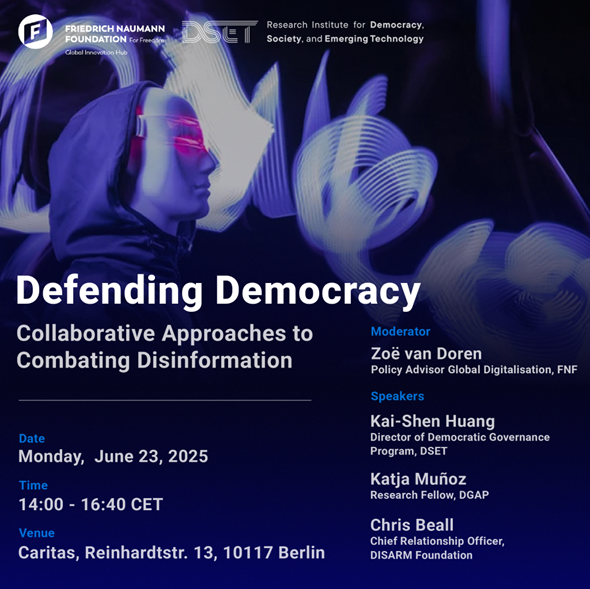
Defending Democracy: Collaborative Approaches to Counter Disinformation
© 2025 Friedrich Naumann Foundation for Freedom (FNF) Global Innovation HubOn June 23, the Friedrich Naumann Foundation for Freedom (FNF) and the Research Institute for Democracy, Society and Emerging Technology (DSET) co-hosted a closed-door round table titled "Defending Democracy: Collaborative Approaches to Counter Disinformation." Experts examined the DISARM Framework, the relationship between influence networks and online behavior, with a focus on the challenges faced by Taiwan and other democracies when countering digital manipulation.
Speakers included Dr. Kai-Shen Huang, Director of the Democratic Governance Program at DSET, Dr. Katja Muñoz, Research Fellow at German Council on Foreign Relations (DGAP), and Chris Beall, Chief Relationship Officer at the DISARM Foundation.
Resilience in Truth: Public-Private Collaboration in Taiwan’s Response to Disinformation
In the first session of the round table, Dr. Kai-Shen Huang gave a 30-minute presentation on DSET’s policy report titled ”Resilience in Truth: Public-Private Collaboration in Taiwan’s Response to Disinformation”, in which he applied the DISARM Blue Framework to analyse Taiwan’s defence against information manipulation. His research found that Taiwan’s defence against information manipulation is undermined by a series of challenges, including the lack of a regulatory framework, fragmented efforts across different ministries, and the lack of formal public-private collaboration. Dr. Huang also discussed the relationship between information manipulation and social media platforms. In the case of TikTok, it’s widely used by Taiwanese teenagers. Still, the platform has a variety of issues such as a lack of transparency in algorithm and content moderation practices, the deletion of sensitive topics surrounding Taiwan’s sovereignty, and so on.

Dr. Kai-Shen Huang, Zoë van Doren (Moderator), Dr. Katja Muñoz, and Dr. Chris Beall at the panel "Defending Democracy: Collaborative Approaches to Counter Disinformation."
© © 2025 Friedrich Naumann Foundation for Freedom (FNF) Global Innovation HubInsights from Outside Taiwan
The second session of the roundtable featured two 15-minute presentations by Dr. Katja Muñoz from DGAP and Dr. Chris Beall from the DISARM foundation. Dr. Katja presented her previous research on how influence networks are designed to manipulate online behaviour. Her recent publications offer critical insights into how insurgents use social media platforms as tools to spread narratives and manipulate their followers. Dr. Katja also stressed that it’s crucial to build resilient democratic discourse by identifying similar patterns of manipulation globally and examining the underlying manipulation mechanics. When common tactics across different countries, such as Taiwan and Germany, are identified, we can implement more robust countermeasures that can be applied globally.
Dr. Chris provided an overview of the DISARM framework, a standardised tool and model for identifying Foreign Information Manipulation Interference (FIMI). He pointed out that Taiwan’s defence against information operations demonstrated three characteristics: decentralisation, rapid response, and active inputs from citizens. He emphasised that the defence against information manipulation is not only the responsibility of governments. Instead, the whole society needs to participate in the information defence. Dr. Chris also introduced D-RAIL, DISARM Foundation’s latest tool, which breaks down information operations into different steps and increases attackers’ operational costs by implementing countermeasures at each stage of information operations. DISARM Foundation has already completed the first round of testing in Canada, and Dr. Chris expressed interest in future collaboration with Taiwan on related initiatives.
The Path Forward for Taiwan and Other Democracies
The event concluded with a consensus that defence against information manipulation is not only the government’s responsibility but also requires the collaboration between governments, citizens, and civil society groups. Taiwan’s response to information operations demonstrated a high level of innovation and flexibility. Taiwan’s experience not only benefits its society but also draws significant international attention. The speakers appreciated the active exchange of ideas during the round table, and they look forward to future collaboration on actions that help democracies strengthen democratic resilience.