Changing World Order
Death of the liberal?

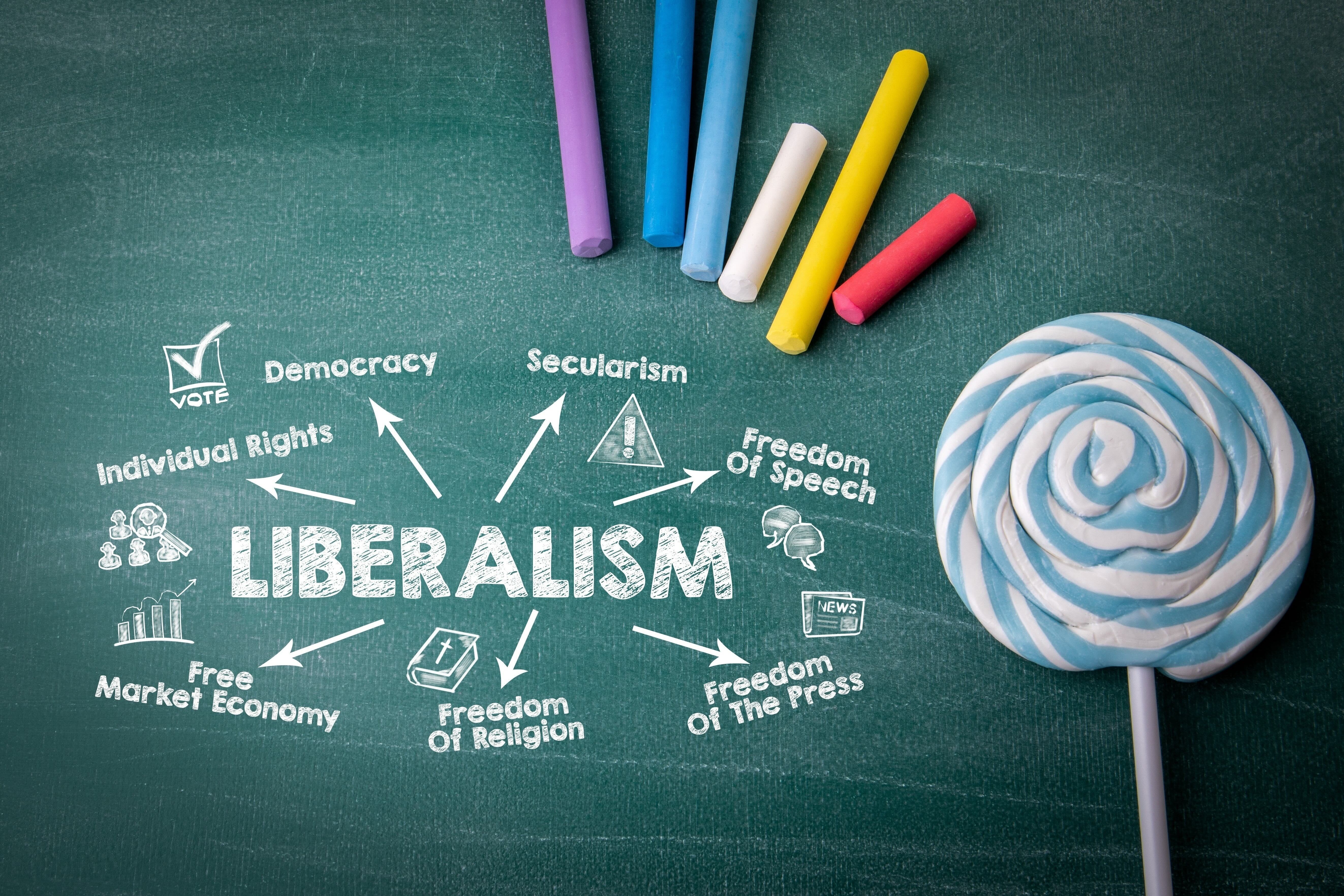
Liberalism. Illustrated chart with key words and icons on a green chalk background.
© Shutterstock
Situated atop a sloped hill surrounded by lush forest in the sleepy village of Gummersbach, Germany, lies the Theodor Heuss Academy, the home of the Friedrich Naumann Foundation’s International Academy for Leaders (IAF). For 30 years, this small institution has been a refuge for emerging leaders in liberal thought and practitioners from every corner of the world. Yet, from 7–14 September, a group of 26 individuals from Europe, Asia, and Africa assembled for the IAF’s final seminar. After three decades of shaping liberal discourse, the IAF convened its last gathering on the topic, “Liberalism & Geopolitics: How to Deal with a Changing World Order.”
On the one hand, we grappled with how liberal principles seem increasingly pitted against the dynamics of geopolitics. On the other, the closure of the IAF—a direct consequence of the electoral loss of Germany’s liberal party—points to the broader decline of liberalism in Western democracies.
How do we make sense of the closure of such a unique space in a world where liberal forces are in retreat? Is this the death of the liberal?
It wasn’t the death of a liberal, but the assassination of controversial conservative activist Charlie Kirk that sparked my musings. Far from being liberal, Kirk’s views often bordered on hate speech. Yet, he spent much of his life debating those on the opposite side. At the young age of 32, he was gunned down while addressing college students. Some on the right linked his assassination to radical elements on the left. Meanwhile, across the Atlantic, a march led by far-right activists in London drew over 100,000 people protesting against immigration and what they believe is the erosion of ‘British’ values, culture and identity.
Amid these tensions, several geopolitical incidents captured global attention. While we engaged in hypothetical simulations, Israel struck Qatar. As we debated how liberals should respond to these geopolitical shifts, Russian drones were shot down in Polish airspace. It seemed the world was screaming to us - liberal values have lost their relevance in these times.
In Germany, the decline of liberal support was underscored by the Free Democratic Party’s (FDP) electoral fall, which consequentially led to the closure of the IAF.
In many ways, the liberal is now in a kind of political ICU, suffocated by nationalist and populist sentiment.
The closure of the IAF underscored a sharp decline in liberalism’s influence. In Germany, the Free Democratic Party’s (FDP) electoral defeat was the final blow, signalling liberalism’s retreat into political ICU, suffocated by nationalism and populism.
As South Africans, we’ve witnessed our own populist wave and how political formations have launched an assault on our the principles of our constitutional democracy. However, it wasn’t liberal ideology that saved us—it was pragmatic compromise. The alliance between the DA and ANC, while politically uncomfortable, was based not on mutual love but on a shared commitment to the constitution. In a toxic political climate, this marriage of convenience has shielded South Africa’s democratic and economic pillars. But the job is far from finished.
Our experience offers a crucial lesson to the global liberal movement: adapt or die.
Liberalism in South Africa has survived because it has learned to evolve in a hostile environment. It’s not that liberals are without fault, but their flexibility has kept the flame of liberalism burning. This adaptability is key to survival in a world where the political landscape is rapidly shifting.
Globally, liberals must find ways to form cross-border alliances and share ideas. This is critical to preserving the liberal tradition. The IAF served as one such space, offering connections, training, and collaboration. Its closure leaves a void, a gap in the liberal network that the world desperately needs.
The forces of nationalism and authoritarianism are eroding democracy, individual rights, and free markets. But as we’ve learned in South Africa, the key to survival lies in pragmatism. Rigid adherence to abstract ideologies risks alienating those whose lived experiences don’t align with existing systems. The liberal cause must simplify its message to resonate with everyday people, those who care more about securing a decent life for their families than about ideological purity.
This is not the end of liberalism. It’s a moment of transformation. Whether liberalism survives depends on our ability to adapt, innovate, and collaborate. New spaces and networks must emerge, grounded in local communities but with a global vision.
The closure of the IAF is a painful reminder that nothing lasts forever. But it’s also an opportunity to rethink how liberalism can thrive in a fragmented world. This is a call for liberals everywhere to revitalise their ideas, forge new alliances, and ensure the flame doesn’t flicker out.
Liberalism may be in retreat, but it is far from dead.