Myanmar
“These elections will not be free and fair”
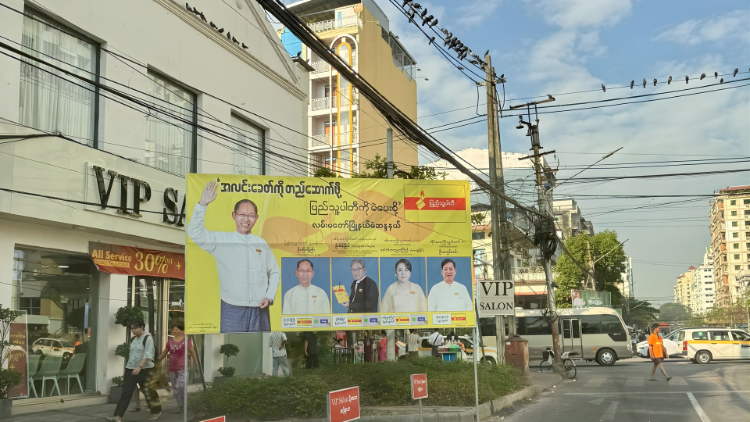
People's Party's Electoral Campaign Billboard in Myanmar 2025
© Friedrich Naumann Foundation for FreedomMyanmar has been under military rule since February 2021. Now the junta is organizing elections, which are widely criticized by international observers. A couple of weeks before the elections, the Friedrich Naumann Foundation for Freedom interviewed two politicians in Yangon/ Myanmar. Both cherish democracy. One will stand as a candidate in the upcoming elections. They will bring a minimal platform for civilian politics, he believes. The other politician ran in past elections, but will not be a candidate this time. He has no trust in the process. Both remain anonymous, we call them NP and P. Why have they chosen starkly different paths?
NP, why are you not participating in this year’s election?
NP: I have participated in two elections since 2015. This year I am not running for office for three reasons. First, I do not trust the Election Commission, particularly at the constituency level. Many key procedures depend on individual officials, and based on my own experience, I do not believe the vote count would accurately reflect the ballots cast. Without a trustworthy township-level commission, a credible election is impossible. Second, I do not trust the current leadership overseeing the process. Compared with the 2010 election under Than Shwe, I find today’s leadership far more unpredictable. That unpredictability raises serious concerns about personal safety. Third, I am thinking about my long-term political credibility. I have built my reputation as an ethical and educated politician. Participating in an election that many of my supporters view as illegitimate could damage my standing. This is not the end of my political career; it is just a pause.
P, why are you participating in the election?
P: I want to expand the shrinking political space in Myanmar. To do that, we need politicians inside parliament. I am aware that this election will not bring complete change, but it can preserve a minimal platform for civilian politics. When I travel to villages, I see many ward and village leaders who are closely aligned with the military. Corruption and intimidation are widespread, and since 2021, I have not seen anyone standing up for ordinary people. These communities have no one to rely on. Witnessing this reality has strengthened my determination to represent these people and work on their behalf. I believe genuine representation must begin at the local level, which is why I decided to participate in the election.
Do you think your rejection of the election represents a broader mood in the country?
NP: My stance is mainly shared by urban, educated, and professional communities, particularly in cities like Yangon and Mandalay. In most remote areas, my choice does not reflect the general mood. People’s attitudes there largely depend on local leadership or ruling authorities. In many parts of Myanmar, especially rural areas, people tend to follow the guidance or pressure of those in power or leadership. This differs greatly from urban populations, who are generally more individualistic and make decisions based on personal perspectives rather than collective pressure.
Given the severity of conflict in villages, how do people there view the election?
P: Some villages will have polling stations, while others will not hold elections at all. Many villagers do not believe in the election or think that genuine representation can emerge from it. In reality, many people in conflict-affected areas do not even have the time to consider whether elections are beneficial. Their daily survival challenges overshadow political considerations. They often lack trust in candidates and see no future impact from the election because current leadership has not improved their lives.
What are the main challenges for candidates and voters?
P: There is no rule of law. Running is dangerous. In some areas, candidates have been arrested by armed groups; in others, election educators have been detained.
NP: Even where elections are technically held, many communities cannot participate. The military does not fully control large parts of the country and cannot safely establish polling stations. For instance, in the case of Monywa, the town itself and the surrounding villages face very different security situations. While elections may be held in Monywa town, residents of nearby villages cannot travel there to vote because they have been warned that they would be shot if they attempt to do so.
Moreover, in villages affected by ongoing conflict, there is insufficient information to assess whether residents are interested in the elections or what their views are on the electoral process and outcomes. Many people do not know who the candidates are, where polling stations are located, or when voting will take place.
Did you face any pressure to participate in the election?
P: No. In fact, there was pressure not to participate. Our party was abolished by the authorities because they saw it as a threat to their winning chance. Despite this, I decided to run as an independent candidate to show that they cannot erase us politically. For years, political discussion has been confined to tea shops, which benefits no one. If we can be in parliament and debate politics legally, the impact would be far greater. Through parliamentary politics, we can expand political space, represent people genuinely, mobilize citizens toward solutions, and help younger generations understand democratic procedures. This is especially important now, as young people need to see how the military has manipulated democratic transitions and learn how to reclaim them in the future. Sometimes, political engagement requires operating alongside one’s adversaries.
Will the elections be free and fair?
NP: No.
P: No.
NP: There is a deep lack of trust in those managing the election results. Additionally, campaigning is severely restricted. These factors make the election neither free nor fair. The outcome will depend on who votes. If only military supporters vote, the military party will win.
P: We are participating within a controlled status quo. The military will shape outcomes according to its vision and put in place numerous barriers for candidates. Party registration rules are complex, unclear, and selectively enforced. Even winning a seat does not guarantee victory, as regulations can later invalidate results. Campaigning is indeed heavily restricted. We cannot speak freely in public. We are confined to designated areas, such as football fields, where few people attend. Advance voting procedures are questionable, voter education is lacking, and election officials are poorly trained. Different townships enforce different rules, often disadvantaging candidates the authorities do not favour. Overall, the system is designed to control the outcome.
Many international observers and exile groups have called the election a sham. How do you view such statements?
P: It is difficult to say. International and exile groups have their own standards for evaluating elections. The process does not meet their norms. That is likely why they reject it. However, domestically, we have no alternative path. If we did, we would take it. Politics does not offer uniform solutions. While international actors hold perspectives from outside, they cannot protect us politically or militarily, nor can they deliver change. Local politics must play a role in creating new platforms for change. Given our limited options, participating in the election is a way to shrink military space and expand political space. This could be a step toward broader transformation.
NP: I agree that Myanmar has very few options. A sustained, complete military takeover would be disastrous. Current negotiations lack political will. The election may disrupt this stagnation — for better or worse — but change itself should not be feared. Although I am not participating, I still see elections as a better option than continued military conflict. Their impact depends on who participates and how the process unfolds.
You’ve experienced political shifts before. How does this election compare to prior events?
P: The situations in the election years 2010, 2015 and 2025 are very different. Before, there were fewer conflicts and no large-scale armed resistance like today. Now, armed conflicts are widespread, and post-election leadership will face enormous challenges. If the new leadership cannot manage power-sharing or cannot stabilize the country somehow, another coup is possible. Meaningful parliamentary engagement is essential for any positive change.
NP: After the election, the new government will need to govern more effectively, even if public acceptance is limited. In 2010, economic improvements came first, followed by political reforms. In 2025, fragmentation and armed conflict make progress much harder. However, a new government might pursue power-sharing if there is political will. Parliament could become a platform for discussing federalism and for negotiating with armed groups. Ultimately, it depends on new government´s willingness.
Which path offers the best chance to reduce violence and achieve a political solution?
P: Negotiation is the only viable path. All stakeholders must prioritize the interests of the people over political dominance. This would be the solution for Myanmar.
NP: I agree. Negotiation requires one side to initiate dialogue. Military force is only a tool, not a solution. True negotiation involves compromise. Hopefully, an elected government and parliament can bring all stakeholders to the table.