North Korea and Russia
North Korea and Russia expand their cooperation

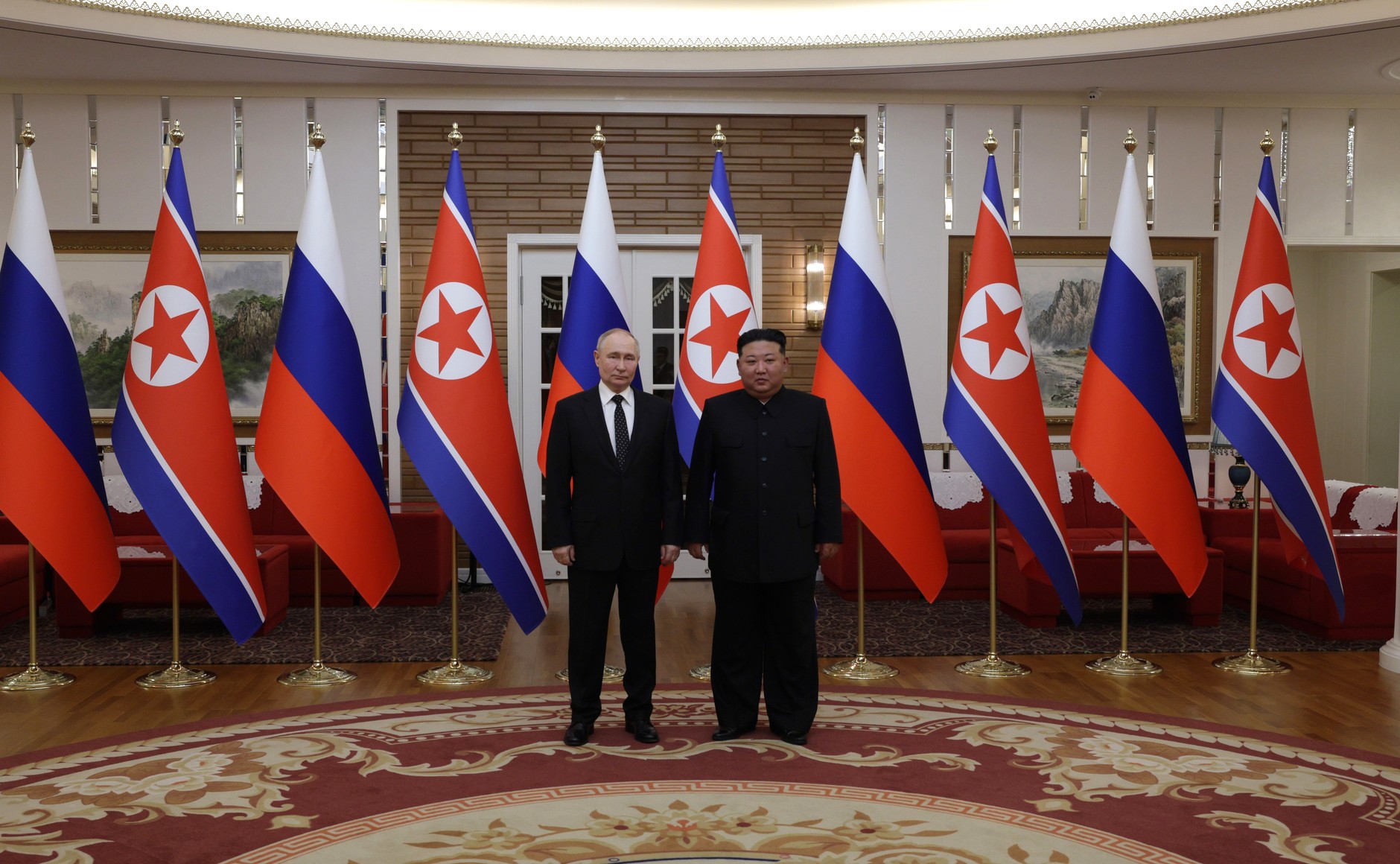
The Russian President Vladimir Putin (l.) and North Korean leader Kim Jong Un in Pyongyang.
© Credit: Kremlin.ru, CC BY 4.0, Link.Russian-North Korean relations are making “considerable progress,” as North Korea’s Foreign Minister Choe Son Hui stated during her state visit to Russia.
There are several indications that this is not just political rhetoric: Numerous high-level meetings between representatives of the two countries over the past four weeks, a new report by South Korean intelligence on an expansion of North Korean support for Russia's war of aggression, and an agreement on propaganda cooperation between the two states. The clearest sign is probably the construction progress on the 1.3-kilometer bridge over the Tuman-Gang border river between Russia and North Korea.
Road bridge over the Tuman River
An analysis of satellite images by the US think tank Center for Strategic & International Studies (CSIS) shows significant progress in the construction of the road bridge. The neighboring railway bridge—the only land connection to date—has been heavily used since 2022. This indicates a high level of trade between the two countries. Regardless of whether the bridge is purely a propaganda project or whether the expansion of the infrastructure was necessary due to the capacity utilisation of the railway bridge, the rapid progress of the construction project is a symbol of the rapidly growing bilateral relations and the fact that these are considered to be long-term.
Delegation visits
In addition to the North Korean foreign minister's state visit to Moscow, a Russian delegation traveled to Pyongyang on the occasion of the 80th anniversary of the founding of the North Korean Workers' Party, led by former Russian President and current Deputy Chairman of the Security Council Dmitry Medvedev. Representatives from the ministries of defense, foreign affairs, and natural resources and the environment were also present. This covered the areas in which the two countries have recently been cooperating more intensively.
Following this delegation, Foreign Minister Choe Son Hui traveled to Moscow. There she met with her Russian counterpart Sergey Lavrov and praised the “considerable progress” in bilateral relations between the two countries. A day later, she held talks with Russian President Vladimir Putin.
Nine days later, Moscow sent a high-ranking military delegation to Pyongyang. According to North Korean state media, the two sides discussed cooperation and exchange between their military-political organizations. The delegation was led by Deputy Defense Minister Viktor Goremykin, who also heads the Main Directorate for Military Policy, and his North Korean counterpart Pak Yong-il.
State media reported only briefly on the visits, and no concrete measures were announced. However, this is not unusual.
Intelligence briefing
In early November, South Korean intelligence reported that North Korea was recruiting and training additional soldiers for deployment in Russia's war of aggression. However, no details were disclosed. In addition, South Korean intelligence has a theoretical incentive to exaggerate North Korea's involvement and Russia's compensating measures in order to heighten the threat scenario domestically and in relation to the US. However, South Korean agents have been quite reliable in their assessment of Russian-North Korean cooperation so far. The report is therefore a serious indicator of the developing relations between the two countries.
Propaganda cooperation
North Korea's ambassador to Moscow, Sin Hong-chol, and Bella Cherkesova from the Russian Ministry of Digital Development, Communications, and Mass Media signed a media agreement. The North Korean news agency KCNA and the Russian state media group Rossiya Segodnya also agreed to intensify their cooperation. In the agreements, both parties commit to sharing publications and image material and to better coordinating their reporting. The agreements demonstrate efforts to coordinate propaganda and improve the perception of the other side in domestic politics.
The enemy of my enemy is my friend
The joint infrastructure project is certainly the clearest symbol of the deepening bilateral relations between the Russian Federation and the Democratic People's Republic of Korea. As long as both states are united by their common interest in disrupting the existing liberal international order and fighting “the West,” intergovernmental relations will continue to progress. True to the old motto, “the enemy of my enemy is my friend.”
Tim Neubauer is currently completing an internship in the FNF office in Seoul. He specializes in foreign and security policy, covering and analyzing relevant global developments for Germany, the European Union, and NATO in the North Atlantic and Indo-Pacific regions. His work experience includes stations in Berlin, Brussels, Washington, D.C., and Seoul. Tim has two master's degrees, one in political science and one in history, both from the University of Mannheim.