Myanmar
Myanmar’s Forgotten Democratic Revolution
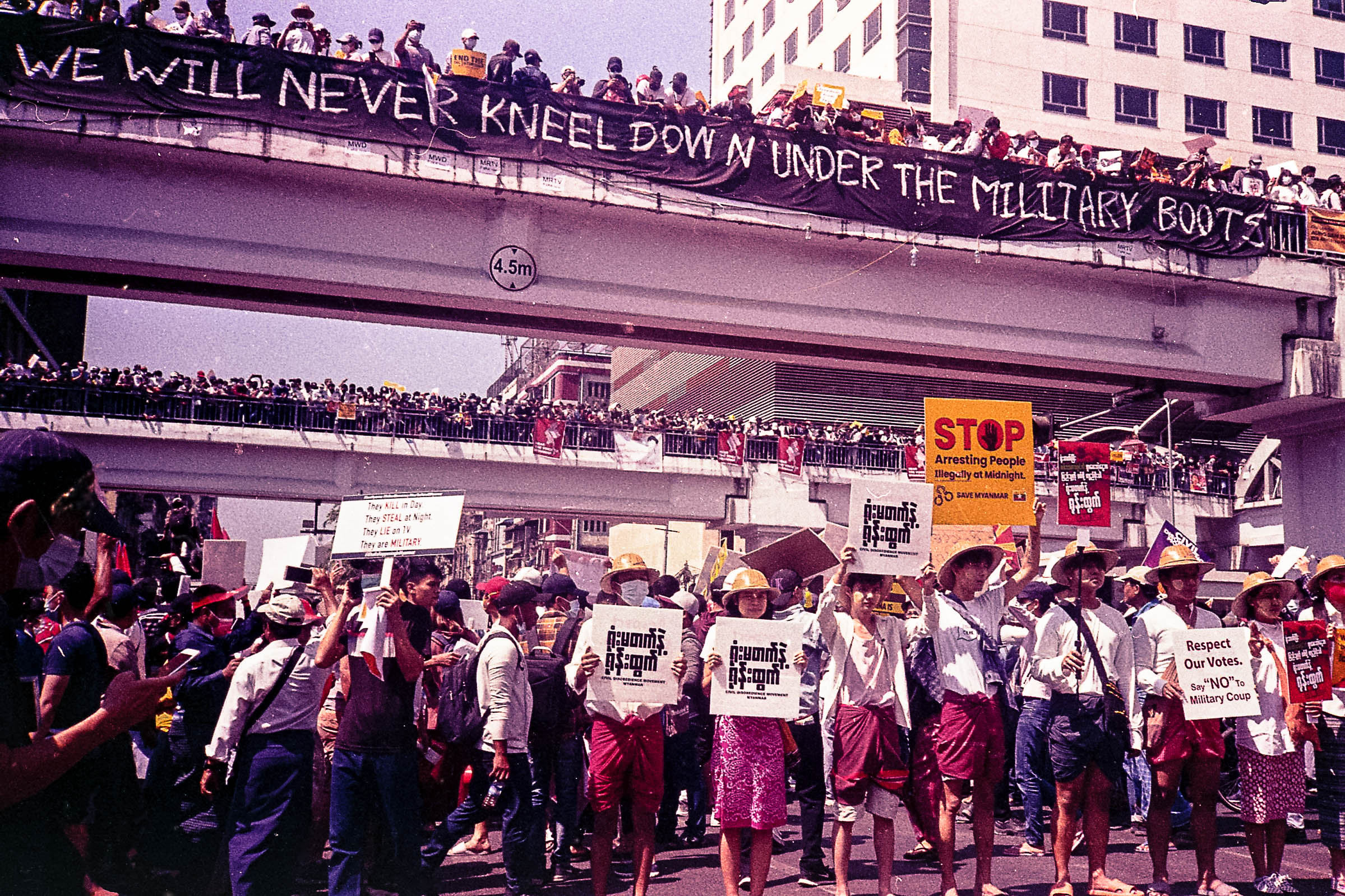
A mass anti-coup protest in downtown Yangon taken on 17th February 2021
© LilyFive years after Myanmar’s military seized power in a coup on Feb. 1, 2021, the country remains trapped in violence and political paralysis. What was once framed as a historic democratic uprising has largely faded from global attention, replaced by a quieter but more durable reality: the consolidation of a modern authoritarian state, sustained by authoritarian alliance, mostly by China, and western democracies’ indifference.
In January 2026, Myanmar’s generals finalized the results of a month-long national election, a process widely dismissed by Western governments and international observers as a façade designed to legitimize continued military rule. Inside the country, the vote inspired little confidence. But armed resistance has weakened, opposition forces are fragmented, and the junta appears emboldened by economic, diplomatic and military backing from authoritarian allies, most notably from China.
Myanmar’s present crisis did not begin with the coup. It was embedded in a political transition that was never designed to produce full democracy. Since formally handing power to a quasi-civilian government in 2010, the military has sought not to withdraw from politics but to entrench its dominance under new institutional forms. The result, now fully visible, is a state that combines electoral rituals, legal mechanisms and coercive power, hallmarks of modern authoritarianism.
Before the Coup: Democracy Constrained
When Aung San Suu Kyi’s National League for Democracy took office in 2015, Myanmar was already a divided and warring state. The 2008 Constitution, drafted by the armed forces, guaranteed the military control over key ministries, a quarter of parliamentary seats and a veto over constitutional change.
This arrangement produced two parallel centers of power: an elected civilian leadership with popular legitimacy and a military establishment with coercive authority. While Suu Kyi remained enormously popular at home, constitutional provisions barred her from the presidency, forcing her to assume the newly created role of state counselor, an advisory position enabled by a legal loophole and sustained by her party’s landslide victory.
Her government struggled to influence the military, including on peace negotiations with ethnic armed groups. Internationally, her reputation suffered irreparable damage when she defended the military against genocide allegations at the International Court of Justice (ICJ), denying responsibility for atrocities against Rohingya Muslims in Rakhine State even as her government lacked real control over the soldiers on the ground.
Despite these contradictions, the NLD’s landslide victory in the November 2020 election reaffirmed popular rejection of military rule. For the generals, the result was intolerable to continue their path democracy. On Feb. 1, 2021, they detained civilian leaders, annulled the election and declared a state of emergency, not as a temporary intervention, but as a reset of the political order.
After the Coup: From Protest to Prolonged War
The initial public response was swift and unprecedented. Millions of people, led largely by a younger generation raised during a decade of relative openness, poured into the streets demanding the restoration of democracy and the release of detained leaders. The military at first hesitated, allowing demonstrations to gain momentum. Then came the crackdown. Security forces fired live ammunition into crowds, killing hundreds within weeks. Arbitrary arrests became routine. Videos and images of killings, torture and raids circulated widely on social media, fueling public outrage and hardening divisions across the country.
Myanmar fractured into two irreconcilable camps: those aligned with the military and those determined to remove it from politics altogether. Hatred toward the military deepened to a point where neither domestic mediation nor international diplomacy could restrain the population’s growing militancy. The military responded with escalating brutality.
Resistance also took many forms. Civil servants, teachers and doctors joined a nationwide civil disobedience movement. Urban supporters financed resistance groups. Thousands of young people fled to border regions, where ethnic armed organizations trained them.
For years, the junta struggled to reassert control. According to a BBC analysis based on local data, the military today controls roughly 21 percent of central Myanmar; resistance forces and ethnic militias hold about 42 percent in peripheral regions, with the remainder contested. Coordination among armed groups improved, culminating in Operation 1027 in October 2023, when the Three Brotherhood Alliance inflicted significant losses on the military in northern Shan State. In December 2024, the Arakan Army captured Maungdaw in Rakhine State, further weakening the junta’s position.
Yet battlefield success did not translate into strategic victory.

USDP Campaign Poster in Yangon before the election
Recalibration of Power through China and Authoritarian Alliance
Momentum stalled when China intervened decisively. Alarmed by instability along its border and disruptions to trade and infrastructure projects, Beijing pressured ethnic armed groups in northern Shan State to halt their offensive and relinquish territory under agreements it brokered and monitored. Dependent on Chinese arms, trade access and political space, the groups complied.
The fighting in Rakhine State continued, but the easing of hostilities in northern Shan gave the military breathing room. Since then, the junta has intensified airstrikes and deepened reliance on foreign partners. Reuters and Amnesty International reported that Iran supplied jet fuel to Myanmar’s military between 2024 and 2025. Conscription laws were activated, forcing thousands of young men into service. Contrary to early expectations, mass defections did not materialize. Extended training programs, reportedly developed with Russian advisers, have helped the military adapt, including in drone and air operations.
Myanmar’s ties with Russia have expanded beyond arms purchases to include naval cooperation, air defense and discussions of nuclear collaboration. China, meanwhile, has continued to advance its strategic interests: securing access from Yunnan Province to the Indian Ocean through Kyaukphyu, expanding investments in gas, rare earths and copper, and supporting Myanmar’s e-governance and electoral systems. Chinese influence now extends beyond the junta to political parties, business and bureaucratic elites through training programs and study visits to Beijing.
Elections as Authorization, Not Choice
The military-led election reflected this recalibration. Despite international condemnation and boycott calls from the shadow National Unity Government (NUG), turnout reportedly exceeded 50 percent, driven in part by fear of repercussions for nonparticipation.
Inside Myanmar, some political elites framed participation as a pragmatic attempt to reclaim limited political space. Others pointed to restrictive rules, party disbandments and opaque electoral procedures that systematically undermined genuine opposition. The military’s use of “rule by law”, deploying legal mechanisms to neutralize challengers, was unmistakable.
International recognition appears secondary to the junta’s strategy. It has prioritized engagement with authoritarian partners, signing new trade and cooperation agreements with Belarus, Russia and China. Cambodia, Vietnam and Laos sent election observers, while Thailand characterized the vote as a step toward border stability.
A Modern Authoritarian State Takes Shape
Myanmar today exhibits the core features of modern authoritarianism: rule by law, electoral form without political competition, and authoritarian capitalism supported by external partners. In the absence of sustained Western engagement and amid global crises elsewhere, the junta is betting that gradual economic stabilization and regional backing will secure long-term legitimacy.
Meanwhile, Myanmar’s democratic movement has receded from international view. Aid cuts, immigration uncertainty and the erosion of global attention have weakened exile communities rather than empowering them. Beyond targeted sanctions on senior generals, Western democracies have shown limited willingness to pursue a coordinated strategy to resolve Myanmar’s conflict. The United Nations’ special rapporteur has openly criticized the international community for failing the country amid deepening crises. ASEAN, despite nonrecognition by some members, remains divided, with mainland Southeast Asian states continuing pragmatic engagement with the military.
Inside the country, years of violence and isolation have exacted a profound human cost and left many people exhausted. Increasingly, citizens seek a semblance of normalcy. The military has sought to capitalize on this fatigue by hosting public festivals, entertainment events and national celebrations both to project an image of restored order and to signal control to allies and foreign observers. Even segments of the business community now hope for greater economic openness in the post-election period.
Myanmar’s revolution has not ended. But it has been contained not only by repression, but by geopolitics. In a world increasingly shaped by authoritarian cooperation, Myanmar offers a cautionary lesson: democracy can be undone not just by coups, but by neglect.