Bulgarian Elections 2026
Bulgaria’s Election: Results Clear, Conclusions Pending

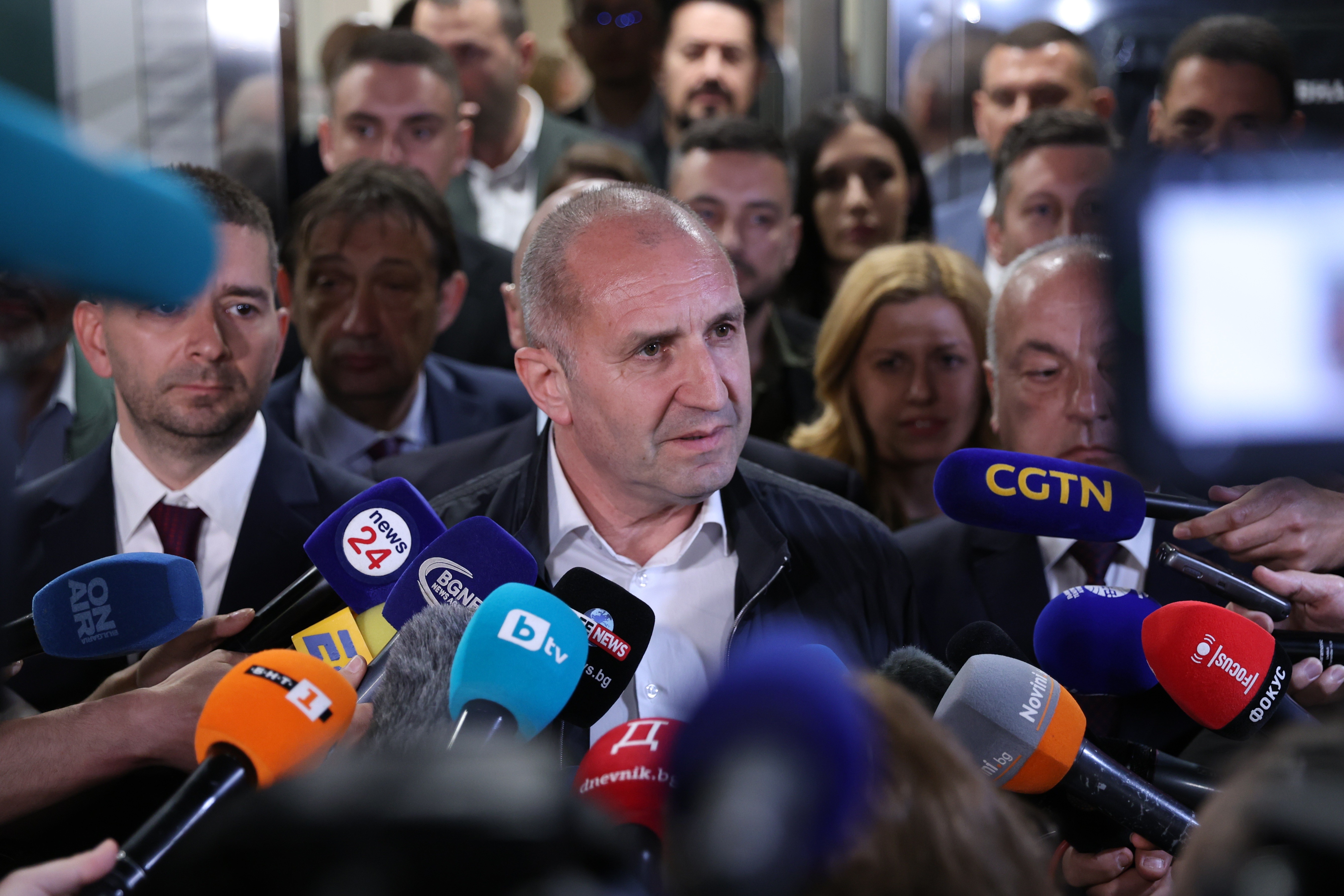
Rumen Radev, Leader of "Progressive Bulgaria" Party addresses the press on election night.
Sofia (April 19, 2026)
© Blagoy Kirilov/BTA (PB)After five years, eight elections, and what at times began to resemble a national routine of voting without governing, Bulgaria has finally produced a result that is difficult to misinterpret.
Progressive Bulgaria, led by Rumen Radev, secured 44.6% of the vote (131 seats, a parliamentary majority), leaving the conservative Citizens for European Development of Bulgaria-Union of Democratic Forces (GERB-SDS) to narrowly secure second place (13.4%, 39 seats) ahead of We Continue The Change-Democratic Bulgaria (PP-DB) who scored 12.6% and 37 seats. The Bulgarian Socialist Party, a constant of Bulgarian politics since 1989, will not enter parliament at all - a development that, until recently, would have seemed improbable, if not slightly impolite to suggest.
This is not simply a victory for Progressive Bulgaria. It reflects a significant shift in voter behaviour. After several years of fragmented parliaments and short-lived governments, the electorate appears to have prioritised political clarity and the prospect of more stable governance - or, at minimum, governance that lasts long enough to be recognised as such.
At the same time, the outcome raises a new set of questions. As is often the case in Bulgarian politics, greater clarity at the ballot box does not automatically translate into predictability in practice, and recent experience suggests that clarity can sometimes be the beginning of a more complicated conversation rather than the end of one.
Who is Radev? Why Now?
Part of what makes this result so significant is the figure at its centre. Rumen Radev, a former air force commander and one of the highest-rated political figures in recent Bulgarian politics, entered the race not as a traditional party leader, but as a sitting president nearing the end of his second term. His decision to resign and move directly into party politics positioned him as both an insider and an outsider, a combination Bulgarian voters have historically found compelling, and politicians have historically found difficult to compete with.
His appeal appears to draw from several directions at once. A portion of the electorate is clearly fatigued by parties that have cycled through power without delivering stable governance, a cycle that has by now become rather well documented. At the same time, Radev has attracted more conservative and state-oriented voters, alongside segments of protest voters and parts of the nationalist electorate traditionally aligned with Vazrazhdane (Revival), which saw its support decline almost fatally.
In that sense, Radev did not simply win votes. He assembled a coalition of dissatisfaction, expectation, and, to some extent, projection. His campaign offered relatively few concrete policy commitments, which likely made it easier for different groups to see their own priorities reflected, a flexibility that is politically useful, yet not indefinitely sustainable.
Stability, but at What Price?
The paradox of this election is that Bulgaria may achieve greater governability, but through a political force whose geopolitical positioning is less clearly aligned with the Euro-Atlantic mainstream than that of the reformist camp. Radev has consistently been associated with more Russia-accommodating positions, including scepticism towards military support for Ukraine and calls for renewed dialogue with Moscow, positions that have drawn criticism from pro-European actors both domestically and abroad.
The End of the Old System (and Some Familiar Faces Looking Uncomfortable)
If Progressive Bulgaria is the story of the election, the collapse of the old parties is the sub-plot that explains it.
GERB-SDS’s result is not just a loss. It is a structural shock. Built around Boyko Borissov’s dominance, GERB now faces a political landscape in which it is no longer the gravitational centre around which everything else has to reluctantly orbit. For a party that has spent more than a decade defining the system, this is less a difficult election and more an identity crisis. While GERB does not disappear overnight, it risks becoming something it has not been for years - one political actor among several, rather than the system’s default setting. Bulgarian politics has seen such transitions before, although usually with a little more warning.
Meanwhile, Movement for Rights and Freedoms (DPS), now led by Delyan Peevski, has also seen its position weaken - 7.12%, 21 seats. Peevski remains a controversial figure at best, having been sanctioned by both the United States under the Magnitsky Act and the United Kingdom over corruption-related concerns, which is not typically the kind of international recognition parties seek to highlight. The party, traditionally resilient thanks to its disciplined and tightly organised electorate, appears to have been particularly affected by the unusually high turnout. When more voters participate, the relative weight of highly mobilised core electorates tends to diminish.
For many reform-oriented observers, that is a modest, if understated, silver lining - the combined influence of GERB and DPS, long associated with entrenched governance practices, is now significantly reduced.
And then there is the Bulgarian Socialist Party. Or rather, there is not. Its absence from parliament is less an electoral footnote and more a historical marker. A party that once embodied continuity has, at least for now, been written out of the current political chapter, which, for Bulgarian politics, is no small editorial decision.
The Question of Direction
From a European perspective, the result appears somewhat ambiguous. Bulgaria remains deeply integrated into the European Union, both economically and institutionally, and its overall strategic orientation is unlikely to shift in any fundamental way. This does not suggest a reorientation away from the EU or NATO, but rather continuity in slightly more complicated packaging.
What the outcome does introduce, however, is a degree of uncertainty about how this positioning will translate into policy. Given the relatively limited programmatic clarity during the campaign, expectations are high, but the direction remains less clearly defined. In practice, this may result in a more cautious and at times more selective alignment with common EU positions, particularly where these intersect with sensitivities around Russia, energy, and security - areas where agreement in Europe is rarely effortless to begin with.
At the same time, the election reflects a degree of voter preference for a more nationally framed approach to policy within that European framework, suggesting a government that may place greater emphasis on how common decisions are interpreted, and occasionally renegotiated, at the national level.
Berlin, in particular, will continue to serve as a key reference point. Economically, politically, and institutionally, Germany remains one of Bulgaria’s most important partners, and this structural relationship is not dependent on electoral outcomes. Trade, investment, and policy coordination tend to prove more stable than political cycles, even when those cycles begin to resemble a recurring calendar event.
And What About the Liberals?
For Bulgarian liberals, this is not the outcome they wanted. But it is also not the end of the story. Beyond party structures, there remains a visible and politically engaged segment of society, particularly in urban centres and among younger voters, that continues to prioritise rule of law, European integration, and institutional accountability. That constituency has not disappeared; it has simply had better electoral evenings.
PP-DB (PP being FNF’s partner party) remains firmly in parliament, scoring slightly higher than in the previous elections, and continues to represent a coherent anti-corruption, pro-European, rule-of-law-oriented electorate. The problem is not relevance. It is reach. The liberal agenda remains clear and consistent, even if it occasionally struggles to compete with simpler promises delivered with greater confidence.
The election makes one thing clear - when voters were asked to choose between principled reform and decisive power, many chose the latter. Radev did not win by offering a detailed policy platform. His campaign was, at times, notably economical with specifics. He won by appearing more capable of ending the cycle of instability.
For liberal-minded citizens, this creates a more complex political environment. On the one hand, there is likely to be increased concern around institutional balance and foreign policy orientation. On the other, the clearer political landscape may allow for more focused civic engagement, whether through electoral participation, public debate, or the quiet but persistent habit of asking inconvenient questions.
At the same time, this creates an opening. If Progressive Bulgaria governs effectively, it may consolidate a new political centre. If it does not, or if uncertainties translate into friction or unmet expectations, PP-DB is well positioned to act as the structured pro-European counterweight.
So Now What?
For now, Bulgarian voters have signalled a preference for clearer responsibility and more predictable decision-making, after several years in which both were in short supply. Early signals suggest that this may already be having institutional effects.
Borislav Sarafov, a controversial Chief Prosecutor, has submitted his resignation following an ultimatum from a senior figure within Progressive Bulgaria, after a long time of resisting calls to step down, despite both the Supreme Court of Cassation and the Constitutional Court having determined the illegality of his position. The timing is unlikely to be coincidental.
If nothing else, the expectation now appears to be that this parliament might spend more time governing than preparing for the next election, which, by recent standards, would already qualify as a notable development.