Innovation for Democracy
AI for Democracy, More Digital Participation Best Practices from across the World, and More in the New Digital Participation Guide!

Since 2023, we have partnered with People Powered, a global hub for digital and participatory democracy, to develop a series of online resources on digital participation. This year, as AI technology has evolved rapidly and people have become eager to learn how AI can help democracy, People Powered and we have developed a new chapter on this topic in the Digital Participation Guide. People Powered also offers a preliminary review of 17 existing AI deliberation tools, as well as a comprehensive guide and strategy for citizens hoping to adopt AI in their participatory programmes.
Additionally, to help citizens from different regions relate to this guide, People Powered added six more case studies of best practice in digital participation from Thailand, Taiwan, Uganda, Ireland, Colombia, and Germany.
Let’s discover what’s new in the guide together!
How Can AI Contribute to Democracy?
In their Digital Participation Tool Ratings 2025 and Digital Participation Guide, People Powered answer this question by introducing AI tools for democracy and offering a step-by-step guide with examples on how to use AI responsibly, inclusively and efficiently in participatory processes.
-
What AI Tools Are Available for Participation and Deliberation?
In its Digital Participation Tool Ratings 2025, People Powered selected and reviewed around 17 digital deliberation platforms leveraging AI from the many such tools available worldwide. These include Talk to the City, which was developed by the AI Objective Institute, a partner of FNF; and the Stanford Online Deliberation Forum, which was explored by FNF at its 2023 Hacking Democracy Conference.
Although People Powered haven’t rated them, they have created an index as below to help readers quickly familiarise themselves with these tools. This index provides an overview of the tools' features, including whether they are open source or proprietary, the languages these platforms support, the countries and regions they originate from, and how to access them.

-
What Is the Roadmap for Formulating an AI for Democracy Deployment Strategy?
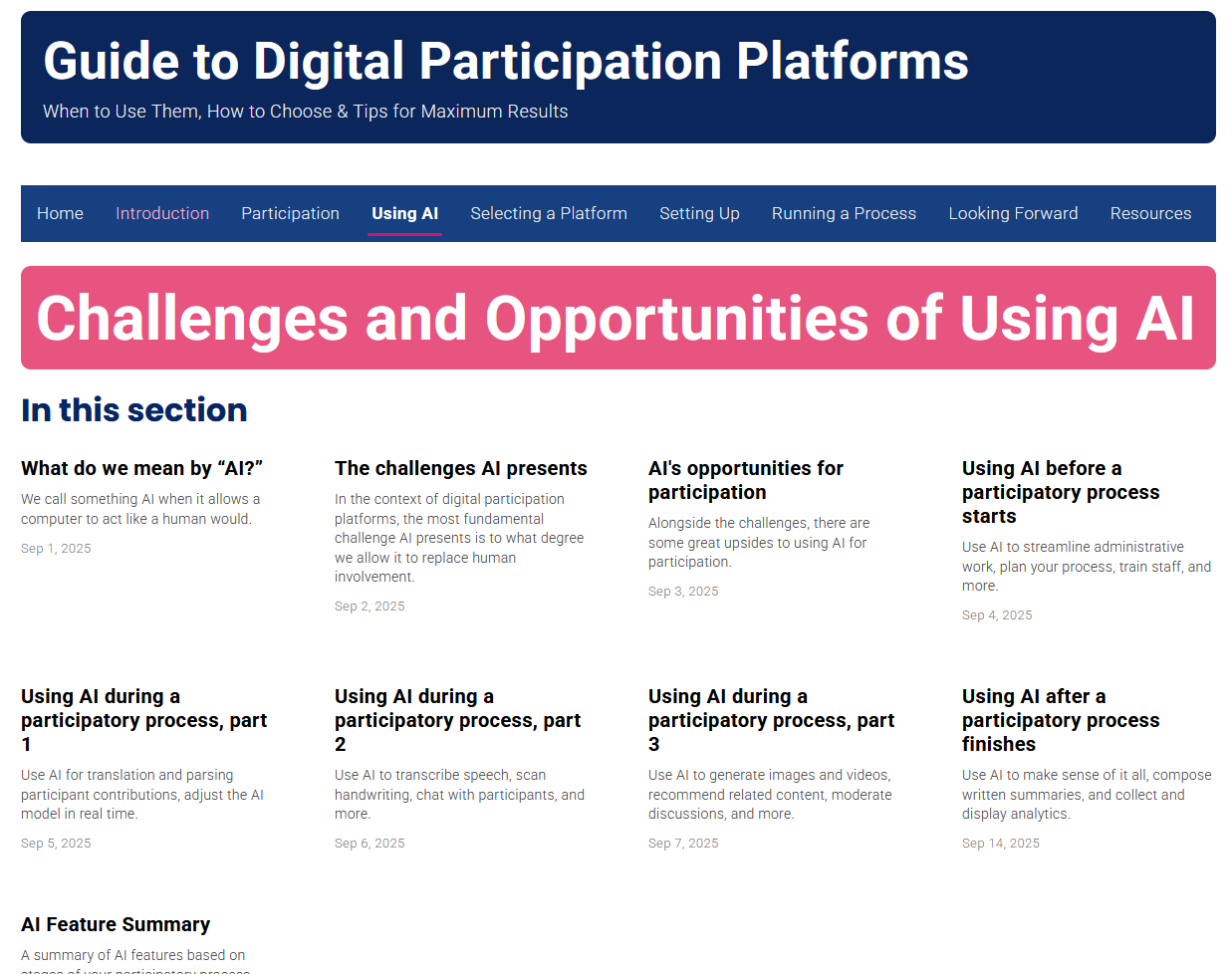
People Powered didn’t just select tools; they provided citizens with systematic and holistic knowledge on how to use AI in their participation programme by adding the 'Using AI — Challenges and Opportunities of Using AI' chapter to their Guide to Digital Participation Platforms.
This chapter introduces readers to the key considerations for deploying AI in participatory programmes and provide them with a step-by-step guide. It begins by helping readers to understand what AI really means, and informs them of the challenges and opportunities of using AI. The chapter then explains how AI can be applied to each stage of participation programme: before, during and after a participatory process, and it also summarised in a chart in the 'AI Feature Summary' section.

-
Before Using AI
The first step, as suggested in the 'What do we mean by AI?' section of the chapter, is for people to develop an AI policy consisting of core, irreplaceable principles before deploying AI. This will ensure that AI is held accountable before any damage is caused, and that using AI doesn't defeat the participatory programs’ purpose— we should use AI to enhance people's participation, rather than just using it for its own sake. The guide offers People Powered's AI policy as an example. Their AI policy is based on the following principles: mission alignment, human-centredness, transparency, accountability, sustainability, equity and inclusion, continuous learning, privacy and security.
Such a policy can also provide a framework for guiding citizens to consider all the challenges involved in using AI for participation. For example, in the next section, 'The challenges AI presents,' People Powered's AI policy was adopted to list possible challenges. Furthermore, the section informs readers of existing approaches to mitigating these challenges. However, it also reminds readers that this does not mean that all the challenges can be solved and that citizens must always be aware that the top priority is to ensure an inclusive, transparent and human-centred participatory process.
-
What Can AI Do for Participation?
Although there are many challenges, if used correctly, AI can enable more inclusive, transparent and efficient participatory processes. The ‘AI's opportunities for participation’ section lists what purposes AI is currently used for participation as below:
- Translation
- Sentiment analysis
- Topic clustering
- AI discussion moderation
- Parsing and summarizing large amounts of text
- Chatbots
- Generating images
This helps us to envision how we can use AI in our participatory processes. However, as the section reminded us, users still need to consider the purpose and process of their participatory programmes, rather than assuming that any AI tool can do everything.
-
How can AI help at each stage of participation?
Designed for citizens or practitioners implementing a participatory programme, the guide introduces AI tools that can provide assistance before, during and after the participatory process. For example, before a participatory program starts, Go Vocal, Unanimous AI, Frankly and Your Priorities can help you form discussion groups consisting of members who ideally reflect the diversity of citizens.
As for assistance during the participatory process, the guide introduces tools such as DeliberAIde, The People Say, and Cortico, which can transcribe citizens' input into text and process input in video or voice format and allow users to mark or take notes on these file types. This saves time and makes participation more inclusive for people who are not comfortable expressing their opinions in typing text on computers or cell phones. Another example is enabling citizens to express their needs and visions by using pictures. For example, with tools such as UrbanistAI, citizens can create images of their ideal community space.
After the end of a participatory process, tools such as Sensemaker and Assembl can help users make sense of the discussion. Talk to the City can summarise and visualise the entire discussion.
More Examples of Best Practice from around the World
People Powered also added Best Practices Case Studies from Thailand, Taiwan, Uganda, Ireland, Colombia, and Germany in digital participation in the guide. These case studies come from different regions across the world and cover not only the use of AI, but also diverse attempts to explore how digital tools can help. In these cases, the purposes for which digital tools were adopted during the participatory process are diverse and include improving public services, encouraging dialogue on public affairs in post-conflict areas, public deliberation on AI governance, participatory budgeting, and ensuring public budgets are allocated equitably. The variety of experiences and context of different regions covered by these case studies aims to help more citizens find knowledge that is closer to their own context. The FNF Global Innovation Hub is also proud that many of our partners were selected as cases among them!

Finally, People Powered has not only added this new content, but has also included and connected it with the resources that we have developed together: The Participatory Playbook and the Online Learning Platform. No matter where users start, they will have a comprehensive study journey.
We thank People Powered and Matt Stempeck for creating all these resources.
Click here to find out more from these resources!