Liberal Documentaries
Think Freedom Screenings in Bulgaria
Think Freedom Screenings in Bulgaria
© FNFIn a world overflowing with information, do real life film screenings and discussions still hold power? Turns out, they very much do.
In small towns across Bulgaria public discourse is often absent. Local powers seem to follow your every move, challenging the status quo, especially if it’s election time - which, lately, with the country’s deadlocked government, seems to be every year around here. In past years, we have tried mostly to reach out with a bid for dialogue – our flagship Think Freedom short documentary series - only through the virtual bubble of online video, or in-person premieres in big capitals. This year we had the chance to test what happens if we don’t address people from mobile phones and computer screens but actually bring our films to them in person.
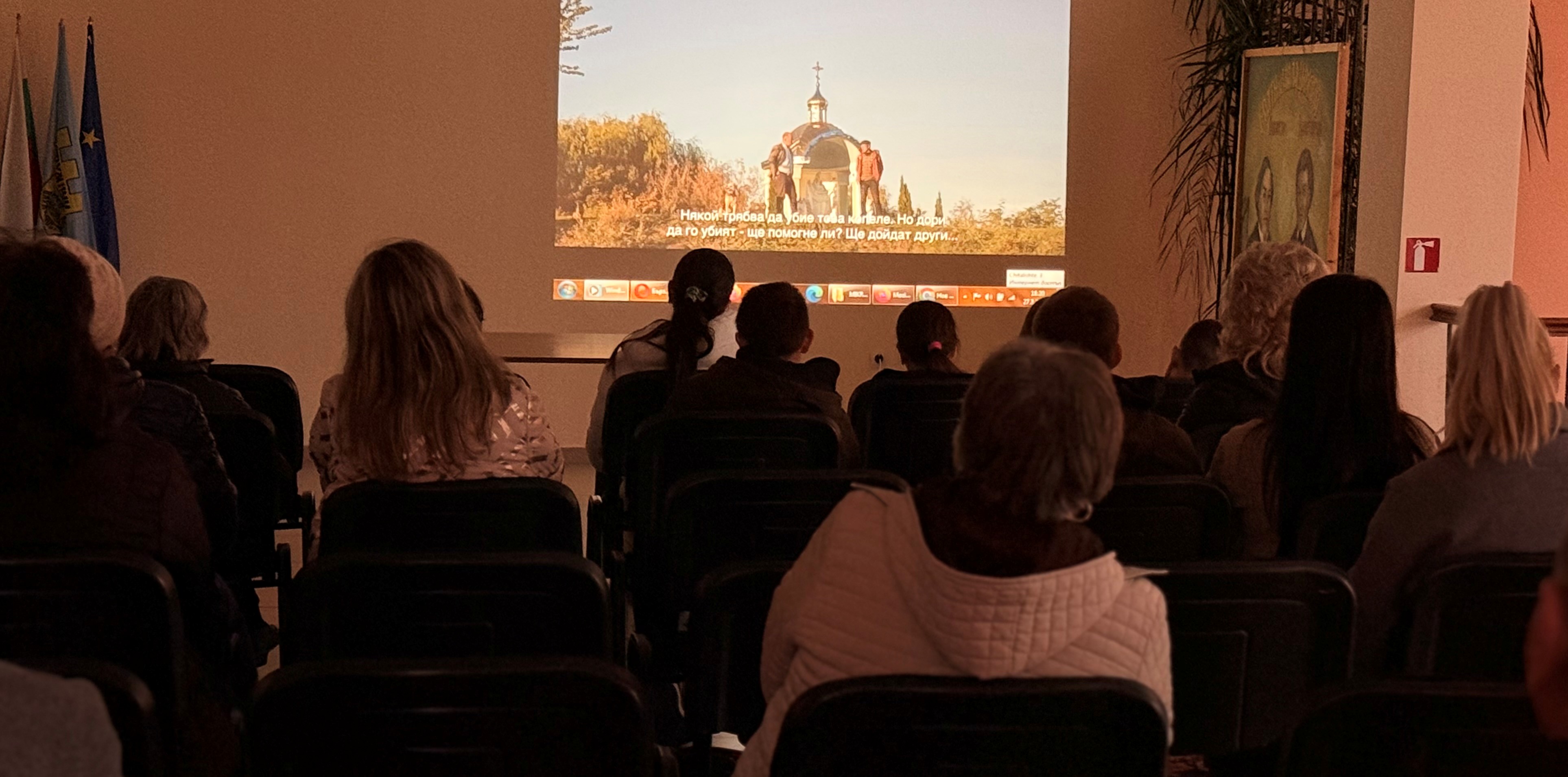
In March 2026 our “Think Freedom” (“Мисли свободно”) series, a curated collection of six short documentary portraits created for FNF East and Southeast Europe by tanuki films and the filmmakers Anna Stoeva and David Djambazov, travelled through Sandanski, Petrich and Belogradchik, and even had an unexpected extra stop in the village of Mikrevo. Much to our surprise, the interest these liberal characters attracted in the small mountain towns sometimes surpassed that of the blockbuster starring Hollywood sweethearts Margot Robbie and Jacob Elordi.
To be fair, the liberal ambassadors of multipliers from East Europe, whose portraits we chose to take on the road definitely hold their ground when it comes to energy and magnetism: an Azerbaijani rapper (link), a protesting Romanian poet (link), an untiring Ukrainian mayor of a small town (link), a Romanian hacker and fire juggler (link), a LGBT+ rights lawyer who fights for the fate of over 100,000 children (link), a free-minded Bulgarian professor who fled communism only to land in a small-minded German town(link). Each story circles around how individuals resist silence when freedom of expression is under pressure. But it was in the rooms after the screenings where the question took on a new, more relatable urgency.


Lively discussions with Anna Stoeva, Film Director, and the Film Protagonist, joining online
© FNF
Lively discussions with Anna Stoeva, Film Director, and the Film Protagonist, joining online
© FNF

Think Freedom Screening in Mikrevo
© FNFThe discussions became the beating heart of the project. Conversations stretched into hour-long exchanges, often cut short only by the cinema's schedules. Through live video calls, audiences spoke directly with the protagonists – and suddenly, the wall between the viewer and the subject on the big screen collapsed. In Sandanski, viewers asked poet Radu Vancu for practical advice on how to overcome fear – not of distant governments, but of local authorities with threatening influence over daily life. In Petrich, a conversation on migration with professor Stefan Kolev drew parallels between small towns across Europe - from Zwickau in Germany to Petrich in Bulgaria. It turned out, once you adjust for scale, the core similarities may much outnumber the differences. In Belogradchik, in a discussion with the director David Djambazov, we determined that in a war such as that between Ukraine and Russia, there might be opposing views on “who is wrong” or “who is responsible”, but when it comes to a single town, a single community, a single small school, the questions start to cut much more directly, much deeper.
Finally, in Mikrevo - a bonus screening organized by some of the active audience members themselves who wanted the films to be shown in their village -, even the youngest attendees joined an inspiringly deep conversation about individual agency vs. collective impact with renowned Romanian rebel artist Dan Perjovschi.
What emerged from these four screenings was a clear demand for true dialogue. Teachers expressed interest in bringing the films into classrooms; audiences wanted to watch all films from the series, besides the three we showed in every town; and people kept asking questions and seeking a space for discussion. More importantly, the project affirmed that smaller communities are not at all apathetic - they are underserved. They are eager for debate and for the chance to see themselves reflected as participants in a shared civic space, not just as a statistic to fight over during campaign runs. Our visits to these towns proved that when given the opportunity, people do not want to just sit back and watch - they want to respond, listen, and perhaps most importantly, begin to speak freely.
“Portraits of Freedom” – a series of short documentary film screenings followed by discussions – BG-RRP-11.025-0076 is implemented under procedure BG-RRP-11.025, Grant Scheme “Presentation of contemporary Bulgarian productions from the CCI sector to Bulgarian audiences.” The full responsibility for the content of this document lies with Tanuki Films Ltd., and under no circumstances can it be assumed that this document reflects the official position of the European Union and the National Recovery and Resilience Plan (NRRP).