LI Prize for Freedom
Laudatio: Dr. Maren Jasper-Winter, Vorstandsmitglied der Friedrich-Naumann-Stiftung

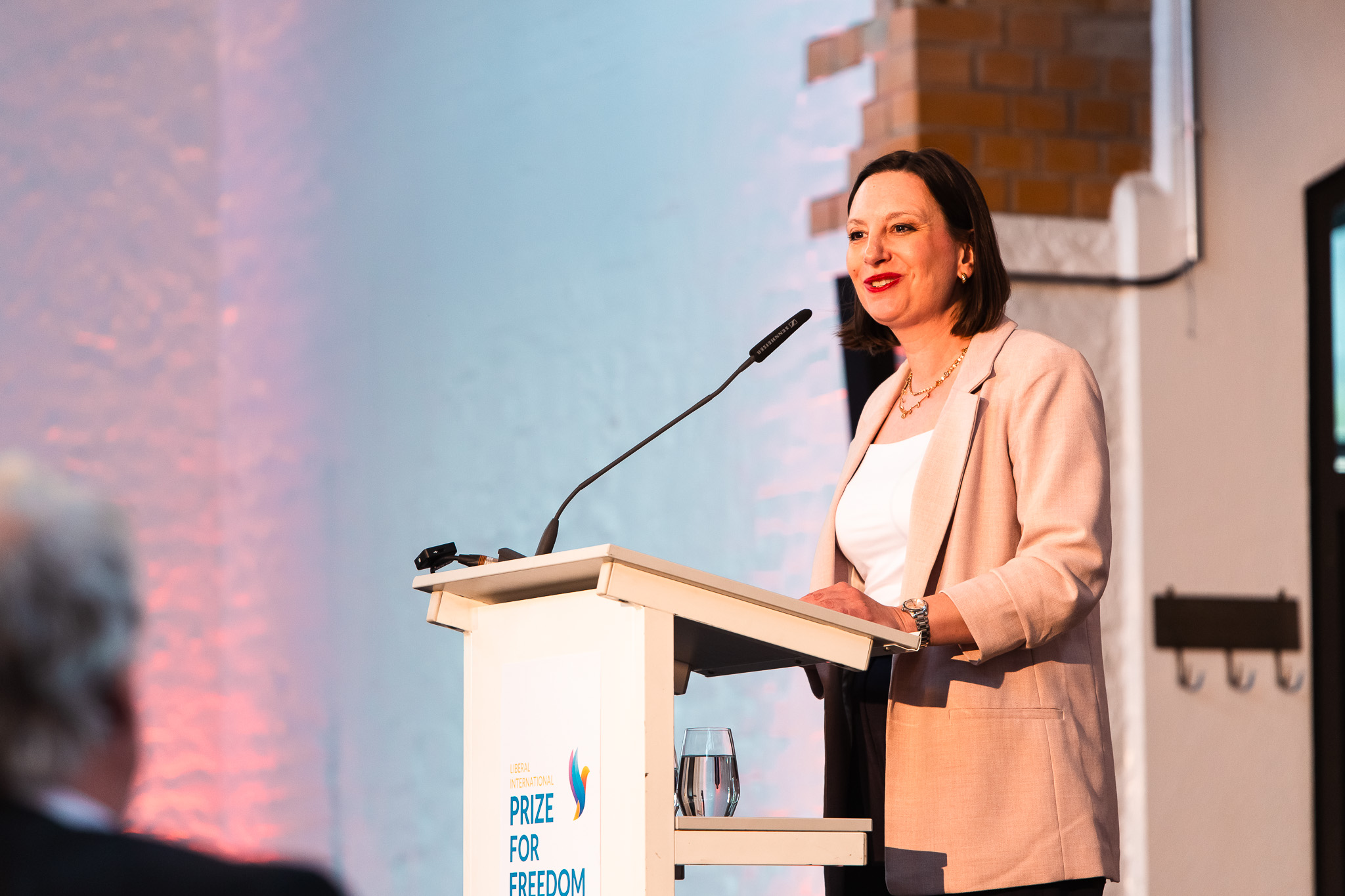
Dr. Maren Jasper-Winter, Vorstandsmitglied der Friedrich-Naumann-Stiftung
© Vimo StudioDear Mrs. Ayşe Buğra,
Dear Karl-Heinz,
Dear Mrs. Thors, dear Dr. Martens,
Ladies and gentlemen,
Dear friends of freedom,
Today, we gather to honour a man who cannot be with us. A man whose absence speaks louder than many words. A man who stands for what we often take for granted - and who has been deprived of his freedom for precisely that reason.
Around 50 kilometres west of Istanbul lies a place that has become a symbol of present-day Turkey for many observers: the high-security prison of Silivri. Built during a time of profound political transformation, this complex now stands as a stark reminder of the tensions surrounding dissenting voices and civic engagement.
It is there that Osman Kavala has been imprisoned - for 3121 days.
On 18 October 2017, he was arrested at Istanbul Airport. He was accused of organising and financing the Gezi protests of 2013 - protests in which more than 3.5 million people took part.
And what was the evidence against him?
One loudspeaker.
One plastic table.
And few biscuits.
These were not only presented as evidence - they were the only evidence cited in the indictment to support the claim that Osman Kavala had allegedly financed the protests.
The Gezi protests marked a turning point for Turkey. Millions courageously raised their voices - for political participation, for a different future. At the same time, the protests and the arrests in their aftermath revealed how intense the pressure can become on those who dare to speak out.
Yet Osman Kavala refused to be intimidated or silenced.
Even from prison, he continued to organise cultural initiatives, to preserve memory, and to foster dialogue and understanding. As early as 2018, in the first year of his detention, he organised a series of commemorative concerts for the Armenian composer and musicologist Vardapet Gomidas. His commitment was never about making noise - but about making a difference.
It is also for this reason that his case drew international attention. In 2019, the European Court of Human Rights took up his case and called for his immediate release. And indeed: in February 2020, he was acquitted due to a lack of evidence.
His wife Ayşe was already waiting for him outside the prison. But she waited in vain. On that very same day, a new arrest warrant was issued.
New accusations. New constructions. Without evidence. Without foundation.
In the end - in April 2022 - a verdict was delivered: life imprisonment under aggravated conditions. Solitary confinement. No prospect of release.
Kavala was accused of the involvement in the 2016 coup attempt in Turkey and of establishing a branch of the international Open Society organisation founded by George Soros in Istanbul. What criminal offence the latter was supposed to constitute was never clarified by the prosecuting authorities.
This verdict is not only a judgment on one man. It is a judgment on the state of the rule of law in Turkey. Particularly because Osman Kavala is not an isolated case.
The Silivri prison holds many people like Osman Kavala hostage. Opened in 2008, it has by now become the largest high-security prison in Europe. Human rights organisations describe it as an “internment camp” for opposition figures, activists, journalists, and artists.
Alongside Kavala, seven co-defendants were sentenced to 18 years in prison each for allegedly aiding his supposed coup attempt. Other prominent inmates of Silivri include the deposed mayor of Istanbul, Ekrem İmamoğlu, and, in the past, the German-Turkish journalist Deniz Yücel.
What Osman Kavala shares with all these detainees is this: they envision a different Turkey. A Turkey of democracy, of the rule of law, of diversity. A Turkey in which dialogue is stronger than fear.
This is what Osman Kavala stands for.
Early on, he understood that cultural exchange is not a luxury, but the foundation of an open society. In 1982, shortly after the military coup, at the age of just 25, he founded the publishing house İletişim Yayınları [ausgesprochen: Iletischim Jajandal]. In the following years, it became one of Turkey’s most important publishing houses, producing works that strengthened democratic values and encouraged critical thinking.
Later, in 2002, he founded the organisation Anadolu Kültür. Its managing director, Asena Günal, is with us today.
Through this foundation, he created spaces where people could come together - across borders and beyond conflict. He brought artists into dialogue, fostered collaboration between Turkey and Europe, and worked tirelessly to promote understanding and reconciliation.
After the murder of his friend Hrant Dink in 2007, he deepened this commitment even further - especially between Turkish and Armenian communities. Where mistrust prevailed, he built bridges. And that is precisely what makes him so threatening to those who fear a unified and open society. For it is always easier to rule recklessly when there is division and distrust in a society. But we must not allow that to prevail. We must stand with those who resist it - those who work for dialogue, for understanding, for a different future. And that is why we honour Osman Kavala today.
But let me be clear: the Liberal International Prize for Freedom is more than a tribute to a courageous individual.
It is a commitment.
That we are paying attention.
That we do not forget.
That we do not accept a world in which people are imprisoned for their convictions.
Dear Ayşe Buğra,
You are accepting this award today on behalf of your husband. But you carry far more than that. You carry hope. You carry dignity. And you carry your husband’s voice into the world. A voice that some tried to silence - and which still preserves. Osman Kavala has now spent 3121 days in prison. 3121 days without freedom.
3121 days without justice. But one thing is certain: these days are numbered. Not because the walls of Silivri are becoming weaker. But because we must become louder.
So today, let us not only honour. Let us remember. And above all: let us act.
Because freedom is not a state. Freedom is a responsibility. And Osman Kavala reminds us what it means to embrace that responsibility - with courage, with conviction, and with humanity.
Dear Osman Kavala,
Even if you cannot hear us today: your vision of an open, just, and reconciled society lives on. In your work. In your story. And in all the people you have inspired.
We stand here today - in freedom - also in your responsibility. And we promise: we will not let your voice be silenced.
Thank you.