Disinformation
Villain Boris Johnson and calls from disinformers to stop aid to Ukraine


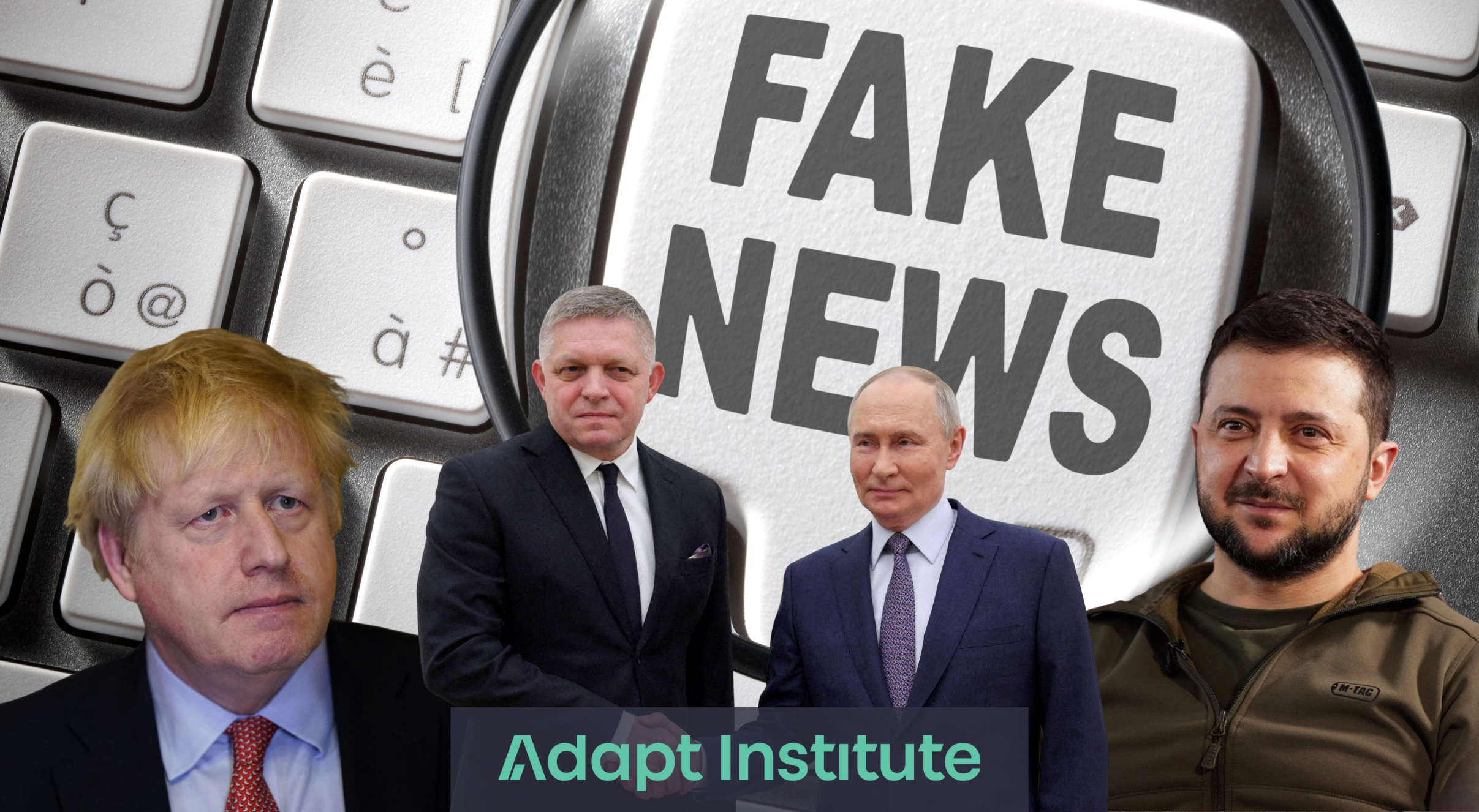
Adapt Institute provides an overview of disinformation trends that have been on the rise in the last two weeks:
- Attacks on the “impotent” EU and Ukraine and the glorification of the image of a menacing Russia are linked by a common goal. In addition to creating an atmosphere of fear, there are also renewed efforts to drive a wedge between Kyiv and the West, thereby halting aid to Ukraine. Narratives about a war-mongering Europe and provocations by Ukraine, which allegedly provoked a bloody conflict, continue to dominate.
- Narratives targeting the United Kingdom also continue. After the fabricated scandal about British interference in the elections, claims about the former British PM, who allegedly actively participated in prolonging the conflict in order to make money, also made their way into the Slovak airwaves.
- The Kremlin has exploited an investigative article about Boris Johnson published by a reputable media outlet to reinforce the credibility of false accusations aimed at discrediting Ukraine and its defense against the aggressor.
- There was also criticism of the EU and its institutions for alleged internet censorship and toothlessness in the face of crime committed by illegal immigrants. Far-right MEPs warned of an increase in the number of Africans in Europe and called for a cleansing of Europe along the lines of the US.
No aid to Ukraine!
The disinformation ecosystem continues to build social sentiments towards Russia and Ukraine. While glorifying Moscow, it tries to drive a wedge between Kyiv and its Western allies. Some actors attack Ukraine and president Zelensky, others focus on energy, and still others rail against a warmongering Brussels. The key theme of recent weeks has been efforts to stop aid to Ukraine.
Let's start with Milan Uhrík, who returned to the European Parliament (EP) plenary session to highlight the contrast between the interests of Ukraine and the EU. According to the leader of the far-right Republika movement, these interests are incompatible, and he calls on the EU to "finally start solving the problems of Europe and not the whole world." The MEP portrays aid and support for Ukraine as something that is at the expense of ordinary Europeans. With the clear slogan "Enough for Ukrainians," Uhrík manipulates the emotions of an audience that finds itself in a deteriorating economic situation.
Pavol Slota tried to play on a similar string. In his post, he focused on the possible delivery of American Tomahawk missiles to Ukraine. The chairman of the national party DOMOV, who makes no secret of his overly positive relationship with Russia, published a video generated by artificial intelligence in which the Ukrainian president is portrayed as a poor man begging for help. He also accuses Zelensky of "provoking the bloodiest conflict on European soil since World War II." Slota bases his post on a verified narrative that is heard relatively often from the mouthpieces of Russian propaganda—requests or pleas for help from the Ukrainian side are portrayed as attempts to draw the West or even the whole world into the conflict.
The issue of Tomahawks was also raised on the Mr. Slovak page. Recently, this page has specialized mainly in historical revisionism and reviving positive memories of the shared past with the USSR. This time, the website published a statement by singer Jožo Ráž, whose claims about crossing Russia's red lines and words praising "a strong Russia that acts wisely and sensibly" may be appealing to some Slovaks due to his popularity. Ráž is, of course, no expert on geopolitics or Tomahawks, but his statements about American mercenaries paid to provoke war in Europe are presented as something relevant.
The series of Slovak visits to Moscow also continues. This time, MP Richard Glück (SMER-SSD) attended the celebrations of the 20th anniversary of the founding of the Russian state-controlled media outlet RT. He also gave the media an interview in which he mentioned the threat to freedom of speech in Europe.
In a post reporting on his trip, Glück boasted that he had met Steven Seagal. Over the past decade, the action star has undergone a transformation from Hollywood actor to useful tool of the Kremlin. In addition, the MP presented his visit as "a clear signal that Slovakia is interested in a sovereign policy in all four directions", despite the so-called iron curtain between the West and Russia. The effort to build (restore) relations with Russia was also announced by PM Robert Fico in one of his posts.
As a bonus, there was also speculation about who was responsible for the fires at refineries in Hungary and Romania, which broke out on October 21, 2025. These were even accompanied by claims that a similar incident had occurred at the Slovnaft refinery in Slovakia. This was a hoax spread by pro-Russian accounts (what a coincidence), which was denied by Slovnaft's communications department.
Speculators fueled by Russian propaganda were looking primarily for Ukraine's involvement. Gradually, false reports began to appear accusing Kyiv of the attacks and linking the situation to possible negotiations between the US and Russia. In Slovakia, a similar narrative was spread, for example, by the dubious page Bádateľ. The post, without any evidence, speaks of the suspicion of Ukrainian forces and calls for "the closure of the border with Ukraine and the cessation of all aid."
The Slovak PM also tried to stir things up before the European Council meeting on Thursday, October 23. In Brussels, he supported the 19th package of sanctions against Russia in exchange for a clause on the EU's response to energy prices. Fico paved the way for his decision with his traditional rhetoric about the EU's excessive focus on the war in Ukraine. In one of his posts, he reiterated that the EU had turned into a "war cabinet" living in the "naive belief that this is how Russia can be weakened and defeated."
In another post, in which Fico informed his audience directly from the negotiations in Brussels, narratives about Russian frozen assets appeared. "This piece of Russian cheese", as Fico called the assets, allegedly "smells very good to the European raven". Fico considers the discussion about whether frozen assets should be used for military support to Ukraine to be a manifestation of the EU's impotent foreign policy. He prefers to supplement his statements with warnings about the risk of "tough Russian retaliatory measures," which he essentially conveys to Western allies.
PM's rhetoric was accompanied by posts from other government-affiliated actors. Eduard Chmelár, a former advisor to Fico, accused the EU of "encouraging Ukraine in the senseless destruction of its own country and behaving like a gangster." The war, he said, was only meant to highlight the "long-term decline and impending end of European civilization." Chmelár has long been one of the faces of the disinformation scene, predicting the end of the West at Moscow's behest. Incidentally, they consider the West to be the ultimate evil.
The same is true of MEP Judita Laššáková, who in a video described the conclusions of the European Council meeting as a "suicidal campaign." This is indeed paradoxical, given that her party leader Robert Fico also signed them.
Boris Johnson: the bogeyman of Russian propaganda
In addition to the EU, another grateful target has fallen into the sights of Russian propaganda: Great Britain. On October 12, the Russian state-controlled news agency TASS published an article claiming that former British PM Boris Johnson had supported prolonging the conflict in Ukraine for money.
The media outlet First Channel (Perviy Kanal) even mentioned bribery in the article. As expected, other media outlets and actors joined in – the propaganda machine was set in motion in an effort to revitalize the old-new narrative about evil Great Britain and the artificial prolongation of the conflict in Ukraine.
The narrative referred to an investigative article by The Guardian. It examined Johnson's ties to businessman Christopher Harborne, who donated £1 million to the former British PM. Christopher Harborne is a shareholder in British arms manufacturer QinetiQ, which, according to available information, supplies drones and robots to Ukraine. Journalists focused on the fact that in 2023, Johnson took Harborne with him on a visit to Ukraine, where they attended high-level meetings.
However, The Guardian did not provide any information about Johnson's motives for inviting Harborne on the trip. The article focused exclusively on issues of transparency and ethics related to the gift (conflict of interest). However, it did not claim or suggest that Johnson had accepted £1 million in exchange for persuading Kyiv to continue the war with Russia. This part is a product of the imagination of Russian propagandists, whose narratives have been eagerly adopted by some figures on the Slovak disinformation scene. Naturally, government officials, including PM Robert Fico, were also involved.
Boris Johnson has faced similar attacks in the past. Vladimir Putin (but also Sergey Lavrov, for example) repeatedly claimed that Ukraine had rejected agreements that were "almost reached" in Istanbul in 2022. During the negotiations, Johnson visited Kyiv and reportedly advised Ukraine skeptically to "fight on" and avoid agreements with Russia. The Kremlin is trying to portray this recommendation as a British ultimatum to prolong the war. This is also refuted by David Arakhamia, head of the Ukrainian delegation in Istanbul, who speaks of the distortion of his own words by the Russian media.
Even if we were to link these two cases, which is of course what Russian propagandists are trying to do, it is difficult to believe (even considering Boris Johnson's controversial character) that the British side would sabotage peace negotiations just for the sake of contracts to supply drones. The timing does not add up either – Johnson visited Kyiv on April 9, 2022, but the draft of the peace agreement dated April 15, 2022 shows that the negotiations continued despite the so-called British ban.
At the same time, Harborne's donation came much later – in November 2022. Let us remember that Johnson was no longer prime minister at that time. The Russian media also fail to mention that Harborne accompanied Johnson to Kyiv not during his visit in April 2022, but in September 2023, when Johnson traveled to Ukraine as a private individual. The negotiations between Ukraine and Russia eventually broke down for several reasons – but mainly due to disagreements over security guarantees, the issue of demilitarization, and emerging evidence of Russian war crimes.
We also looked at this topic using the Gerulata Juno analytical tool. We used it to analyze the most popular posts on Slovak Facebook that contained the keyword "Johnson." We excluded posts that did not contain problematic narratives from the list. We then evaluated the posts based on the total number of interactions (the sum of all reactions, comments, and shares).

The post with the highest number of interactions belongs to Robert Fico. The Slovak PM totally bought into the Russian propaganda narrative. He talks about a bribe "from an arms oligarch" and also about pushing for "the war to continue until Russia is on its knees." The text of the post is accompanied by a video showing Fico speaking in the Slovak parliament. In his speech, he also tried to revitalize the narrative about a prepared peace agreement that Ukraine was about to sign. Like the Kremlin-controlled media, Fico does not concern himself with the fact that the events (and the entire timeline) do not add up. He says it is no surprise that "you won't read much about this case involving the British prime minister." Fico sees this as a conspiracy by the Western arms industry. The reality is that no serious media outlet would take up such Russian propaganda-influenced reports, let alone the PM of an EU member state.
The second post was published by Michal Bartek. It comes as no surprise that the Hlas-SD MP repeated the same modus operandi as the PM in his short video. He referred to an article by The Guardian, but also added a Russian spin about the peace talks being thwarted for £1 million. The war in Ukraine is therefore supposed to be "just plain business." Bartek even goes on to say that so-called opposition experts cannot accuse him of spreading disinformation because the investigation comes from a reputable British source. The MP thus quite nicely and of his own accord revealed the logic of his post to his audience. The fact that he embellished the original content considerably in order to attract further attention is, of course, the other side of the coin, which was supposed to remain hidden.
The third post on the topic was again published by the Slovak PM. This time, he addressed his voters in a video series entitled "What didn't fit in the press conference." Among other topics, he devoted the end of the video to repeating narratives about Boris Johnson. He labeled him a "show-off" who "prevented the signing of the peace treaty." We would just like to point out that this is a continuation of the campaign that Fico has been waging against the UK in recent months. In one of our previous reports, we also addressed the fabricated case of British interference in the 2023 parliamentary elections. As is the case now, very few facts were used. However, the pattern was repeated – the disinformation scene took over the investigative article and turned its conclusions upside down to its (or Russia's) advantage.
Another post was published by Anna Belousovová. According to the former politician, who recently ran for the far-right Republika party, "what we have known for a long time" has reportedly come to light in recent days. Belousovová presents an article from The Guardian as an answer to the questions "Why did the West support and continue to support the war against Russia?", "Why did it drag Ukraine into it through Zelensky?" and "Why is it prolonging this lost war?". Boris Johnson allegedly even directly forbade Zelensky from "accepting the peace treaty proposed by Russia in February 2022." The reality is that Ukraine and Russia did not negotiate a peace agreement until April 2022. This is not so important in the context of the overall manipulative image that the nationalist is trying to create. At the very least, however, it shows how responsibly Belousovová works with information. Like Fico, Belousovová has jumped on the conspiracy theory about the arms lobby, which she claims is deliberately prolonging the war in Ukraine. However, it is not entirely clear whether this industry is equivalent to the Western countries that Belousovová accuses of waging war against Russia a few lines above. Simply put, the logic did not hold up even in Moscow's imagination, but Belousovová took it to another level.
The last post in the series was published by the State Secretary of the Ministry of Defense. Igor Melicher basically repeated the narratives mentioned above. However, he added to them the claim that Christopher Harborne was supposed to accompany Johnson on a visit to Ukraine as early as 2022. This directly contradicts what is written in the article by The Guardian, from which the State Secretary draws his information. At least, that is what he is trying to pretend. In reality, however, Melicher is just parroting Moscow's rhetoric. He also raises fears about the looming geopolitical change in Europe that is supposed to result from this scandal – allegedly, it will have "far-reaching consequences for the entire collective West and all the false moralists who have been adding fuel to the fire of war and continuing to support it in recent years." By moralists, he actually means Western countries that have decided to help the victims of aggression, and by adding fuel to the fire, he probably means all support. Naturally, as is customary in the Slovak government coalition, Melicher concluded by calling for the lifting of sanctions and the establishment of peace.
The far right calls for Europe's purge
Disinformers also exploited topics related to the EU and its measures to spread hatred and fear. The posts that appeared in this category covered a wide range of topics, from illegal migration to social media regulation and freedom of speech.
Far-right MEPs Milan Uhrík and Milan Mazurek (both from the Republika movement) decided to return to the roots of their success on social media. While Uhrík spoke about the alleged obstruction of police action against crime committed by illegal migrants in the EU, his party colleague warned of the arrival of huge numbers of African students in the EU. According to Mazurek, students coming from Africa are supposed to stay in Europe after completing the Erasmus+ program, thereby allegedly transforming it beyond recognition. In the video, he misleadingly claimed that 105,000 Africans would be taking advantage of mobility each year. This is inaccurate, as mobility between continents is supposed to be two-way and will be used by a total of 105,000 people (by 2027).
Similarly, in a video capturing his speech in the European Parliament (EP), Uhrík raised concerns about crime committed by illegal migrants and claimed that EU institutions "have turned the police into toothless fashion organizations that are practically unable to take action against these criminals." According to Uhrík, progressives are politically responsible for "all the rapes, thefts, and murders committed by illegal immigrants and their gangs throughout Europe." Using dramatic music and editing, along with exaggerated language, he created a sense of urgency and used misleading dramatization on his audience. In addition to misrepresenting the situation in Europe as one full of crime and violence, he claimed that the EP's vision of the role of the police is to protect rainbow parades and imprison people for their opinions on social media.
He contrasted this with the (in his view positive) example of the US, where President Donald Trump "dismissed transvestites from the army and sent police officers into the streets to chase and deport illegal immigrants." Although Uhrík—whether intentionally or unintentionally—used the term "transvestites," the Trump administration announced the dismissal of transgender soldiers from the army, which is perceived as discriminatory. The deportation of illegal migrants from the US has also been met with disapproval by experts and parts of the public, for example because arrests on the streets have repeatedly proved to be unjustified. Nevertheless, Uhrík states in the video that "Europe needs exactly this kind of cleansing."
Mazurek expressed a similarly inappropriate glorification of the US under Trump's second administration in connection with the EU's Digital Services Act (DSA). According to the MEP, the DSA is intended to guarantee censorship within the Union, with people being persecuted, arrested, or subjected to house searches "because someone wrote something on social media; people are even being arrested for sharing something, or even for seeing something." In contrast, the US allegedly promotes freedom of speech as long as social media posts do not directly incite violence or contain threats. In reality, however, public debate is restricted in areas such as research, education, and activism.
Negative portrayals of the EU also appeared in posts by PM Robert Fico, who spoke of the alleged favoritism shown to Ukraine at the expense of the interests of Slovakia and other member states, while highlighting relations with post-war Russia. In another post, he stated that on issues of "national identity," Slovak law will take precedence over European law and international agreements based on a recent constitutional amendment. Nevertheless, the constitution still contains a clause on the supremacy of European law, which stems from the accession process and the gradual development of the case law of the Court of Justice of the European Union. The PM and his government are thus treading on thin ice and are likely to receive a response from European institutions requesting rectification.
In the video, Fico also criticized the fact that the Party of European Socialists (PES) expelled Smer-SSD from its ranks. However, he stated that if this is a punishment for introducing two sexes and marriage as a union between a man and a woman in the Slovak Constitution, he considers expulsion from the faction to be an "honor." In reality, however, the unaligned SMER-SSD MEPs are losing their influence in EP negotiations, which will likely result in them joining other factions. In this sense, there is discussion about the strengthening of the extreme right in Europe, as some MEPs have confirmed the possibility of joining the Patriots for Europe faction.
Project is organized by Adapt Institute and supported by the Prague office of the Friedrich Naumann Foundation for Freedom. It continuously monitors the activities of both Slovak and foreign disinformation actors, but focuses mainly on the former. The project activities are built upon daily monitoring of emerging disinformation, hoaxes, and conspiracy theories in the online information space. This approach allows the analysts to identify disinformation posts and narratives that resonated with the public the most, as well as to find out where they originated, and how they spread and evolved on social media. The report takes the form of a bi-weekly summary of arising trends in the spread of malicious information content online. Based on that, Adapt Institute can inform the public about emerging and current trends in the field of disinformation, manipulation, and propaganda.