Disinformation
Fueling hatred against students and continuing tales of fascism


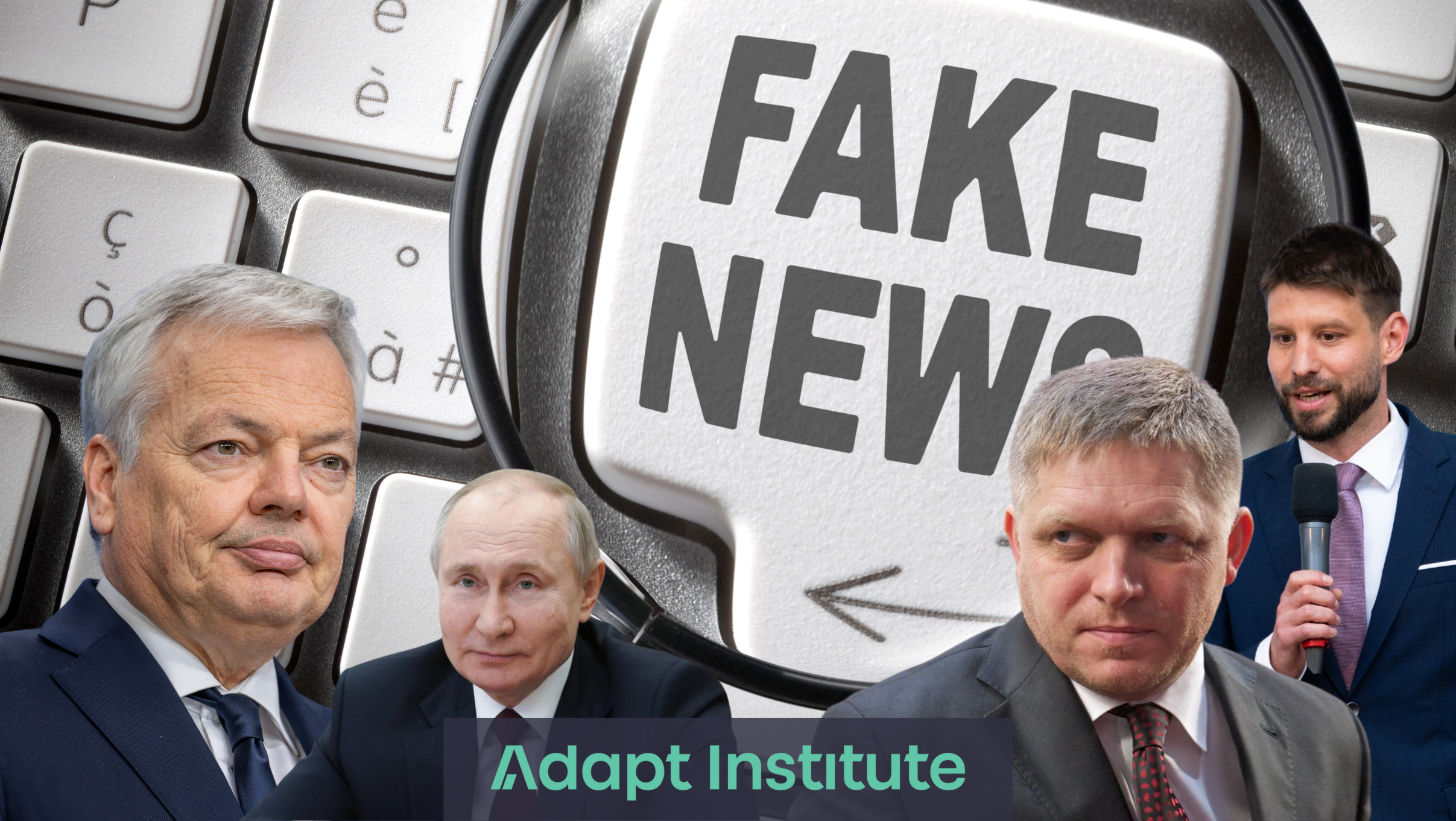
Adapt Institute provides an overview of disinformation trends that have been on the rise in the last two weeks:
- The investigation into allegations of corruption against former European Commissioner Didier Reynders was used by disinformers to launch attacks against the European Commission and the EU as a whole. European institutions were portrayed as corrupt and rotten, and Reynders was artificially linked to Progressive Slovakia. Conspiracy theories also emerged about attempts to "cover up" the case.
- PM Robert Fico was supposed to take part in a discussion with students about Slovakia's foreign policy. The meeting was eventually canceled because critical messages written in chalk on the sidewalk were waiting for the PM outside the gates of a secondary school in Poprad. The police questioned the student, who was then subjected to an avalanche of attacks from the disinformation scene. There were hateful comments, comparisons to the spread of hatred before the assassination attempt on the PM, and questioning of the young man's mental health.
- The traditional narratives of Russian propaganda were also present. This time, the glorification of Putin was complemented by the uncritical sharing of the rhetoric of Chechen leader Ramzan Kadyrov. This led to a revival of the narrative about so-called Ukrainian neo-Nazis, which the Kremlin manipulates to justify its aggression and war crimes.
Corruption and fascism in the "Brussels den"
The investigation of the former Belgian European Commissioner (2019–2024) attracted the attention of disinformers. Didier Reynders, who was responsible for justice in the European Commission (EC), faces allegations of money laundering. At the end of 2024, reports emerged that he had been buying lottery tickets for several years through the National Lottery, an organization for which he was responsible as minister from 2007 to 2011. He then allegedly participated in lottery games and deposited the resulting ("laundered") profits into his personal account.
The case is currently back in the media, as in October 2025 Reynders was questioned in connection with unexplained cash deposits totalling approximately €700,000 that he made into an ING bank account between 2008 and 2018. After the questioning, the judge decided that there was serious evidence of Reynders' guilt and officially designated him as a suspect.
Several actors from the SMER-SSD party were quick to seize on this new development. The party was the target of criticism from the European Commissioner at a time when he was leading disputes over the amendment to the Slovak Criminal Code drafted by the current ruling coalition and over the abolition of the Special Prosecutor's Office. The new developments in the Didier Reynders trial thus served politicians to attack him personally and, by extension, the entire EC and EP. For example, the official SMER-SSD Facebook page shared a short statement by MEP Monika Beňová, who, in an emotional speech, accused Reynders of bullying Slovakia with fabricated reservations about the rule of law, while allegedly ignoring actual violations of the rule of law (she was probably referring to the established narrative about the violation of the rights of the Slovak population through anti-pandemic measures, which were manipulatively portrayed as an instance of totalitarianism).
In a video on this topic, MEP Ľuboš Blaha automatically linked Reynders to the opposition party Progressive Slovakia, as its MEPs are members of the same political group (Renew Europe) as Reynders was in the past. From this rather coincidental fact, Blaha drew the false conclusion that they are all "progressive thieves" and represent a rotten and corrupt progressive mafia. Blaha also presented the idea that if Reynders is convicted, the entire faction should be dissolved or renamed from "Renew Europe" to "Rob Europe." The fact that the former European Commissioner's illegal activities had no bearing on the faction's activities, as well as the fact that the EP—and therefore the faction—currently exists in a new composition, plays no role in Blaha's thought processes.
The topic was also addressed by Tibor Gašpar, Vice-President of Parliament for SMER-SSD, who claimed that public criticism of the missteps of EC President Ursula von der Leyen or Didier Reynders could have serious consequences for critics. Gašpar tried to create the impression that opponents of the EC were being silenced, misusing the case of Belgian lobbyist Frédéric Baldan. In April 2023, Baldan filed a criminal complaint against EC President Ursula von der Leyen for corruption (over vaccine supply contracts via text messages with Pfizer's CEO) and later forwarded the complaint to the European Public Prosecutor's Office (EPPO), which he claimed was using delaying tactics to cover up the case.
Gašpar took over Baldan's own post from social network X, in which he claimed that the bank had frozen his accounts. According to him, this was a coordinated action by politicians to silence him. Tibor Gašpar deliberately used specific vocabulary when presenting these (uncritically accepted) claims. Although the media report on Baldan as a lobbyist, Gašpar referred to him as an "activist" and described his actions as "drawing attention" to corruption and misconduct on the part of both politicians. In reality, Baldan filed criminal complaints, demanded the resignation of von der Leyen and the entire Commission, and demanded €100,000 in compensation for "losing trust in European institutions."
Disinfluencer Ľuboš Hrica went even further in presenting Frédéric Baldan's case. Like Gašpar, Hrica presented Baldan as a committed activist and a defenseless victim of oppression by European institutions. He conspired that lobbyists and bank owners were working hand in hand "with these fascist larvae in the Brussels den." According to him, the aim of the conspiracy is to control people through digital currency (as the electronic equivalent of cash). According to him, European democracy hides a sophisticated form of dictatorship, or modern fascism.
As in the previous report, the EU and the West were presented through a narrative of the decay of the West, which is supposed to be swept away by a wave of violence. MEP Milan Mazurek (Republika) claimed that "Western countries are turning into a jungle full of murder, rape, and terrorism at every turn. It is spreading like the plague, at an extreme speed." His post contained elements of xenophobia and racism when he warned against "Europe being flooded with foreigners from Muslim countries," which he claimed would spell disaster for Slovakia as well.
To heighten fear and stir up hatred towards foreigners, Mazurek used examples of crimes from the United Kingdom and Sweden, which he reported without sources or additional information. He deliberately painted a picture of countries that senselessly punish online behavior (incitement to hatred) but fail to adequately punish alleged crimes committed by immigrants. Mazurek resorted to vulgar language, calling one of the criminals a "dirty bastard" and another a "dirty degenerate." In an effort to appeal to his target audience, he used misleading dramatization and appealed to basic instincts when he claimed that rejecting progressive policies was equivalent to protecting our children.
Hatred spread with chalk?
Robert Fico was supposed to take part in a discussion with students at a secondary school in Poprad on November 7. Before the PM even arrived at the school, someone had written "Fico is a traitor" and "How does Putin's c... taste?" in chalk on the sidewalk in front of the entrance. The lecture was then cancelled, but according to the government, there was only a request to change the date due to other obligations of the PM.
High school students had agreed to wear black before the debate with the PM. They wanted to express their disagreement with government policies. Some parents and teachers were also reportedly unhappy about the PM's presence. Fico was supposed to come and discuss Slovakia's foreign policy. Robert Fico said at a press conference in Poprad that he was not aware of any dissatisfaction among pupils or students. "The country is divided and there are all kinds of opinions. That's democracy," said the PM, who still plans to visit the high school.
The police also intervened at the scene on November 7, reportedly called in by school staff. The police took 19-year-old student Michal, who wrote some of the messages to the PM, in for questioning. The disinformation scene also seized on the topic, once again seeing (or wanting to see) the incident as spreading hatred towards the PM. This continues the narrative of portraying public enemies, even among students who disagree with government policy. Among other things, there were also fabrications about the training of new assassins.
We therefore looked at this topic using the Gerulata Juno analytical tool. We used it to analyze the most popular posts on Slovak Facebook that contained the keyword "Poprad." We excluded posts that did not contain problematic narratives from the list. We then evaluated the posts based on the total number of interactions (the sum of all reactions, comments, and shares). The number of interactions corresponds to the date of data collection, and in the meantime, the posts could have generated even higher numbers.

The post with the highest number of interactions belongs to MEP Ľuboš Blaha. The long-standing face of the SMER-SSD party dedicated two posts to the student from Poprad, in which he mockingly refers to the student as a "clean-shaven" (a derogatory term for a young man who is not yet married). In this post, he also accuses the student of "painting his nails" and having "problems with his identity". As expected, he also linked the student with progressivism and liberalism, as well as drug use. Of course, as is customary for MEP, he did so without any evidence and only with the aim of comparing the student to the assassin Juraj Cintula. Needless to say, comparing an assassination attempt on PM to a chalk inscription on the sidewalk is quite disproportionate. However, it serves its purpose—to create the impression of progressive hatred spreading among students. Yet securitizing the opinions of young people through rumors and unconfirmed information (which, incidentally, have nothing to do with criticism of government policy) can be considered a dangerous signal to the public, where tensions are running high.
The second post was also published by Ľuboš Blaha. This time, it was his initial reaction to the incident in Poprad. In addition to calling the student a "clean-shaven," he also criticized him for "not even having a high school diploma" and for certainly having been "incited by extremists such as Šimečka and Naď." (opposition politicians) The MEP also disliked the fact that the mainstream media and various commentators had come out in support of the student, arguing that it was a matter of freedom of speech. For Blaha, this is a case of double standards or corrupt progressive morality. He even compared the student's case to that of Daniel Bombic. According to Blaha, the prosecuted extremist is currently in custody only because of his "indecent language." Let us recall that Bombic is currently charged with the crime of expressing sympathy for a movement aimed at suppressing fundamental rights and freedoms, the crime of disseminating extremist material, and electronic harassment. The comparison with the student who criticized the PM with chalk is therefore out of place.
The third post on the topic was published by Juraj Gedra. A member of SMER-SSD, who worked his way up to become a member of parliament through the party's youth structures, he is now the head of the Government Office of the Slovak Republic. Among other things, he gained attention in Slovakia for his involvement in corruption cases and attacks on journalists and civil society. This time, Gedra was among the first (at least of politicians) to link the incident in Poprad with the assassination attempt on Robert Fico. According to Gedra, "a young version of the mentally ill Cintula" was found in Poprad. He added that the "progressive media" are supposed to make him a "hero of primitive hatred." It is quite clear what the head of the Government Office is up to—revitalizing the narrative of unjust hatred directed at the PM can only be useful at a time when criticism of the government is growing. At the very least, some representatives may use these labels of hateful media (and now students) to hide legitimate questions about Slovakia's economic situation or foreign policy position.
Another post was published by Jozef Viktorín from the far-right movement Republika. The unsuccessful candidate in the European elections sees the situation in Poprad as a radicalization of students. Viktorín assesses the student's actions as a new fabricated story from the ranks of "progressives and liberals" who allegedly need a scapegoat to create chaos and intolerance in society. The member of Republika also used the situation to make an awkward call for education reform—a reform that would, for example, stop the so-called unprecedented lectures by progressive activists in schools. Viktorín is relying on the myth that progressive forces are threatening the upbringing and education of the younger generation. However, lectures presented under the guise of harmful sex education and the dictates of cultural change are in reality often focused on building critical thinking and media literacy. Naturally, improving these skills would probably not suit political entities such as Republika.
The last post in the series was published by Anna Belousovová. The politician, who is now only active at the regional level, sees a progressive scheme behind the student's behavior. The opposition is said to be artificially creating heroes out of similar (indecent) students in the eyes of the public, whom they will use during protests and then discard. There were also ad hominem attacks. She said that it is enough to "look at this young man's posts on social media and it should be clear to any normal person that he is not entirely normal" and that he needs "a mental health professional specializing in drug addiction." Belousovová also links the student to the upcoming November 17, when nationwide anti-government protests are planned. As usual, Belousovová sees a scenario and a conspiracy by the opposition behind the incident.
Russian propaganda - Slovakia's daily bread
In the coverage of Slovakia, we naturally cannot avoid mentioning Russian propaganda narratives. There is nothing new on this front – once again, glorification of the Kremlin and proclamations about the flawless Putin dominated the information space. Apart from the narratives about the so-called corrupt Brussels at the beginning of the report, some actors again tried to discredit the EU in the context of the war in Ukraine.
Worth mentioning is the online interview with Ľuboš Blaha, published by TV Markíza. In addition to narratives about the economic war between Brussels and Slovakia, the MEP did not shy away from blaming the West for the war in Ukraine. In Blaha's case, this is a narrative that consistently frames his rhetoric. What is interesting is that this time he managed to smuggle narratives about the European Commissioner's "bloody paws" and the Ukrainian President's efforts to provoke a global conflict directly into the mainstream media (albeit only in its online form).
By comparison, such interviews are usually offered to disinformation media by Blaha. In this regard, he described the frozen Russian assets as "the biggest bank robbery in history". He went on to say that Ukraine is in ruins because of President Zelensky (he did not mention Vladimir Putin, of course) and also called for an end to the war. He did so in his own way, however, by glorifying the Russians, who will "simply take those four regions [...]."
The obligatory odes to Putin were not missing either. This time, Pavol Slota, chairman of the nationalist party DOMOV, chimed in. In his post, he shared only a photo of the Russian president, who allegedly "expelled Soros from Russia" and "banned rainbow ideology in schools", and is therefore hated by the West. It is difficult to argue with the message about the repressive behavior of the Russian regime towards civil society and minorities. However, on the part of the West, this is not hatred, but legitimate criticism and conflict with a president who, among other things, is accused of war crimes in Ukraine.
Another face of the Slovak disinformation ecosystem, Marek Šoun, in his post took up the words of Ramzan Kadyrov, the leader of Chechnya. This was a repetition of the rather harsh narratives of Russian propaganda, which claims that Moscow is only defending its people with its aggression in Ukraine. Narratives about the extermination of so-called Ukrainian neo-Nazis were also repeated—a manipulative narrative that is key to the Kremlin's efforts to legitimize its aggression and crimes in Ukraine.
Project is organized by Adapt Institute and supported by the Prague office of the Friedrich Naumann Foundation for Freedom. It continuously monitors the activities of both Slovak and foreign disinformation actors, but focuses mainly on the former. The project activities are built upon daily monitoring of emerging disinformation, hoaxes, and conspiracy theories in the online information space. This approach allows the analysts to identify disinformation posts and narratives that resonated with the public the most, as well as to find out where they originated, and how they spread and evolved on social media. The report takes the form of a bi-weekly summary of arising trends in the spread of malicious information content online. Based on that, Adapt Institute can inform the public about emerging and current trends in the field of disinformation, manipulation, and propaganda.