Geopolitics
Strategic Neutrality


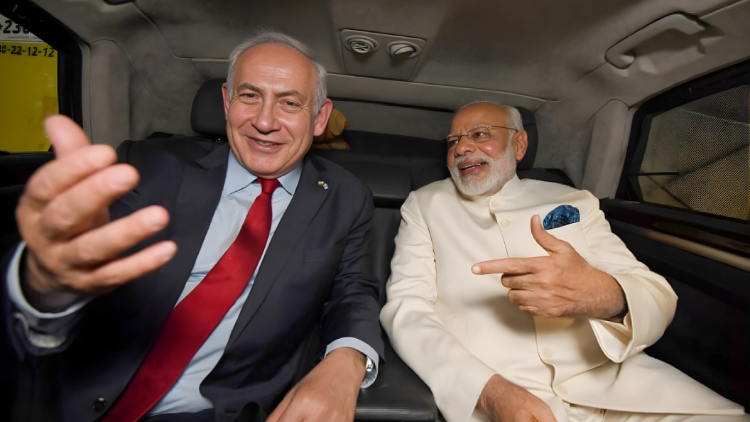
Israeli Prime Minister Benjamin Netanyahu and Indian Prime Minister Narendra Modi after a farewell ceremony in Modi's honor at Ben-Gurion International Airport, July 4, 2017.
© Haim Zach, Office of the President of Israel, Government Press OfficeIndia did not officially criticize the Israeli-American air strikes on Iran, but condemned Iran's retaliatory attacks on its Arab neighbors. On the other hand, India officially condoled with Iran on the death of Supreme Leader Ayatollah Ali Khamenei. Indian Prime Minister Narendra Modi spoke by phone with the heads of state and government of Israel, the United Arab Emirates, Saudi Arabia, Jordan, Bahrain, and Kuwait. India's response to the conflict is essentially shaped by two factors. First, some 10 million Indian citizens live and work in the Gulf region. Concern for their safety is at the heart of Indian policy. Second, India is highly dependent on the Gulf states for energy. The region supplies nearly 50 percent of India's crude oil imports. About 40 percent of these supplies pass through the Strait of Hormuz.
India has traditionally maintained good relations with all countries in the region. This is in line with the principle of Indian foreign policy, which is fundamentally aimed at strategic independence and neutrality. Against this backdrop, Prime Minister Modi's visit to Israel immediately before the outbreak of war was seen by some observers as a “momentous strategic shift.” On the other hand, at the same time as Modi's visit to Israel, a multinational exercise of the Indian Navy took place, in which Iranian ships also participated. On its way back from this exercise, Iran's warship “IRIS Dena” was sunk by an American submarine off Sri Lanka. The “IRINS Bushehr” and the “IRINS Lavan” docked in Indian ports with the approval of the Indian government – officially due to technical problems.
The media and large sections of civil society support the government's stance on the war. Criticism came from the Indian National Congress Party (INC), the main opposition force in parliament. It criticized the timing of Modi's visit to Israel and the government's lack of response to the sinking of an Iranian warship in international waters off Sri Lanka.
Higher prices, fewer remittances
India is dependent on energy imports. Crude oil imports account for 95% of total imports, while liquefied gas accounts for 60%. A prolonged disruption of imports from the Gulf would have a massive impact on the Indian economy. In addition to higher energy prices, this would likely lead to a rise in inflation and a devaluation of the rupee. In the medium term, energy shortages could slow industrial production and weaken the competitiveness of Indian companies.
The war in the Middle East also jeopardizes remittances—the transfers of money from the Indian diaspora to their home country. In 2025, Indian workers from the region transferred more than $50 billion to India. That is almost 38 percent of all remittances.
About 39 percent of India's international air traffic normally passes through the Gulf region. That corresponds to approximately 15 million passengers per year. Due to the war, most flights via the hubs of Dubai, Abu Dhabi, and Doha are currently canceled. Private individuals and businesspeople from India have to accept detours and additional costs. Many foreign guests are canceling their visits to India due to uncertain flight connections.
*Stefan Schott heads the India Office of the Friedrich Naumann Foundation for Freedom in New Delhi. Bipin Ghimire is a political analyst there.