Economy
Tunis Hosts High-Level Economic Forum on Fragmentation, De-Globalization, and Resilience

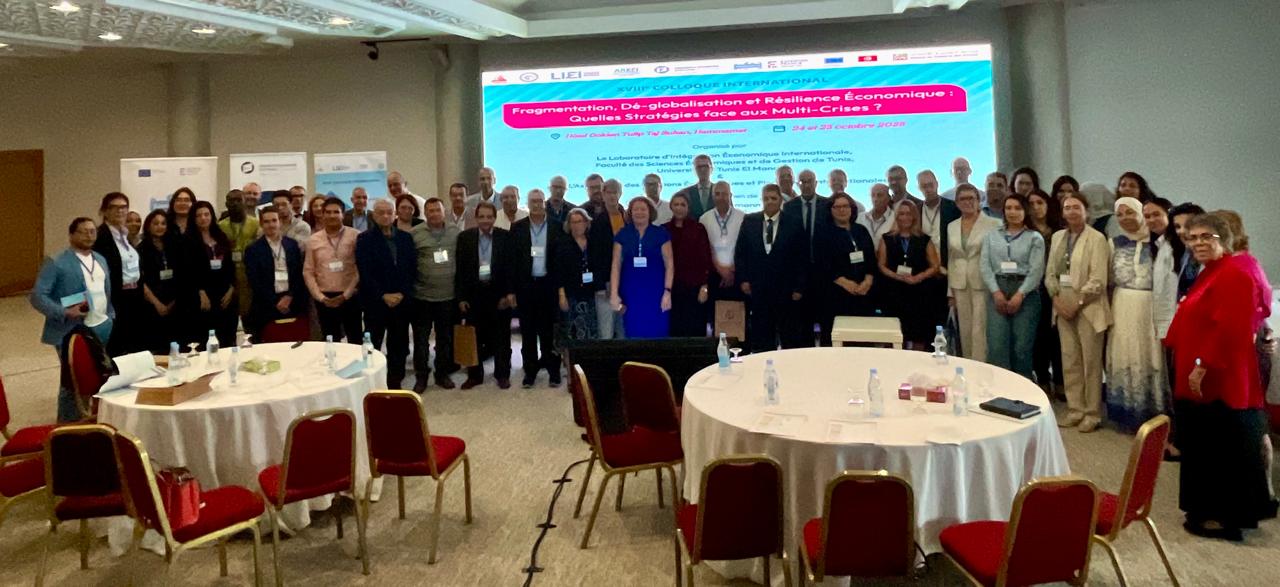
Against a backdrop of global uncertainty and economic fragmentation, the Laboratory of International Economic Integration (LIEI) of the Faculty of Economic Sciences and Management of Tunis (University of Tunis El Manar) convened leading economists, policymakers, and international experts for its annual conference titled “Fragmentation, De-Globalization and Economic Resilience: What Strategies in the Face of Multi-Crises?”
Held in Hammamet, the two-day forum gathered distinguished figures from academia, international organizations, and financial institutions. Supported by the Friedrich Naumann Foundation for Freedom, Savoirs Eco, and the Bank of Tunisia and the Emirates, the event addressed the urgent question of how nations and Tunisia in particular can adapt to the changing dynamics of global trade, finance, and sustainability.
Prominent Voices and High-Level Discussions
The conference featured a series of parallel sessions and plenary debates exploring diverse economic dimensions: from value-chain reconfiguration and monetary policy to green transitions, fiscal sustainability, and digital transformation.
A highlight of the event was the opening session, featuring key speeches by:
- Prof. Fatma Marrakchi Charfi, Director of the LIEI,
- Brigit Lamm, Resident Representative of FNF Tunisia and Libya
- Axel Gastambide, Technical Director of Expertise France,
- Prof. Adel Boubaker, Dean of the Faculty of Economic Sciences and Management of Tunis,
- Prof. Moez Chafra, President of the University of Tunis El Manar,
Their interventions emphasized the importance of academic research and policy dialogue in shaping Tunisia’s economic resilience and global competitiveness.
Major Panels and Key Insights
The first plenary session, chaired by Prof. Salma Zouari (University of Carthage), brought together eminent experts:
- Prof. Jean-Marc Siroën (PSL Paris-Dauphine University) analyzed the challenges of globalization in an era of weakened multilateralism.
- Mr. Ferid Belhaj, former World Bank Vice President and Senior Fellow at the Policy Center for the New South, provided a strategic overview of the “polycrisis” affecting Africa and the Mediterranean.
- Prof. Mongi Safra (University of Tunis El Manar) discussed the prospects of de-globalization for middle-income countries such as Tunisia.
In the high-level roundtable on “Tunisia’s Macroeconomic Perspectives: Stabilization Challenges and Opportunities for a New Development Model,” moderated by Prof. Fatma Marrakchi Charfi, participants included:
- Abderrazak Zouari, former Minister of Regional Development,
- Mongi Safra, academic and senior economic expert,
- Raja Boulabiar, Director General of Forecasting at the Ministry of Economy and Planning,
- Aslan Ben Rejeb, President of CONECT,
- Feryel Chabrak, Director General of the Bank of Tunisia and the Emirates,
- Lodewijk Smets, Senior Economist at the World Bank,
- and Prof. Habib Zitouna (University of Tunis El Manar).
The debate highlighted the pressing need for fiscal reform, enhanced governance, and investment in human capital to restore confidence in Tunisia’s economic trajectory.
An Intellectual Space for Strategic Thinking
Across dozen parallel scientific sessions, Tunisian and international researchers presented studies on energy transition, public debt, sustainable finance, artificial intelligence, migration, climate change, and agriculture.
Experts from universities in France, Morocco, Canada, Spain, and the United Arab Emirates contributed cutting-edge research, reinforcing the colloquium’s role as a regional hub for economic thought and collaboration.
Shaping the Future Through Knowledge
Concluding with a second plenary chaired by Prof. Habib Zitouna, the discussions explored how global upheavals are forcing states to rethink macroeconomic and development policies.
Speakers such as Prof. Isabelle Rabaud (University of Orléans), Prof. Zouheir Bouchaddakh (University of Tunis El Manar), and Prof. Mongi Boughzala (University of Tunis) offered analytical insights on value chain adaptation, monetary autonomy, and regional integration strategies for small economies like Tunisia.
A Platform for Policy Dialogue and Reform
By bridging academic rigor and policy relevance, the 2025 LIEI International Conference reaffirmed Tunisia’s capacity to serve as a laboratory for innovative economic ideas and a platform for reform-oriented dialogue in a rapidly transforming global landscape.