Tanzania
To vote or not to vote?

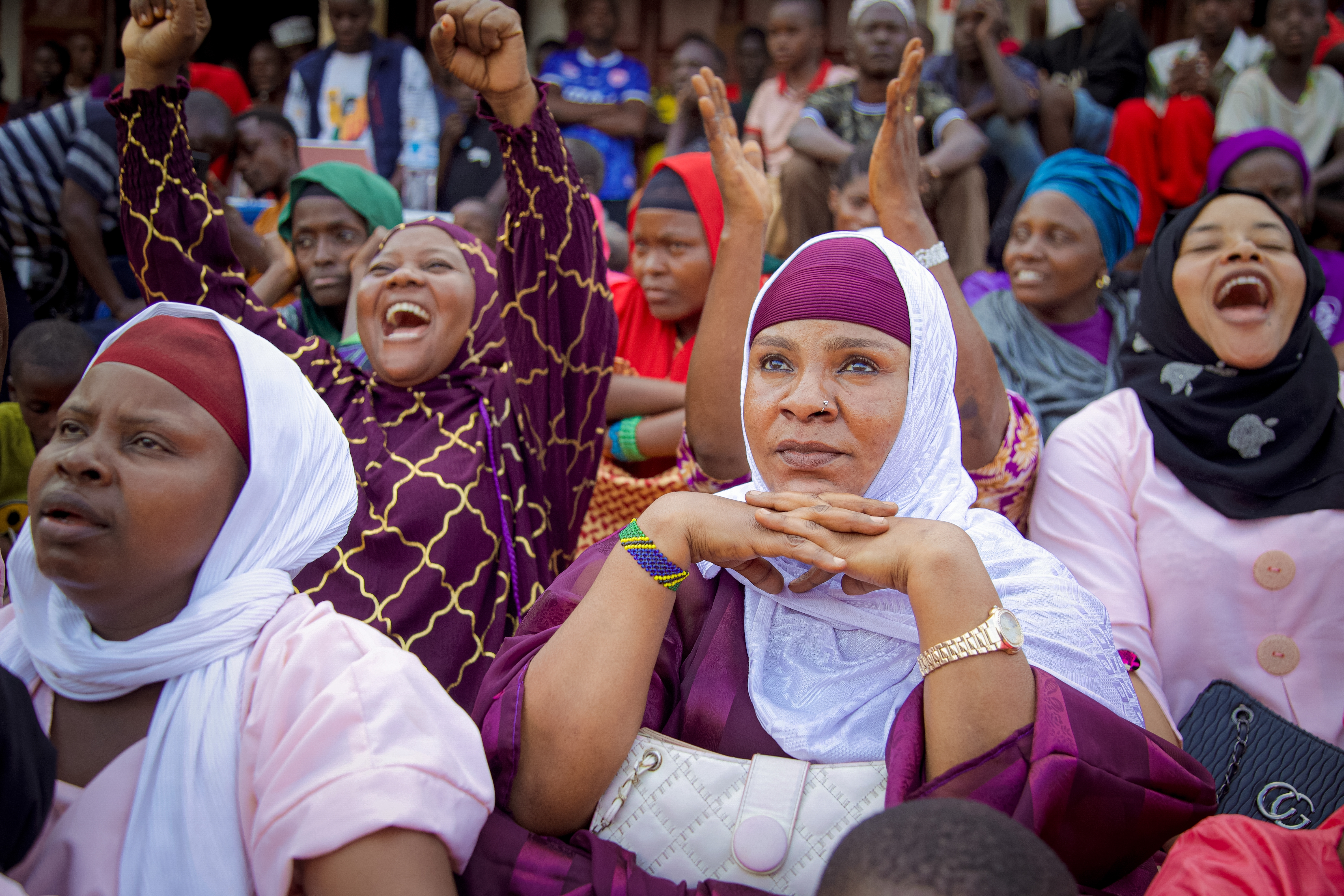
A woman reacts with emotion during ACT Wazalendo party’s political rally in Kigoma, Tanzania, on June 21, 2025
© ShutterstockSitting with my friends, I found myself staring at the ground, listening to people who were usually so certain about their decisions. This time, however, their voices hesitated back and forth. They were not trying to convince each other about political choices, but rather questioning the very point of participating in the coming election.
“Why should I vote?” one asked. “Does my vote even matter?”
These doubts were echoed by others: We are not sure who is reporting the truth. Journalists who attempt to be fair are censored. How do we trust those permitted to cover the news when they only publish one-sided praise?
As Tanzania approaches 29 October 2025, its general election day, the light at the end of the democratic tunnel seems to be dimming for many citizens.
A country on edge
Is Tanzania in a state of emergency?
Growing up, I did not see the Tanzania Police Field Force Unit (FFU) patrolling every major junction, fully armed. People nicknamed them “Fanya Fujo Uone”, loosely translated as cause trouble and you will see what happens. Their presence was sporadic. Today, their frequent visibility signals unease.
On weekends, their deployments have been tied to ongoing legal proceedings against Tundu Lissu, the opposition leader of Chama cha Demokrasia na Maendeleo (CHADEMA). Lissu, who survived an assassination attempt in 2017 and spent years in exile, is now facing a treason trial. Even when no hearings are scheduled, Tanzanians are reminded of his case by the sudden heavy deployment of FFU units across the roads.
Silencing digital spaces
Another blow to public confidence came when Jamii Forums, the country’s largest online discussion platform often described as Tanzania’s equivalent of Reddit, was suspended for 90 days. The official reason: allegedly “misleading the public” and allowing defamatory content against the President to remain online.
Jamii Forums has long been a space where Tanzanians discussed corruption scandals, governance, and daily struggles beyond the limits of state-controlled media. Its suspension has left many feeling voiceless, at a time when freedom of expression is already tightly restricted.
Elections without real choice?
Ordinary Tanzanians are now questioning whether what they see is a genuine election campaign or merely the branding exercise of the ruling party. Posters of the Chama Cha Mapinduzi (CCM) presidential candidate dominate public spaces. CCM, which has ruled Tanzania continuously since independence in 1961, is showcasing its financial power through extravagant spending on campaign materials. In contrast, opposition parties find themselves blocked or disqualified from meaningful participation.
For voters, this creates little interest in the 2025 campaign season. Few meaningful policy agendas are reaching the public. Instead, people see something that looks less like an election and more like a ceremony to confirm the winner.
The CCM’s unchallenged grip
The ruling party is seeking to extend its decades-long dominance in the October 2025 election. President Samia Suluhu Hassan, who took office in 2021 after the sudden death of President John Magufuli, is widely viewed as running an unchallenged race.
The disqualification of the two main opposition parties, CHADEMA and ACT–Wazalendo (Alliance for Change and Transparency), after disputes over electoral procedures and petitions, has left the field heavily tilted in favour of CCM.
This is a stark contrast to the 2020 elections, when opposition parties, despite facing harassment and restrictions, at least participated. Today, with CCM-centric campaigns dominating the political landscape, expectations of another landslide victory are coupled with signs of low voter turnout and growing public apathy.
A fading democratic spark
Tanzania was once considered a relatively stable democracy in East Africa, though one-party dominant. But as space for opposition shrinks, platforms for expression close, and citizens see security forces occupying public life, the democratic spark appears to be fading.
The question that lingers in the minds of many ordinary Tanzanians remains painfully simple: to vote, or not to vote?