Uganda
Implications of the recently passed Protection of Sovereignty Bill

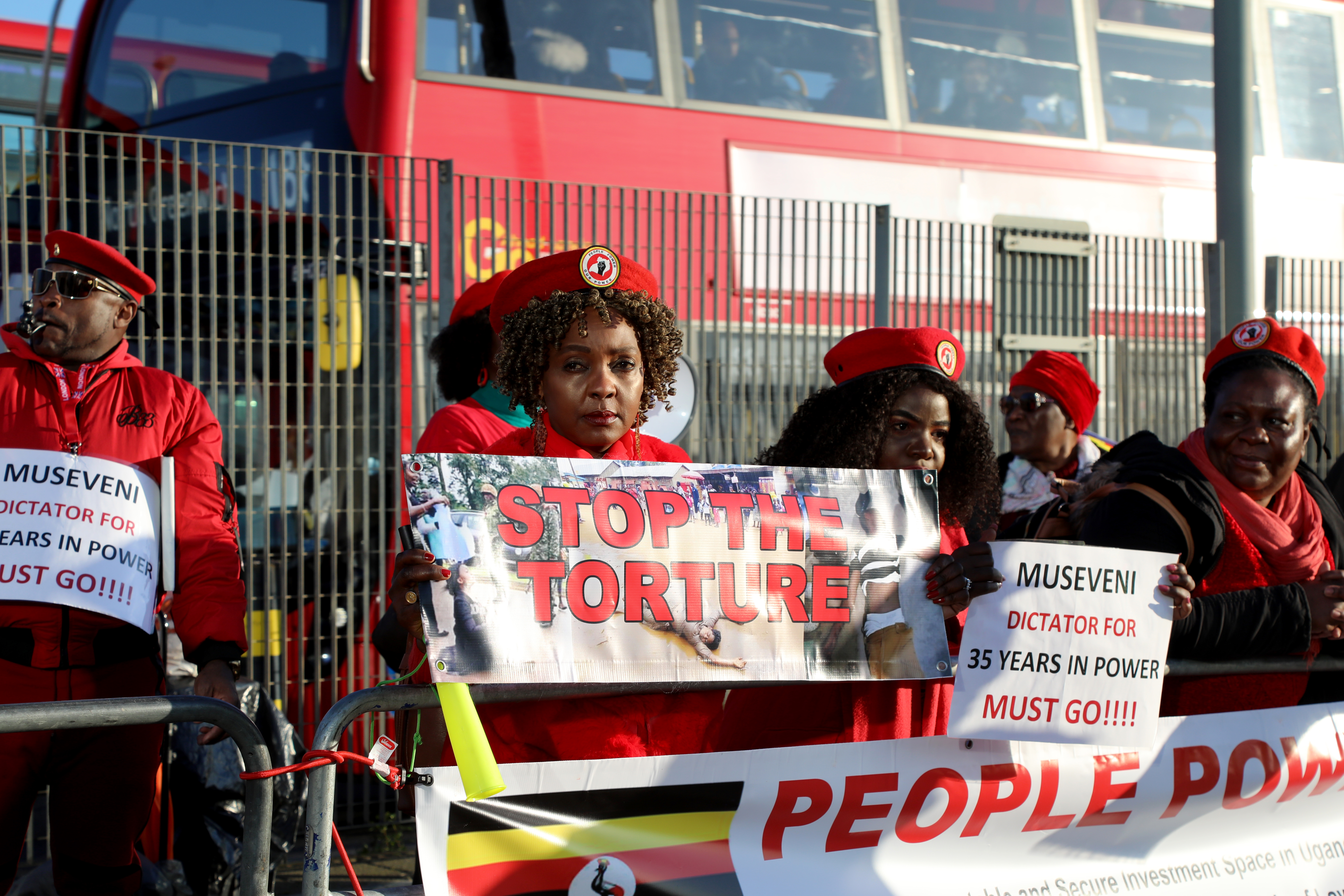
London / UK – January 20, 2020: Opponents of Uganda’s President Yoweri Museveni protest outside the UK Africa Investment Summit in Greenwich, London
© ShutterstockVery reminiscent of the “Big Brother is Watching You” notion, the incumbent Museveni government will use the recently passed Protection of Sovereignty Bill (2026) to silence its critics by claiming it is protecting Uganda from foreign meddling. While the law is officially meant to stop external interference, experts argue that it is a tool to crush local democratic opposition. By cutting off international funding and support for civil society, as well as democracy and governance stakeholders, the government has created a "legal firewall" that protects its own power. Passed on 17 May 2026, the bill introduces harsh punishments, making it nearly impossible for citizens to challenge the regime. This Bill is set to obliterate all milestones gained over the difficult years of upholding the law and keeping the government accountable. Now, the government can operate with impunity, with citizens required to fall in line – or else.
The Protection of Sovereignty Bill makes it a crime to support "foreign interests" over those of Uganda, forbidding anyone with international ties from carrying out policy without government permission. This essentially gives the state total control over political and social initiatives. In many ways, this Bill seeks to isolate the voices of civil society, multipartyism, and citizen participation. The implementation of laws that stifle foreign funding represents a calculated assault on democratic culture, effectively dismantling the foundations of multipartyism to safeguard a dictatorial status quo. This intentional crippling of civic participation transforms the political landscape into a closed circuit, where the absence of public accountability allows power to remain concentrated in the hands of a single leader. Ultimately, these laws function as a strategic tool for autocracy, replacing competitive democracy with a controlled environment where dissent is starved into submission.
What will become of fundamental human rights, civil liberties, and fair democratic participation and representation in Uganda?
Globally, there is a significant Ugandan diaspora community that mobilises dissidents of the incumbent dictatorship of President Yoweri Museveni to call for action to recognise and respect opposition in Uganda. Many of those living in the diaspora have become persona non grata in Uganda due to their political views. What can be said of the political prisoners who are illegally incarcerated? What will be their fate after such a Bill? Freedom of assembly effectively becomes criminal conduct. Not everybody is currently an equal stakeholder in the democracy of Uganda, which is why the advocacy programmes conducted by civil society are critical to the lifeline of an equal playing field.
Furthermore, the International Center for Not-for-Profit Law (ICNL) reports that the Bill prohibits soliciting funds from a foreign source to engage in “disruptive activities.” This vague language provides wide discretion to authorities in arbitrarily enforcing these provisions against disfavoured persons. The Friedrich Naumann Foundation for Freedom has, on past occasions, partnered with Robert Kyagulanyi on a number of programmes that call for a free Uganda. Content from our Freedom Concerts, for example, does not incite violence in any way. What is evident is that this use of language creates a collective approach to “dealing” with those who dare to speak or act against the current regime, criminalising public outcry. Transparency around the funding of programmes by foreign entities is not the issue, the issue is control and monitoring of activities done by institutions whose mandate is to uphold the rule of law.
According to Business Day TV Leader Report, Uganda has been on a strategic path to becoming a premier financial hub in East Africa, a reality proven by the 2025 Absa Africa Financial Markets Index. However, the bill introduces "voluntary shocks" to the economy that could reverse these gains. By prioritising political control, the regime risks a "financial recession" that could extinguish the country's development goals. Global correspondent banks often sever ties with local banks in jurisdictions where political exposure and regulatory fines are high. If Ugandan banks are viewed as "high risk", they may be isolated from global payment systems.
In addressing the Members of the Joint Committee, former Leader of Opposition in Parliament Hon Mr Joel Ssenyonyi vehemently opposed the Bill. He is quoted as saying, “While cloaked in the language of patriotism, a careful legal analysis reveals that this Bill suffers from fatal constitutional defects, including unjustifiable limitations on fundamental rights, dangerous vagueness, and an unconstitutional subversion of the multiparty dispensation. In our current political climate, where state persecution has forced opposition leaders and critics out of the Country, this Bill ceases to be a theoretical threat. It is an immediate, existential danger to political pluralism, economic survival, and Uganda's standing in the global community.”
If allowed to stand, this legislation will transform Uganda into a closed circuit of autocracy where accountability is extinct, fundamental liberties are treated as criminal acts, and the country’s position as an emerging East African financial hub is sacrificed at the altar of regime survival.