DEMOCRACY
We Too Have Voice: The Practice of Deliberative Democracy in Indonesia's Rural Communities

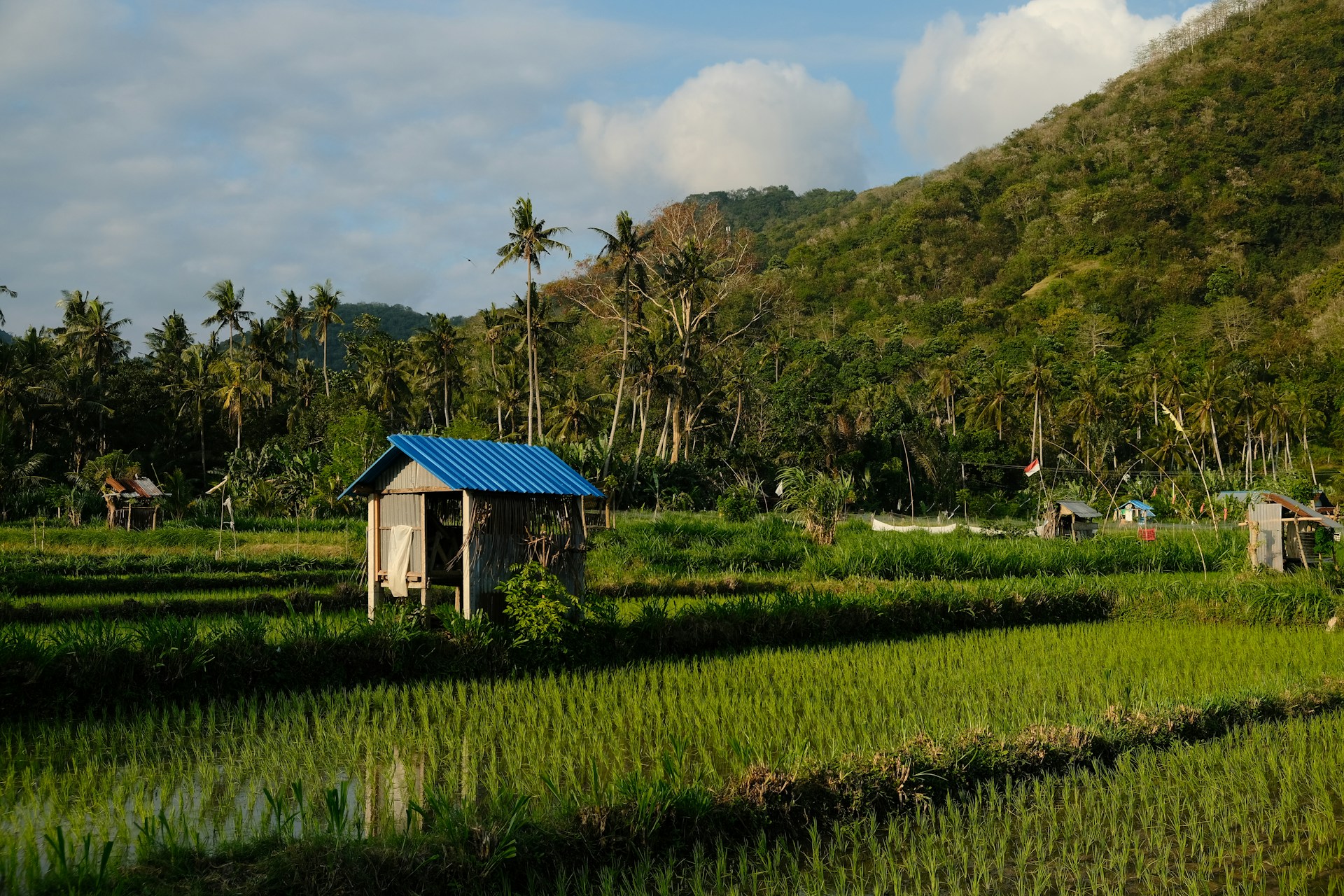
Photo by Matt Johnson on Unsplash (2025)
In mid-December, when many countries across the world experience winter, several people living in rural areas of Indonesia instead reflected on how temperatures had become noticeably warmer than in the past. Just like elsewhere, environmental changes has made communities residing in an equatorial country to experience a growing sense that heat had become hotter and seasonal rhythms increasingly uncertain. For many participants, cooler air was only familiar during nights in the dry season— commonly referred to as bediding in Javanese communities— or during periods of continuous rainfall.
These reflections emerged gradually through conversations among participants during a discussion activity organized by BINA Foundation, facilitated in collaboration with government institutions and supported by FNF, an international organization. The participants themselves came from diverse social backgrounds, including farmers, women farmer groups, local community members, and local government representatives. What initially appeared to be an ordinary community discussion on environmental justice gradually revealed a more substantive social process. Conversations moved fluidly between climate change, agricultural rhythms, household concerns, and daily issues, often without rigid turn-taking or heavily directive moderation.
Interestingly, although the discussion itself was formally organized within a structured institutional agenda concerning democracy and environmental governance, the interaction that unfolded inside the forum did not fully resemble the procedural rigidity often associated with formal democratic deliberation. Participants spoke predominantly in Javanese, responded through personal experiences, occasionally laughed at shared realities, and frequently developed understanding through associative conversation rather than strictly linear debate. Rationality, particularly in the sense of systematic or formalized knowledge, did not always appear in explicit argumentative form. Instead, it became visible through the way participants listened carefully, related experiences across different social backgrounds, and gradually constructed shared interpretations regarding environmental change and everyday uncertainty. In this regard, rationality appeared less as formal debate and more as a socially embedded communicative process, something that Santoso and Tapiheru (2017) similarly identify in contextual interpretations of communicative action within Indonesian social settings.
Reflecting on these experiences, I was recalled of how democracy (as the central agenda of the discussion itself) has long been theorized, particularly within the framework of deliberative democracy. Much of deliberative democratic theory, especially within the Habermasian tradition, emphasizes dialogue, communicative rationality, and the formation of mutual understanding through public reasoning (Habermas, 1984, 1987, 2023). Yet within many local social contexts in Indonesia, elements resembling deliberative practice may already exist as lived social experience long before they are formally conceptualized within academic discourse. The discussion inside the joglo demonstrated how mutual understanding can emerge not only through formal debate or institutional procedure, but also through culturally familiar patterns of interaction grounded in everyday communal life. In many ways, the interaction also reflected a social rhythm closely associated with musyawarah, which, as Lay (2018) notes, functions not merely as a mechanism for producing decisions, but also as a way of maintaining social relations and collectively negotiating shared understanding. Participants did not always speak with the intention of arriving at definitive conclusions. Instead, the conversation unfolded gradually through exchanges of experiences and interpretations, allowing differences in perspective to remain part of the deliberative process itself.
In this sense, democracy may not operate solely as institutional procedure or theoretical abstraction, but also as social know-how embedded within ordinary interaction. The ability to listen, respond, connect experiences, and collectively interpret changing realities appeared to emerge organically throughout the conversation itself. Participants may not necessarily speak in the vocabulary of deliberative democratic theory, yet many of the practices associated with deliberation— communicative engagement, reciprocal listening, perspective-sharing, and collective meaning-making— were visibly present within the interaction. This observation also reinforces the possibility that what academic literature describes as deliberative democracy may, in practice, already exist within everyday communal life long before it is formally named as such (Rum, 2026).
Work Cited
- Habermas, J. (1984). The Theory of Communicative Action (T. McCarthy, Ed.; Corrected, Vol. 1). Beacon Press.
- Habermas, J. (1987). The Theory of Communicative Action (T. McCarthy, Ed.; Corrected, Vol. 2). Beacon Press.
- Habermas, J. (2023). A New Structural Transformation of the Public Sphere and Deliberative Politics (English). Polity Press.
- Lay, C. (2018). Musyawarah. Prisma: Jurnal Pemikiran Sosial Ekonomi, 37(2), 72–85.
- Rum, M. G. (2026). Politik Glenak-Glenik : Piranti Sosial Warga Grojogan dalam Menggeluti Sampah. Universitas Gadjah Mada.
- Santoso, P., & Tapiheru, J. (2017). Contextually-Grounded Democracy: Broadening Pathways for Democratisation. PCD Journal, 5(2), 211. https://doi.org/10.22146/pcd.29006
*Muhammad Gufron Rum is the Executive Director of Yayasan Bentala Indra Nusantara (BINA Foundation) in Jakarta, Indonesia.