Free Markets
The Modernized Comprehensive Agreement between the EU and Mexico: Trade, Strategy, and Geopolitics


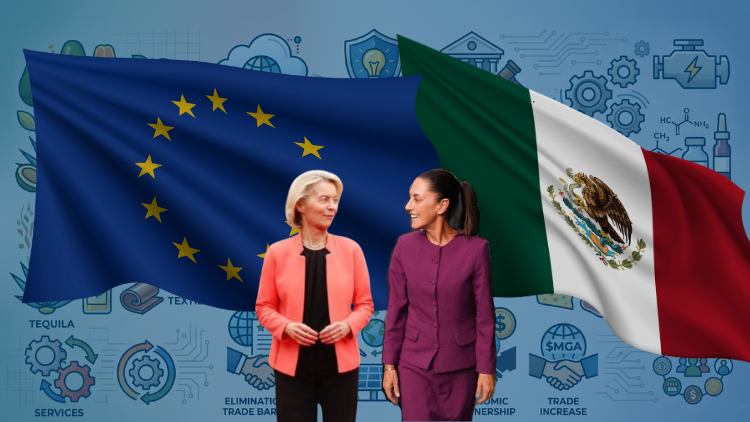
Edited image for ilustration purposes only. European Commission President Ursula von der Leyen and Mexican President Claudia Sheinbaum walking side to side
© FNF LatamThe Modernized Global Agreement (MGA) between the European Union and Mexico represents a comprehensive update to the original EU-Mexico Free Trade Agreement, which has been in force since 2000. During the term of the original agreement, bilateral trade in goods increased by more than 300%, with total trade volume exceeding $94.5 billion in 2025. The modernization of the agreement reflects not only the evolution of global trade but also the profound geopolitical shifts that are reshaping the international order. The agreement was officially signed on May 22 in Mexico City by European Commission President Ursula von der Leyen and Mexican President Claudia Sheinbaum. This underscores the political importance both sides attach to the partnership at a time of growing global economic uncertainty, in which their respective most important partner, the U.S., has also become a disruptive factor: The Trump administration’s erratic and arbitrary tariff policies, which all too often follow political emotions rather than economic rationales, are a massive problem for the export-oriented economies of both Mexico and the EU.
The Mexican Perspective
Mexico is particularly vulnerable to Trump’s tarffs. According to the Mexican news agency La Silla Rota, Mexico faced tariff threats or impositions from the United States eight times in 2025 alone. Donald Trump has repeatedly used tariff threats to pressure Mexico on a wide range of issues, from water distribution agreements to the fentanyl trade. Under Trump, the United States increasingly views Mexico not as a complementary economic partner, but as a competitor for industrial jobs and, above all, as a security problem. Meanwhile, Mexico is extremely dependent on its northern neighbor. According to the Mexican Ministry of Economy, approximately 83% of Mexican exports go to the United States, which puts the country in an extremely precarious position in negotiations with Washington. Mexico and the United States are currently working on the planned review of the United States-Mexico-Canada Agreement (USMCA). According to the Mexican bank BBVA, the review process could lead to three possible outcomes:
- The agreement is terminated.
- The agreement is extended unchanged for another 16 years.
- The agreement remains in force but is subject to annual reviews.
The second scenario would be ideal—and unlikely. The first scenario would be an absolute disaster for Mexico, whose economy has been in a de facto stagnation for six years and whose national budget has spiraled out of control. A slump in exports would lead to a massive crisis. The third scenario is considered manageable, but it would institutionalize uncertainty, as it would allow the U.S. to repeatedly threaten withdrawal or demand concessions—exactly the kind of policy Trump loves.
This is not only a problem for Mexico, but also for the EU. European companies, and German ones in particular, have invested heavily in Mexico as a production hub to supply the North American market from there. These investments are in acute danger due to the uncertain future of the USMCA.
For Mexico, securing stronger trade ties with Europe offers an opportunity to at least somewhat mitigate its economic dependence on the United States and diversify its export markets. In many ways, the MGA comes at a critical juncture for Mexican economic diplomacy.
The European Perspective
Europe, too, finds itself compelled to reassess its relations with the United States. Since his first term in office, Trump has called into question traditional transatlantic alliances and treaties in nearly every area, including trade policy.
As a result, the European Union has intensified its efforts to diversify its own strategic partnerships. The negotiations launched in 2016 to modernize the Global Agreement between the EU and Mexico have therefore become a central component of Europe’s broader economic and geopolitical strategy, opening up new opportunities for sectors such as agricultural and food exports while simultaneously strengthening ties with one of Latin America’s largest economies.
The economic opportunities
The original Global Agreement has already yielded significant economic results. According to the Mexican Institute for Competitiveness (IMCO), trade between Mexico and the European Union has increased fivefold since the agreement entered into force in 2000. Trade between Mexico and Germany alone reached a volume of $24 billion in 2024.
The MGA is expected to further deepen this relationship, with some estimates projecting an increase in bilateral trade of up to 35%.
Germany has become one of Mexico’s most important strategic economic partners. Between 2015 and 2024, German investment in Mexico totaled approximately $24.4 billion, accounting for 7.1% of total foreign direct investment during that period. A large portion of this investment was concentrated in high-value-added sectors such as the automotive and chemical industries.
Major German companies operating in Mexico include Volkswagen, BMW, Mercedes-Benz, Bayer, Bosch, Continental AG, KHS GmbH, and INEOS Styrolution. Notable projects include the $1.3 billion Audi plant in Puebla, which began operations in 2016, and the $1.5 billion BMW plant in San Luis Potosí, which was inaugurated in 2019. In 2024 alone, German companies invested approximately $3.8 billion in Mexico.
The European Commission has also highlighted the benefits the MGA could bring to European agricultural exporters. The agreement would eliminate approximately 95% of Mexican tariffs on agricultural and food products while protecting 568 European geographical indications, including iconic products such as Champagne and Gouda cheese.
The Key Benefits of the MGA
The modernized agreement offers a wide range of benefits to both sides:
1. Removal of trade barriers
The MGA aims to significantly reduce or completely eliminate tariffs and non-tariff barriers to trade in goods and services. It also simplifies customs procedures, reduces administrative costs, and speeds up the movement of goods.
2. Liberalization of services and investment
The agreement expands market access for services and creates a more transparent and predictable legal framework for investment. It also introduces mechanisms to resolve disputes between investors and states in a more impartial manner.
3. Support for small and medium-sized enterprises (SMEs)
Special SME helpdesks and publicly accessible information platforms will help smaller businesses better navigate customs, taxes, and customs procedures.
4. Promotion of digital trade
The MGA prohibits tariffs on electronic transmissions and recognizes the legal validity of electronic contracts and authentication systems. It also strengthens consumer protection in digital trade.
5. Open public procurement
Both parties commit to mutually opening their public procurement markets and ensuring equal treatment of suppliers and service providers.
6. Sustainable development and climate protection
The agreement includes commitments to implement the Paris Climate Agreement and to promote environmentally sustainable economic growth.
7. Gender Equality
The MGA explicitly recognizes the importance of an inclusive trade policy and aims to strengthen women’s economic participation through international trade.
8. Intellectual Property and Innovation
Stronger protection of intellectual property rights aims to promote innovation while taking public interests into account.
9. Animal Welfare and Public Health
The agreement establishes a framework for cooperation on animal welfare standards and the fight against antibiotic resistance.
Ratification and Political Outlook
The agreement will be implemented in two phases. First, an Interim Trade Agreement (iTA) will enter into force, covering areas that fall under the exclusive competence of the EU. The more comprehensive MGA will only enter into full force after ratification by all EU member states and Mexico.
Despite the protracted process that such ratifications often entail, there is reason for optimism. Óscar Ocampo, Director of Economic Development at IMCO, argues that the complementarity of the Mexican and European economies alleviates many of the concerns associated with other trade agreements, such as the EU-Mercosur negotiations.
As Ocampo noted in a commentary for Deutsche Welle: “There is no fear of competition as with Mercosur, since Mexico does not export meat or grains that compete directly with Europe, but rather fruits and vegetables.”
Conclusion
The modernized global agreement between Mexico and the European Union is more than a trade agreement. It is a strategic response to an increasingly fragmented and uncertain international environment. For Mexico, it offers an opportunity to diversify economic partnerships and reduce excessive dependence on the United States. For Europe, it represents an opportunity to strengthen ties with a reliable partner at a time when transatlantic relations have become less predictable.
At a time when protectionism and geopolitical rivalries are reshaping global trade, the MGA signals that both Mexico and the European Union continue to view openness, cooperation, and economic integration as essential pillars for long-term stability and growth.
*If you would like to explore the opportunities presented by the MGA in more detail, our partner IMCO has published a comprehensive analysis, which is available here.