Cultural policy
The solitary artist confronted with a fragile structure

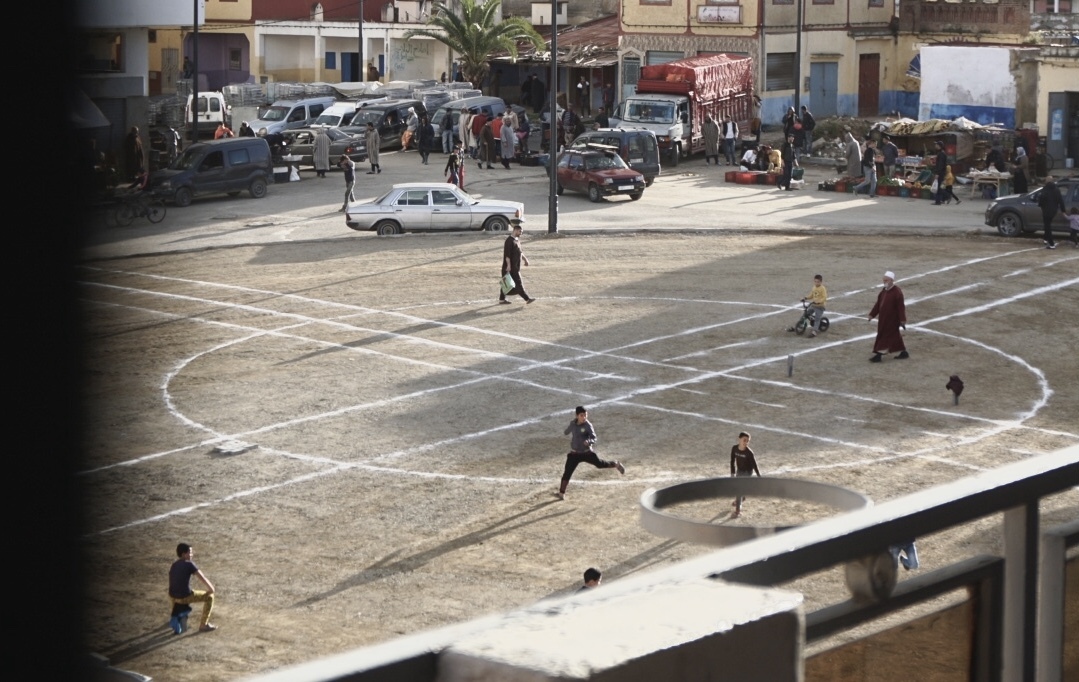
The photo was taken in 2020 during the renovation works of Independence Square in the village he belongs to. The lines seemed very similar to the diagrams prepared by Pierre Bourdieu to represent the social space in a given society or field. The children within this diagram are living fields, like social life itself.
“The art world in Morocco is not structured”
The first sentence I wrote is both correct and true. This is what I discovered through my modest but significant professional experiences, and especially through a study conducted as part of my final thesis in sociology at Mohammed V University in 2024, entitled "Cultural policies in Morocco: the field of plastic and visual arts." These findings were also informed by my collaborations with various institutions in the arts sector.
I share with you in this article a small part of the results of my field research.
A fragile artistic structure
In my research, I found that the essential references in the sociology of art, such as Pierre Bourdieu, Nathalie Heinich and Raymonde Moulin, only provide a partial understanding of the Moroccan case. I found that Bourdieu’s writings on art were closer to reality and suitable for analysis (even though many contemporary sociologists agree that his social theory is outdated today). Therefore, I used Pierre Bourdieu’s concepts to understand the artistic structure, attempt to deconstruct the fields, and uncover and comprehend the power relations within the artistic field.
Indeed, the artistic structure in Morocco has its own specific characteristics. One of the most striking is the fact that the history of painting and most of the arts only really took hold there during the colonial period. I am not referring here to art in its anthropological dimension, but rather as a practice belonging to an autonomous and institutionalised field.
Galleries, museums, art critics and all those involved in production and reception constitute the structure of the artistic field, whether Moroccan or international. However, despite a rich artistic past, this structure remains fragile, marked by clientelism and monopoly. As a result, the market remains dominated by a few major artists and historical works whose creators are now deceased.
This fragility leads many young graduate artists to depend mainly on the support of foreign institutions, such as the Institut français, the Friedrich Naumann Foundation or the Heinrich Böll Foundation, but also on specialised Moroccan organisations such as the Hiba Foundation. As for support from the relevant ministry, it remains limited: in 2024, the budget allocated to culture did not exceed 1,1% (2025 Finance Bill (PLF 2025) of the overall state budget. Of the 40 artists who responded to my research questionnaire, 83% (all generations combined) said they were dissatisfied with cultural policies in the field of plastic and visual arts in Morocco.
The artist as a stranger in their own field
Furthermore, 76% of established artists surveyed said they regularly exhibit in the same gallery, often because of friendly ties with its owner. This lack of transparency in the selection of exhibitors considerably limits access for young creators. Major galleries impose unfavourable contracts, which artists nevertheless accept in order to gain experience and progress in the field.
Many participants also noted the profound differences between the treatment offered by foreign institutions and that of Moroccan institutions in terms of support, exhibitions and artist residencies. Problems communicating with the Department of Culture were mentioned repeatedly: no response to emails, silence on the phone. Several graduates of the National Institute of Fine Arts in Tetouan emphasised that the Ministry should automatically issue them with an artist's card at the end of their training. Their exclusion from this scheme often deprives them of residencies or exhibitions abroad, whereas this document would make it easier for them to obtain a visa.
A forced path to exile
Faced with these obstacles, many Moroccan artists choose to continue their studies at European universities or art institutions. As I pointed out in my title, "the artist is a loner": left to their own devices after their studies, they find themselves faced with cultural policies that do not allow them to make a living from their art. They are forced to face their fate, despite the considerable growth of the cultural industries.
Today, art students are increasingly turning to contemporary art, and are attempting to break into the global market thanks to a few institutional initiatives that are beginning to emerge. However, these efforts remain limited in a context of government austerity that affects culture as much as education and other vital sectors.
To read the article in its original version (in French), visit LODJ.ma