Youth & Politics
Betweeen hope and distance – Morocco's youth and their role in politics

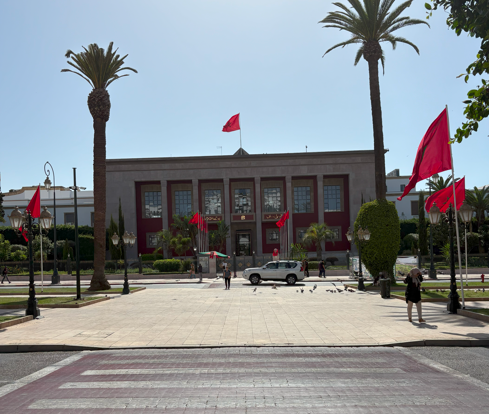
The Moroccan Parliament, decorated with flags in honor of the ‘Festival of Youth’ @Kaan Gümüs.
There is still about a year to go until the next parliamentary elections in Morocco in September 2026. Moroccans will once again have the opportunity to determine the future of their country – and who will govern it when the World Cup takes place in the North African kingdom in 2030. Morocco wants to use this unique opportunity to present itself as a modern and inclusive country. However, this can only succeed if the youth are on board: more than half of the Moroccan population is under 30 years old. This makes Morocco one of the younger countries in terms of population, especially when compared to Germany, where the average age in 2023 was 44.6 years. Morocco's youth is its greatest asset – and its greatest challenge. It is a promise of progress that can only be fulfilled if young voices are not only heard, but also want to be heard.
Political apathy in Morocco
In the last parliamentary elections in 2021, voter turnout was around 50%. However, this 50% does not refer to the adult population eligible to vote, as in Germany, but to those who had already actively registered to vote in advance. This means that the proportion of active voters is actually lower. In 2021, only about 8.75 million people voted. This corresponds to just over a third of the adult population. Furthermore, only 33.6% of all 18-24 year olds registered to vote, less than in any other age group. The older the age group, the higher the proportion of people registered to vote. Among the over-60s, the figure is as high as 94.4%. It can therefore be assumed that it is the young population in particular that does not vote. But low voter turnout is not the only problem. Morocco also has to contend with high youth unemployment (36.7%). This is a catalyst for young people's disillusionment with politics, as working and earning money is more important than participating in politics. This is also one of the reasons why more than half of all 18-29 year olds are considering emigrating from Morocco. This is problematic for many reasons, as young people are often better educated than older people. As a result, Morocco is losing skilled workers with high potential on whom the kingdom depends. Furthermore, it is not conducive to the image of a host country for the World Cup when its own youth prefer to emigrate abroad. Three major challenges can therefore be identified with regard to the political participation of young people: low voter turnout, high unemployment, and a high willingness to emigrate.
Why young people in Morocco do not vote
One reason for this could be the bureaucratic effort involved in voter registration, because in Morocco, unlike in Germany, you cannot simply go to the polling station with your ID and voting card. In order to vote in Morocco, you must register several weeks before the election during a specific period. Only then you are listed in the electoral register and allowed to participate in elections. In addition, many young people lack trust in politicians and public institutions. A report on the civic participation of young people in Morocco shows that 70% of young people do not trust elected public institutions and parties. “(...) This mistrust is expressed not through confrontation, but rather through quiet withdrawal.” Conversations with young people conducted for the research of this article confirm this statistical survey. A 29-year-old man from Tiznit (near Agadir) believes that young people would know “(...) how corrupt the whole system and the politicians are.” He goes on to say: "The Moroccan youth doesn't care about politics at all because they know that nothing will change anyway. That's exactly why we don't vote.“ A 20-year-old man from Tangier expresses a similar view, claiming that ”(...) politicians are only interested in their own interests and have no connection to reality."
So, are young Moroccans completely uninterested in politics and unmotivated to express their opinions in any way? A 25-year-old from Nador confirms that he hardly ever follows Moroccan politics, but does follow international politics and exchanges views on social media. YouTube plays an important role in this, as he watches talk shows on political topics there. However, he also admits that he does not vote because, in her view, “(...) it makes no difference because Morocco is a monarchy.”
Morocco is indeed a monarchy, but a constitutional one. The head of state is King Mohammed VI, who has been in office since 1999. However, his power is not absolute, but limited by the constitution in its current version from 2011. There is also an elected parliament with a lively party landscape (including three liberal parties) and a head of government elected by parliament. The king, who is also the spiritual leader of the country (Amir al mu'minin, commander of the faithful), sets the guidelines for policy in important speeches. Among other things, he is also the initiator of the ongoing modernization of family law. In particularly important matters, such as foreign policy, he sometimes directs the fortunes of his country himself. He enjoys enormous trust and respect among the population, which is why some potential young voters may not even consider it necessary to vote. However, they may underestimate the power wielded by parliament and the parties they (do not) elect. They are also often unaware of the additional scope for action offered by their own constitution.
For example, Morocco has a ministry that deals with youth issues. Furthermore, since 2011, it has been possible to submit petitions (Art. 15). Citizens' initiatives are also possible (Art. 14). The constitution also allows municipalities to establish youth councils (Art. 170). For example, with the support of NGOs, there has been a youth council in Agadir since 2010. But if there are so many opportunities, why aren't young people getting more involved?
In addition to the reasons mentioned above, it could be that they are not sufficiently informed about opportunities for participation. This task would fall to families, schools, and political parties. There is also a huge difference between urban and rural areas, as rural regions often lack the necessary infrastructure to establish a youth council, for example. In this context, people sometimes speak disparagingly of a “useful” and “useless Morocco.” The prospects for self-fulfillment and political participation for a young person from a small town such as Beni Mellal are different from those for a young person in Casablanca.
Political parties and their representatives are often perceived by the general population as ineffective and elitist, i.e., out of touch. This is also reflected in the above-mentioned report, which shows that young people in Morocco do not feel involved in decision-making processes, but rather as “(...) a target group that needs to be sensitized.” This means that they do not feel taken seriously by Moroccan politicians and institutions, as if they first had to be educated to vote and participate in politics, even though according to the constitution, it is the task of public institutions to actively involve young people in political processes.
How young Moroccans show their interest in political issues
Young people in Morocco are therefore disillusioned with politics. However, they do show a general interest in political issues. They are creating new spaces in which they can exchange ideas. An important example of this are civic associations and non-governmental organizations (NGOs), in which many politically active young people are involved. Well-known examples are the AMDH (Association Marocaine des Droits Humains), which campaigns for human rights, and ADFM (Association Démocratique des Femmes du Maroc), an NGO that is primarily committed to women's rights. It engages in strategic lobbying and has even been able to bring about political change. Together with other NGOs, it has contributed to the amendment and abolition in 2014 of the criminal law article that allowed rapists to avoid punishment by marrying their victims. These and other successes presumably explain why trust in associations is so much greater: 70% of all Moroccans trust civic society institutions, while 70% of young people do not trust public institutions. Another example of political participation is social media. Moroccan media outlets are increasingly publishing their content on Instagram and other social media platforms, where young people then take a very firm stance in the comments and also criticize authorities and politicians. For example, one Instagram page posts about politically relevant events, specifically for the city of Tangier. In one post, commenters call on city officials to finally deal with the trash lying around on some of the city's streets. But even on political issues of greater geographical and political significance, solutions are eagerly discussed.
This shows that the embers beneath the ashes of the Arab Spring have not yet been extinguished and that young people in Morocco still have the motivation to get involved. The 2030 World Cup is a unique opportunity to present itself on the international stage as a modern and inclusive country. It is questionable whether the kingdom can use this opportunity to give young people a voice and involve them in political decision-making processes. However, it is also up to young people themselves to overcome their distrust of politics. They must get involved and show the state and the parties that they want to get involved if they want to be taken seriously. It remains to be seen whether and to what extent Morocco and its youth will master this challenge in the context of the World Cup and beyond.