Ibn Khaldun - Policy Brief
From Centralization to Inclusion:
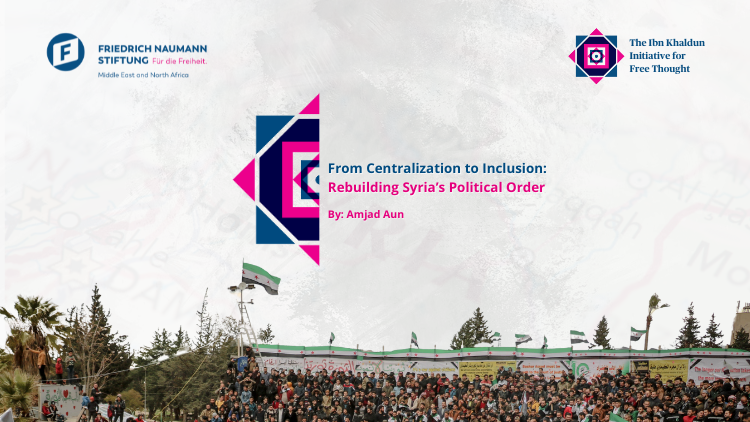
A Policy Brief on Federalism and Institutional Reform in Post-War Syria by Amjad Aun
For more than five decades, Syria’s political and economic trajectory was shaped by a deeply centralized system under the Ba’ath regime. The concentration of power in Damascus marginalized entire regions and communities, entrenched inequality, and created an elite class whose wealth was tied to loyalty rather than productivity. This overcentralization not only fostered corruption and economic stagnation but also alienated vast segments of Syrian society—laying the groundwork for the 2011 uprising and the devastating civil war that followed.
Today, as Syria emerges from years of conflict, it faces the monumental challenge of rebuilding its state, economy, and social fabric. Yet the legacy of mistrust, fragmented governance, and weakened institutions continues to obstruct progress. The collapse of informal trust-based systems and the failure of formal legal structures have left Syrians without reliable mechanisms for cooperation, justice, or economic recovery.
Against this backdrop, federalism emerges as a viable and necessary framework for rebuilding a sustainable political order—one that distributes power, restores inclusion, and fosters local ownership. This policy brief explores how a cooperative federal model could transform Syria’s governance structure by embedding three pillars of long-term stability: inclusion, ownership, and cooperation.
Drawing comparisons with international cases such as Belgium, the paper argues that federalism—when designed as a shared-power arrangement rather than a step toward partition—can reconcile Syria’s ethnic, sectarian, and regional diversity. It offers a roadmap for implementing federal reforms through regional deliberations, national negotiations, and transparent feedback mechanisms under UN facilitation.
The proposed model envisions a bottom-up process in which every Syrian region contributes to defining its governance priorities while preserving the unity of the state. By establishing local autonomy over education, taxation, and resource management, and maintaining central oversight in defense and foreign affairs, Syria could transition toward a system that reflects both its complex reality and its aspirations for peace and stability.
Ultimately, the brief calls for a reimagining of the Syrian state—from one rooted in control to one grounded in cooperation. Federalism, in this vision, is not simply an administrative reform; it is the foundation for rebuilding trust, empowering communities, and preventing the reemergence of authoritarianism.
Read the full policy brief:
From Centralization to Inclusion: Rebuilding Syria’s Political Order