When a Euro Meets a Dinar
What Prices Reveal About Freedom and Everyday Life

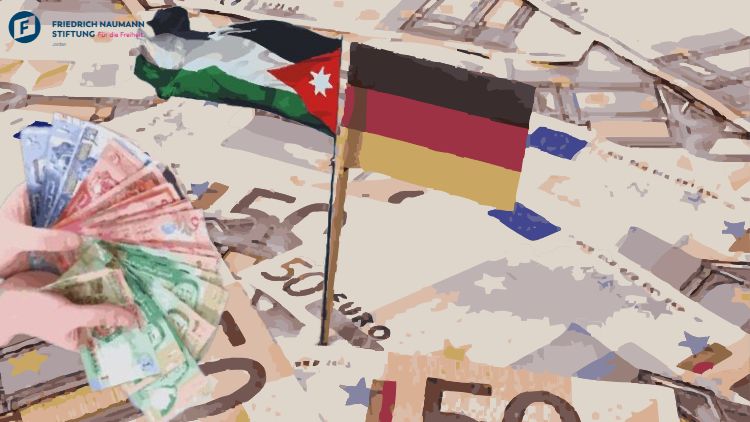
When we talk about prices, we often mean bills, budgets, and bargains. But prices also tell a deeper story — one about how societies manage freedom, responsibility, and fairness. Whether in Berlin or Amman, every price tag reflects a set of choices: how much governments tax, how open markets are, and how citizens are empowered to decide for themselves.
Looking at Germany and Jordan side by side reveals how different economic systems shape everyday life — and yet, how both face similar challenges: keeping living costs fair, maintaining stability, and ensuring that competition benefits the consumer.
Shared Challenges in Different Economies
At first glance, the two economies couldn’t be more different. Germany, one of Europe’s largest economies, is defined by industrial scale, high wages, and dense regulation. Jordan, a small, open market in the Middle East, relies heavily on imports and has a younger, more cost-sensitive population.
Yet in 2025, both countries share one success: price stability. Germany’s inflation rate hovered around 2.4% in September 2025 — close to the European Central Bank’s goal — while Jordan maintained an inflation rate of about 1.9% in the same period, according to the Central Bank of Jordan. After years of global price turbulence, both economies have achieved something precious: predictability.
For citizens in both places, this matters more than it may seem. Stable prices mean stable plans — for families, businesses, and governments alike. It allows people to think about tomorrow not as a worry, but as a possibility.
The Hidden Story Behind Taxes and Prices
When consumers compare prices abroad, they often notice how much cheaper or more expensive a product seems — but rarely how much of that difference comes from taxes.
Germany’s value-added tax (VAT) stands at 19%, with a reduced rate of 7% on essentials such as food, local transport, and books. This system keeps basic goods relatively affordable while generating revenue for public services. Jordan applies a 16% general sales tax, along with selective excise taxes on items like fuel and tobacco.
For German readers, Jordan’s tax system may appear simpler but more regressive, as indirect taxes form a larger share of total revenue. For Jordanian readers, Germany’s complex yet transparent tax design illustrates how predictable rules can enhance both fairness and efficiency.
In both countries, taxes are not merely fiscal tools — they are expressions of how governments balance individual freedom and collective responsibility.
Fuel: A Common Pressure Point
No commodity links the two countries more clearly than fuel — and no price captures public sentiment more directly.
In October 2025, Jordan’s government set the price of 95-octane gasoline at JOD 1.08 per litre, while 90-octane stood at JOD 0.855. In Germany, petrol averaged around €1.66 per litre. The difference reflects not only market size and import dependence but also contrasting policy priorities: environmental taxation in Germany and energy affordability in Jordan.
Yet affordability is relative. A German earning the minimum wage of €12.82 per hour can fill a 40-litre tank after roughly five hours of work. A Jordanian earning JOD 290 per month would spend several days’ wages to do the same. In this sense, lower nominal prices do not necessarily translate into higher purchasing power.
Both societies face the same question in different forms: how to make essential goods affordable without distorting the market or harming long-term sustainability.
Lessons from Each Side
The comparison offers valuable lessons in both directions.
For Jordan, Germany’s example underscores the importance of regulatory stability and transparent taxation. When tax rates and fuel pricing follow clear, predictable rules, investors gain confidence and citizens trust that prices reflect real costs, not sudden policy shifts.
For Germany, Jordan’s experience highlights how smaller, import-dependent economies must remain agile and fiscally cautious — adapting to global shocks with limited resources while maintaining stability at home.
Both can learn from one another. Germany’s energy transition offers insights into long-term planning and diversification, while Jordan’s adaptive fiscal management under pressure demonstrates how efficiency and discipline can support resilience.
The Liberal Perspective: Fair Prices Through Free Markets
In liberal economies, prices are more than numbers — they express how openly markets function and how responsibly governments intervene. When regulation is predictable and support is targeted, citizens can plan, compete, and prosper on their own terms.
When competition is fair, taxation is transparent, and social support is designed to reach those who need it most, people are empowered to make informed choices and take responsibility for them.
Economic freedom is not about making everything cheap; it is about making everything fair. In a liberal economy, prices are not controlled — they are trusted. They reflect effort, value, and innovation, not privilege or opacity.
Germany and Jordan show that while their systems differ, the principles of freedom in the marketplace remain the same: openness, accountability, and respect for individual initiative.
Beyond Numbers
Behind the statistics lies a shared reality: families trying to balance their expenses, entrepreneurs calculating risks, young people saving for the future. Whether the currency is a euro or a dinar, the pursuit is the same — stability, opportunity, and dignity.
By learning from one another’s systems, both countries can move closer to markets that empower citizens instead of burdening them, and governments that guide rather than control.
Because in the end, every price — from a loaf of bread in Berlin to a litre of petrol in Amman — signals the extent to which freedom and fairness guide a nation’s economy.
Sources:
- Federal Statistical Office of Germany (Destatis) – Consumer Price Index (September 2025).
- European Central Bank (ECB) – Inflation outlook, 2025 monetary policy updates.
- Central Bank of Jordan (CBJ) – Main Economic Indicators, Inflation and Fuel Price Data (2025).
- Jordan Department of Statistics (DOS) – Consumer Price Index Reports, 2025.
- German Federal Ministry of Finance (BMF) – VAT structure and policy documentation (standard 19%, reduced 7%).
- Jordan Ministry of Energy and Mineral Resources – Monthly fuel price announcements (October 2025).
- German Minimum Wage Commission – Minimum wage adjustment (January 2025).
- Jordan Ministry of Labour – Minimum wage announcement (January 2025).