Scorched Earth, Shared Futures
What Jordan’s Heatwave Tells Us About Resilience and Freedom

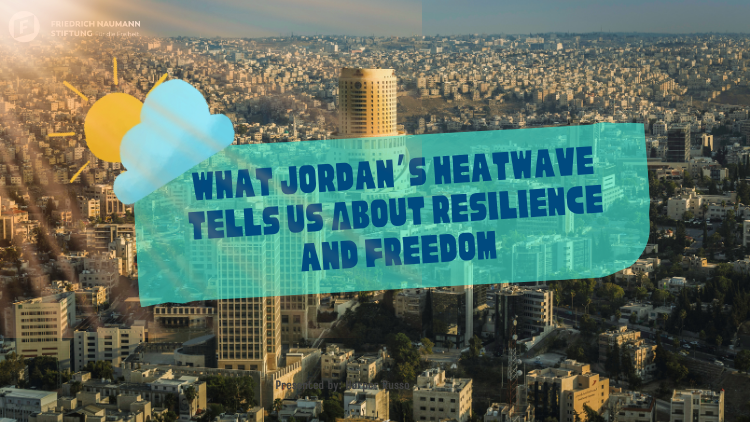
It’s mid-August in Amman, and the city is under a punishing sun. Side walks glow, rooftops ripple with heat, and community rhythms shift imperceptibly—late evening conversations, morning chores, afternoon stillness. In places like shaded shops and shared courtyards, the phrase “the heat is unbearable” threads every conversation, marking the city's adaptive pulse.
This heatwave isn’t just discomfort—it reveals how environmental stress constricts basic freedoms: comfort, productivity, and well-being. Yet, amidst the challenge, there are signs of resilience, creativity, and collective care.
Rising Temperatures—and Rising Stakes
Jordan is facing a severe water crisis. The country sees less than 100 m³ of renewable water per person annually, well below the 500 m³ threshold for absolute scarcity (UNICEF Jordan, Fanack Water). Experts project per-person renewable water could drop to 61 m³, and possibly 35 m³ by 2040, as climate change intensifies (UN Water SDG6 Country Study: Jordan).
Around half of municipal water is lost to leakage or unauthorized use, reducing supply to homes during peak demand months (World Bank, Trade.gov). In some neighborhoods, residents rely on just 36 hours of water per week—a stark indicator of how scarcity limits daily life (Alliance for Water Resilience).
Tradition Meets Innovation
When modern systems stretch thin, tradition offers surprising solutions. Windcatchers, ancient architectural features, can lower indoor temperatures by 8–12°C through passive cooling—no energy required (The Guardian). Recent studies indicate optimized windcatcher designs—especially hybrid models combining evaporative cooling and solar ventilation—offer efficiency gains in urban contexts (MDPI, MDPI review).
Modern Solutions for a Hotter Future
Jordan’s response includes both infrastructure and innovation. A national strategy is underway to reduce non-revenue water (leakage/theft) from ~50% to 25% by 2040, targeting better service for an estimated 1.6 million residents, particularly in refugee-hosting areas (World Bank).
In parallel, a landmark Red Sea–Dead Sea Pipeline Project aims to inject desalinated water from Aqaba through a conveyance network to Amman—offering a large-scale climate-adaptive solution (Water supply and sanitation in Jordan).
Why It Matters to FNF—and to Freedom
Freedom is more than a principle—it is a lived reality. It means being able to access clean water, find relief from the heat, and continue working or studying even in extreme conditions. These are not luxuries; they are the basic elements of a life lived with dignity.
At the Friedrich Naumann Foundation for Freedom, we promote this broader understanding of freedom—one that thrives on adaptability, shared responsibility, and community-driven action. By connecting urban planners, youth, and local leaders, we work to ensure that climate and resource planning is fair, inclusive, and responsive to the needs of all.
Beyond the Heatwave
Jordan’s current heatwave is more than a weather headline—it is a call to recognize the intersection of environment, infrastructure, and freedom. When communities revive passive cooling traditions, employ conservation strategies, or advocate for equitable resource access, they are exercising resilience—freely, purposefully, and collaboratively.
After all, when the climate becomes a shared challenge, resilience becomes a democratic responsibility—and a powerful form of freedom.