Free Youth Course 4
Tackling Hate Speech and Misinformation

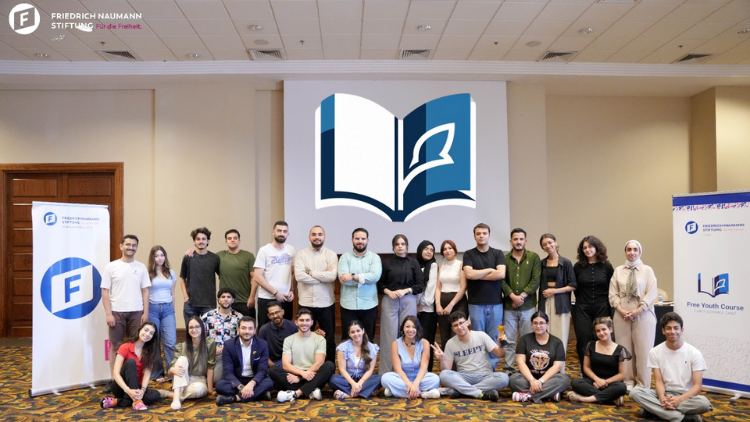
The Friedrich Naumann Foundation for Freedom (FNF) Jordan successfully concluded the fourth edition of the Free Youth Course from 14 to 16 August 2025 at the Hilton Dead Sea. Over three days, young participants from across Jordan came together to address one of today’s most pressing challenges: the spread of hate speech and misinformation.
The program combined interactive lectures, simulations, and group discussions, equipping participants with both theoretical understanding and practical skills to counter manipulative rhetoric. By doing so, the course contributed to FNF’s broader mission of empowering youth to defend liberal values, strengthen democratic dialogue, and foster a resilient civic culture in Jordan.
Day One – Foundations of Understanding
The opening day laid the groundwork by exploring the definitions, forms, and social implications of misinformation and hate speech. Participants began with an engaging ice-breaking exercise that connected misinformation to familiar, everyday experiences, highlighting how easily false or misleading content circulates in society.
This was followed by an interactive session distinguishing between misinformation (false information shared without harmful intent) and disinformation (false information shared deliberately to mislead). The discussions encouraged participants to reflect on how these forms of manipulated content influence trust, decision-making, and public debate.
The day concluded with a deeper exploration of hate speech, framed through a human rights perspective. Using the International Covenant on Civil and Political Rights as a reference point, participants considered the difficult balance between protecting free expression and preventing speech that incites discrimination or violence.

Day Two – Legal Frameworks and Practical Exercises
Building on the first day’s conceptual foundations, the second day introduced participants to key international principles and legal frameworks. Central to this exploration were the Rabat Plan of Action and the Camden Principles, both of which provide guidance on distinguishing between legitimate expression and prohibited hate speech under international human rights law.
Participants worked in groups to apply the six Rabat indicators to practical case studies. These exercises helped them assess intent, content, context, and potential harm in real-life scenarios, sharpening their ability to critically analyze whether a statement should be categorized as hate speech.
The day also included group discussions assessing the broader impact of misinformation on societies—socially, politically, and economically. By comparing hate speech and misinformation through concrete examples, participants developed a clearer understanding of how the two phenomena differ yet often intersect in shaping public discourse.

Day Three – Applied Media Literacy
The final day shifted the focus from frameworks to practice. Participants engaged in hands-on media literacy exercises designed to simulate the challenges faced by journalists and media consumers.
Through the “Fact or Fake” activity, they practiced verifying news stories and identifying red flags in misleading content. Newsroom simulations placed participants under time pressure, forcing them to balance speed with accuracy when processing information—a reflection of real-world media environments.
In addition, participants analyzed actual social media posts to detect disinformation strategies and instances of hate speech. These activities provided a tangible understanding of how manipulative narratives spread online and how young people can actively resist them.
The course concluded with a collective reflection session, where participants shared insights and strategies they could apply in their daily lives and communities. Certificates of participation were then awarded, marking the end of three intensive days of learning, exchange, and empowerment.

Key Outcomes
-
Sharpened Media Literacy: Participants strengthened their ability to identify false or misleading content, particularly in digital spaces.
-
Knowledge of International Standards: Exposure to global principles gave participants tools to assess hate speech in line with human rights law.
-
Resilience Against Populist Narratives: Young people learned to critically analyze manipulative rhetoric that exploits fear and division.
-
Stronger Youth Networks: The course fostered connections among liberal-minded youth in Jordan, building a community ready to collaborate on future initiatives.
Through this training, the Free Youth Course once again affirmed its role as a platform for empowering Jordan’s youth with the skills and values needed to safeguard democratic dialogue and advance freedom in society.