From Talk to Action
How Volunteering Builds Citizenship

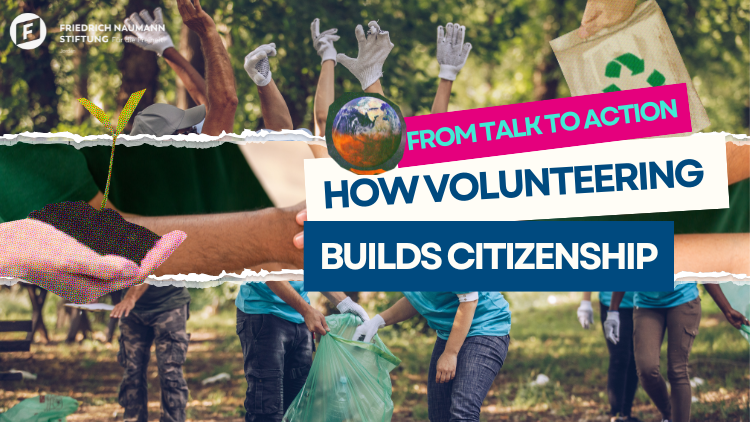
When you hear “volunteering,” you might think of planting trees, sorting clothes, or lending a few hours to support a local event. But in Jordan and across the MENA region, volunteering carries a broader significance: it’s a vital entry point into civic engagement, especially for youth.
Volunteering as Civic Participation
While volunteering is often associated with charity, it’s also a learning space—where empathy intersects with civic responsibility. Research shows that active participation in community initiatives helps individuals understand how society functions and empowers them to shape it. These experiences shift people from observing to participating.
Volunteering as a Soft Introduction to Politics
Official figures suggest that political institutions can feel distant to many young Jordanians. The word “politics” may seem confined to institutions they cannot access or view with skepticism. Volunteering, however, presents accessible, immediate, and hands-on ways to take action. In doing so, it teaches organization, collaboration, and social awareness—without feeling “political.”
Youth Disinterest in Politics: The Numbers
Surveys highlight a disconnect:
- Data from the OECD (2019–2020) reveals that 52% of youth in Jordan reported no interest in politics, significantly higher than the 24% average across OECD countries (International Republican Institute, OECD).
- Arab Barometer data shows that 64% of Jordanians are not affiliated with any political party, and 51% say no party represents their views (Arab Center Washington DC).
- A local Jordan News–cited study reported that 60% of Jordanians have no interest in politics at all, while almost 99% of college students weren’t members of any political party (NAMASIS - Namasis).
This low engagement underscores the significance of volunteerism as a practical alternative form of civic expression.
Intergenerational Bonds Through Service
Volunteering unites people across age groups. When youth assist in refugee-related programs or community events, they often work side by side with older volunteers. These shared experiences build understanding—and reinforce the idea that citizenship involves collective action and intergenerational responsibility.
FNF’s Role & the Jordan Refugee Desk
At the Friedrich Naumann Foundation for Freedom, we see volunteering as an embodiment of liberal values: personal initiative, community responsibility, and constructive action. Our Jordan Refugee Desk, for example, depends on volunteers who support refugee artisans, assist with events, and link communities with new economic and social opportunities. These aren't ancillary tasks—they are core to how we operationalize freedom in action.
Volunteering Impact in Refugee Support
With over 1.3 million refugees in Jordan, volunteer-driven projects make tangible differences (Arab Center Washington DC, Information Saves Lives | Internews). Programs linked to refugee support often rely on volunteers to assist thousands in camps and urban areas—showing how civic action and social solidarity intersect in practice.
Final Reflection
Volunteering may seem modest—an afternoon or a weekend commitment. But over time, these acts add up. They spark habits of participation, enhance trust, and build visible evidence of citizenship in action.
In short, volunteers aren’t just doing good—they’re helping define what it means to be active, responsible members of society.