The Power of Small Steps
How STEPNAU Redefined Growth in 2025

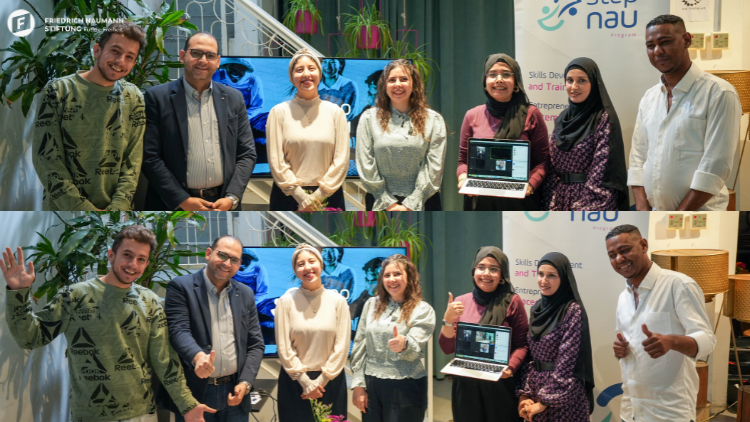
In 2025, the Friedrich Naumann Foundation for Freedom in Jordan reimagined one of its most impactful initiatives — STEPNAU, a programme that empowers refugees and migrants to turn ideas into sustainable ventures. After two years of large-scale hackathons and broad technical training that reached more than 110 participants, this year’s edition — MiniSTEPNAU — took a different path: one that values depth over size, and precision over scale.
Instead of gathering hundreds of participants for uniform workshops, MiniSTEPNAU 2025 focused on what truly matters — individual needs. The new format offered tailored mentorship, business clinics, and targeted resources, allowing each participant to move from abstract learning to real-world progress. It was a shift from teaching to testing, from general guidance to genuine growth.
Rethinking What Support Means
Every entrepreneur’s journey is different. Some need clients; others need clarity. Many just need space — literally — to begin. Recognizing this, STEPNAU 2025 introduced a needs-driven model that provided alumni with exactly what could move them forward: access to short-term workspaces, coaching on pricing and outreach, or small in-kind support to help them host pilot trainings or launch events.
These seemingly small interventions had an outsized impact. Participants could test their services in real time, gather feedback, and refine their ideas with guidance that met them where they were — not where a generic curriculum assumed they should be.

Where Learning Became Action
This year’s alumni — drawn from the 2023 and 2024 cohorts — turned insights into outcomes.
-
Over 40 hours of mentorship guided teams through marketing, financial planning, and product development.
-
Majdi launched WeLEARN, a new digital platform for education and skills exchange.
-
Ahmad expanded his CAPRS initiative into a revenue-generating mobile application now serving five clients.
-
Maher, Ahmad, and Israa led community projects exploring sustainability, AI innovation, and youth engagement.
These achievements reflect the heart of the new approach: giving participants the confidence, structure, and visibility to test their ideas — and the freedom to grow at their own pace.

Mentors on the Frontline of Change
Mentors who guided the process witnessed the transformation firsthand. They praised the shift from one-size-fits-all training to applied problem-solving — from talking about growth to seeing it happen. The model’s short feedback loops — test, learn, adapt — proved especially effective, allowing participants to evolve quickly and stay motivated.
Mentors also suggested new additions for the next phase: practical mini-clinics on pitching and finance, monitoring templates to track results, and structured follow-ups to sustain progress beyond the programme.
October Reflections in Amman
On October 13, alumni, mentors, and the FNF Jordan team gathered in Amman for a closing event — not to mark an ending, but to shape a beginning. Rather than a ceremony, it was a working reflection: an open exchange of ideas about what changed, what worked, and what comes next.
Together, participants co-created a roadmap that includes:
-
Peer connection channels, such as a newsletter and private alumni group;
-
Short thematic clinics on pricing, pitching, and outreach;
-
Pilot demo-days connecting alumni projects with NGOs and CSR partners;
-
A shared toolkit of templates and contracts to standardize operations;
-
Micro-grants or in-kind support for promising ventures ready to test the market.

The Freedom to Build, Together
By designing with participants rather than for them, MiniSTEPNAU didn’t just redesign a programme — it redefined what empowerment looks like in practice. Each mentoring session, each prototype tested, each idea refined became part of a bigger story: one of ownership, resilience, and freedom through action.
Because true change doesn’t arrive all at once. It grows quietly — in small rooms, shared ideas, and steady progress.
This year, those small steps didn’t just move projects forward — they moved people closer to their own vision of freedom.
And that, perhaps, is the real legacy of STEPNAU 2025: proving that when opportunity meets belief, every step — no matter how small — can lead to something extraordinary.