Freedom in Transition
How Millennials and Gen Z in Jordan reshape their future

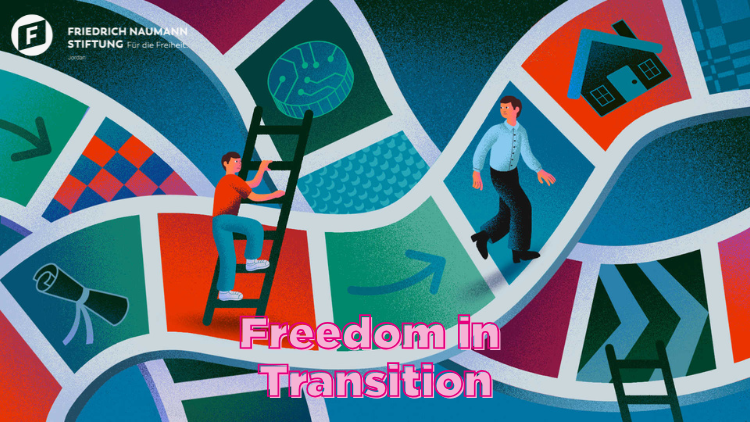
In Jordan and across the MENA region, two generations are stepping up in a world of shifting expectations and new possibilities. Millennials — born roughly between 1981 and 1996 — came into the workforce when the digital revolution was gaining steam and global institutions still dominated many aspects of life. Meanwhile, Gen Z — born around 1997 to 2010 — has grown up with the internet, social media and the idea that change is constant.
Both generations share the aspiration of freedom: freedom to choose what they study, freedom to shape how they work, and freedom to participate in society. But the ways they pursue that freedom differ — and in Jordan’s context, these differences matter for the future of work, learning and democracy.
Work: From the Corner Office to the Digital Platform
For Millennials, a stable job in the public sector or a respected private institution was often the goal. For Gen Z, flexibility and meaning are rising priorities. Globally we see this via freelancing-platform growth, but in Jordan the picture is further complicated by labour-market realities.
Here are some Jordan-specific facts:
- Youth unemployment is very high: estimates put the rate for ages 15-24 at around 41–47 % in recent years. (MacroTrends)
- Labour-force participation for young people remains low: The employment-to-population ratio for males 15-24 is only ~22.5 % in recent data. (Trading Economics)
- For platform / online work: A survey found that 73.6 % of “platform workers” (digital-gig) in Jordan were under 35; 86.7 % had a bachelor’s degree or higher. (Jordan Times)
So: Jordanian young people — especially Gen Z — are turning to non-traditional modes of work (digital, freelance, gig) because the traditional routes are blocked. The promise of freedom is there: you can work how you want, make your own path. But the reality often is: fewer secure jobs, more precarious internships or gigs, and a big gap between aspiration and access.
What this means for freedom and democracy:
- Freedom isn’t just the absence of coercion; it’s about opportunity. When large numbers of youth are unable to find stable work, their freedom to choose, to plan, to participate is constrained.
- Programmes that help young people gain digital freelancing skills, build professional networks, and understand contracts/taxes can help bridge the gap — and align with liberal frameworks of individual agency + responsibility.
Learning and Transition: The Bridge from Study to Work
Both Millennials and Gen Z recognise that education no longer ends at graduation. Lifelong learning, digital upskilling, and self-directed career pivots are central. But in Jordan the transition from study to work is long and uncertain.
Facts from Jordan:
- A report by the International Labour Organisation (ILO) found that young people in Jordan often take three years or more to move from school to stable or satisfactory employment. (UN DESA)
- A study by UNICEF showed that while Jordan’s youth are increasingly educated, many cannot find jobs aligned with their aspirations — delaying financial independence, marriage, family formation. (UNICEF)
Gen Z in Jordan is thus entering adulthood with high expectations (digital literacy, global connectivity, creative work) but in a labour market where structural barriers (gender gaps, youth inactivity, mismatch between education and jobs) still loom large. For Millennials, many are already managing or adapting to these conditions — carving paths, shifting sectors, creating their own opportunities.
Implication for liberal-democratic programmes
- Education is freedom only when it connects to outcome: work, civic participation, agency.
- Lifelong learning programmes should emphasise not just “skills” but also civic capacities: media literacy, digital rights, entrepreneurship within open societies.
- In Jordan, special focus on young women, refugees and marginalised youth is crucial because the transition gaps are steep for these groups.
Civic Life and Digital Self-Expression: Two Generations, One Democratic Horizon
Both Millennials and Gen Z live in an era of rapid change and connectivity. In Jordan and elsewhere in MENA, young people are using digital tools to expect more: more transparency, more participation, more freedom of expression. But the frameworks they use differ.
- Millennials might emphasise reform: working within institutions, building experience, gradually pushing for change.
- Gen Z often emphasises disruption: authenticity, identity expression, new platforms, entrepreneurial citizenship.
- In Jordan, for example, digital freelance work, online activism, startup ideas all become vehicles for youth to claim freedom on their own terms.
This aligns with liberal-democratic values: individuals as free agents, supported by institutions that protect rights and encourage participation. But for these values to be meaningful, the structural conditions must exist: decent jobs, equal access, education that opens doors, not just certificates.
What Should Be Done? Practical Steps in the Jordan / MENA Context
- Hybrid Training+Civic Citizenship: Design programmes that merge employability skills (digital, freelancing, entrepreneurship) with civic modules (rights, media literacy, democratic engagement).
- Support Digital and Freelance Economies: In Jordan, where many youths opt for platform/gig work, provide support on contracts, taxes, social protection so freelancing becomes genuine freedom, not precariousness.
- Shorten the Study-to-Work Bridge: Work-based learning initiatives (as the ILO and partners are doing in Jordan) reduce transition time. (International Labour Organisation) Scale them, focus on young women and refugees.
- Target Inclusion: Young women, economically inactive youth, refugees must be part of the freedom equation. In Jordan, structural gender gaps and low youth participation persist. (ijeba.com)
- Promote Entrepreneurial Citizenship: Encourage youth-led civic enterprises — digital platforms, small businesses, social startups — that combine economic freedom and democratic engagement.
A Generation Dialogue, Not a Divide
Millennials and Gen Z in Jordan are not simply separated by age — they are linked by a shared quest: freedom. Millennials built the base; Gen Z is redesigning the structure. Both must be supported in ways that respect their context and their potential. For societies committed to liberal democracy, this means more than rhetoric — it means real opportunity, real agency, and real participation.
If freedom is the journey, then for Jordan’s young generations it is a journey that begins with work, is sustained by learning, and blossoms in civic life. The sooner the structural barriers are addressed, the more fully they can walk that path — as free agents, responsible citizens, innovators in a region in transition.