Free Youth Course V
Exploring the Social Market Economy at the Dead Sea

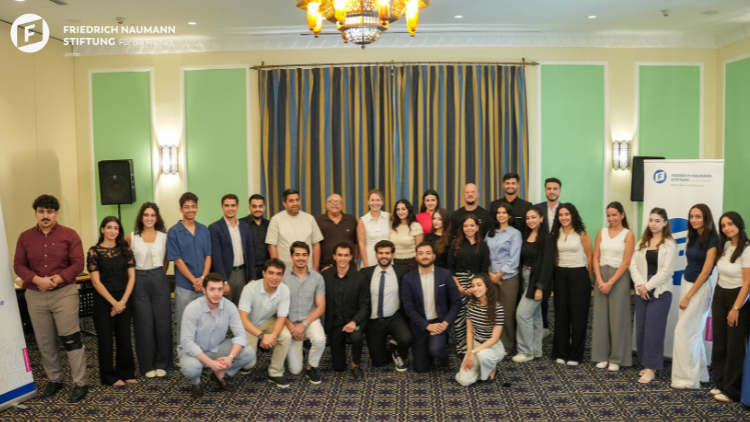
From 25 to 27 September 2025, the Friedrich Naumann Foundation for Freedom (FNF) Jordan held the fifth edition of its flagship Free Youth Course (FYC) under the theme “The Social Market Economy.” Taking place at the Dead Sea and bringing together twenty-four students from the German Jordanian University (GJU), the program once again proved to be a unique platform for young Jordanians to engage with liberal values, entrepreneurial thinking, and economic principles. With its dynamic blend of training, debate, and inspiration, the course reaffirmed its place as one of FNF Jordan’s most impactful youth initiatives.
Entrepreneurship and Inspiration on Day 1
The course began with a strong emphasis on entrepreneurship. Trainers from 180 Degrees Consulting delivered an intensive program designed to equip participants with essential entrepreneurial skills, combining theory with practical exercises and a challenging business case scenario. The sessions encouraged creativity, teamwork, and problem-solving—skills essential for young people stepping into an evolving economy.
The day closed on a particularly motivational note with a talk by Mr. Omar Al Alami, a GJU graduate and successful businessman, who shared his personal journey from student life to private sector leadership. His story offered participants not only valuable lessons but also a tangible example of how ambition, resilience, and innovation can lead to success in Jordan’s business environment.

Exploring Economic Theories and Models on Day 2
On the second day, the spotlight shifted to business management and the comparison of economic systems. Participants began by learning how to design and structure effective business proposals, before moving into deeper discussions on the theories that shape economies worldwide. Guided by H.E. Dr. Yousef Mansour, Jordan's former Minister of Finance, the students examined classical free-market thought, socialist-inspired planned economies, and reconciliatory mixed models rooted in Keynesian policies.
These sessions allowed participants not only to understand the theoretical frameworks but also to critically assess their relevance to Jordan’s economic context. The conversations highlighted how each system brings both opportunities and challenges, encouraging students to think about how economic ideas can be adapted to support the Kingdom’s growth and stability.

The Social Market Economy in Practice on Day 3
The final day of the course was dedicated to exploring the social market economy, a model that combines the efficiency of the free market with the principles of social justice. Students were introduced to the German experience under Ludwig Erhard and the Freiburg School, where this model emerged as a cornerstone of post-war economic recovery. Through case studies from Germany, Austria, and the Nordic countries, the sessions demonstrated how policies such as health insurance, quality education, and minimum wages can be integrated with economic freedom to create both prosperity and fairness.
Participants then put their knowledge to the test in group debates, defending different economic models and presenting their arguments before their peers. Final student presentations, closing remarks, and a certification ceremony marked the conclusion of the day and gave participants both knowledge and confidence.

A Milestone in FNF Jordan’s Youth Programming
The fifth edition of the Free Youth Course stands out as a milestone, not only for the content it delivered but also for the values it reinforced. Through a mix of entrepreneurship, open debate, and discussions on liberal economic thought, the program offered students an opportunity to gain practical tools for leadership and innovation. Beyond its academic content, the course created a space for reflection on how economic freedom and social responsibility can influence the future of their country.
Since its inception, the Free Youth Course has reached far beyond the classroom. With 119 participants trained across five editions and almost 1,921 applications received, the course demonstrates the strong demand for platforms that give space to youth voices and encourage dialogue on freedom, democracy, and economic opportunity. Its success demonstrates that investment in youth leadership continues to pay off, planting seeds of liberal values that will grow with each new generation.
Looking Ahead
As the curtains closed on this edition at the Dead Sea, the sense of achievement was clear. The Free Youth Course has become more than just a program; it is a movement that inspires students to think critically, challenge ideas, and embrace the values of freedom and responsibility.
By empowering young Jordanians with both knowledge and practical skills, the course contributes to shaping future leaders who are prepared to navigate the challenges of tomorrow and to uphold the principles of a free and just society.