Why Liberal Values Matter
Education as a Tool for Freedom in Jordan

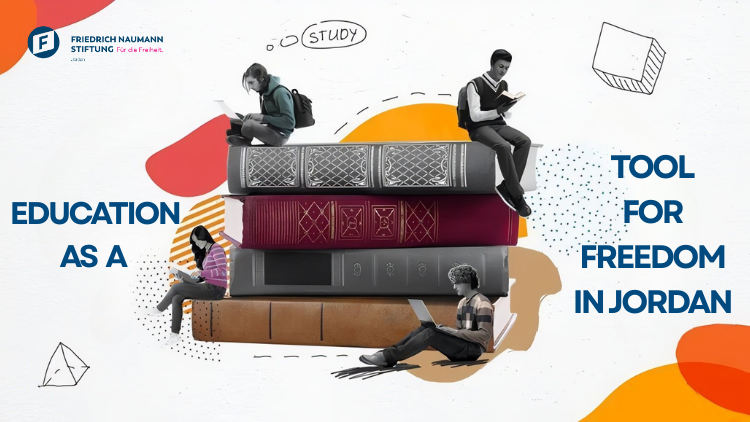
Education is often described as the engine of progress. In Jordan, it is more than that—it is the foundation on which a freer, more inclusive society can be built. A truly liberal society rests on three pillars: freedom of thought, equality of opportunity, and civic responsibility. Each of these values can only take root if citizens are given the tools to think critically, to question, and to participate. Education is therefore not just a social service; it is the single most important factor for Jordan’s democratic future.
Civic Education: Where Liberal Values Begin
From primary school onwards, Jordan’s civic curriculum introduces students to rights and responsibilities. But the real promise lies in how these lessons prepare young people to participate in shaping their communities. Student councils, mock parliaments, and debate clubs are not trivial exercises — they are training grounds for democratic life. By voting for representatives, defending opposing arguments, or collectively deciding on projects, students practice compromise, tolerance, and accountability.
In a society where public participation is still limited, these school traditions illustrate how liberal values can be nurtured from the ground up. If strengthened, they can transform classrooms into laboratories of freedom, where the next generation learns not only about democracy but how to live it.
Universities as Laboratories of Democracy
Higher education deepens this potential. Universities in Jordan are not only places of academic study but also vibrant arenas for civic practice. At the University of Jordan, students participate in cultural exchange and research that broaden perspectives. At the Hashemite University, student council elections through open lists model transparency and representation. These processes reflect real democratic challenges: building coalitions, negotiating differences, and leading responsibly.
Here again, liberal values show their transformative power. By opening space for debate and self-governance, universities equip young Jordanians with the skills to participate in wider democratic life. A society that encourages youth to lead today will be stronger and freer tomorrow.
National Reforms: Unlocking Potential
Jordan’s government has already signalled its recognition of education’s importance. Reforms aim to expand access to kindergarten, strengthen teacher training, and ensure inclusivity for marginalised groups such as children with disabilities and refugees (UN SDGs Partnership). The World Bank’s recent $700 million investment underscores how critical education is for Jordan’s future (World Bank).
Yet the liberal promise of these reforms will only be fulfilled if they move beyond technical adjustments to embed critical thinking, equality, and participation at every level of the system. Without these values, reforms risk producing employees but not free citizens.
Informal Education: Freedom in Practice
Education does not stop at the classroom door. Civil society and youth initiatives offer spaces for practising freedom in everyday life. Programs that encourage volunteerism, dialogue, and creativity allow young people to test ideas, challenge social barriers, and build inclusive communities. These experiences are vital in a context where formal politics often feels distant. They show that liberal values are not abstract ideals but practical tools for solving real problems together.
The Challenges Ahead
Despite progress, barriers remain. Inequalities between rural and urban schools, traditional teaching methods that emphasise memorisation, and restrictions on civic space limit the transformative potential of education (OECD Report). Without reform, the risk is that education remains focused on producing workers, not free thinkers.
This is precisely where liberal values can make a difference. By ensuring freedom of thought in classrooms, equal access for all children, and opportunities for civic participation, education can bridge the gap between Jordan’s aspirations and the realities its youth face.
Education as the Cornerstone of a Liberal Society
For Jordan, the path toward a freer and more democratic future does not begin in parliaments or ministries—it begins in classrooms. Education has the power to unlock the values that make societies open: freedom, equality, and civic responsibility. It prepares not just skilled workers, but free citizens who can lead, question, and innovate.
By embedding liberal values into its education system, Jordan can move closer to a society where freedom is not reserved for the few, but experienced by all. Education is therefore not only a tool for individual opportunity, but the cornerstone of a liberal society that benefits the entire nation.