INDONESIA
Resilience in Question: Indonesia’s Response to the Iran War

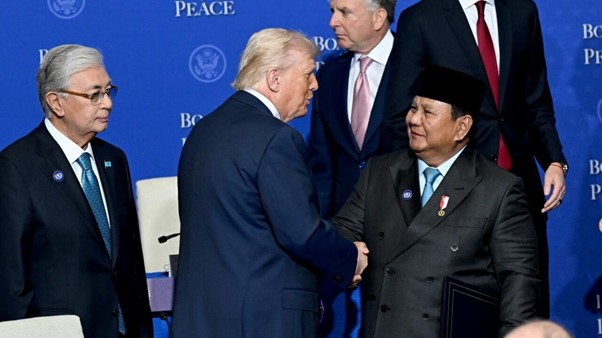
US President Donald Trump (L) shakes hands with Indonesia's President Prabowo Subianto at the "Board of Peace" meeting
© Ministry of State Secretariat of the Republic of Indonesia, 20 February 2026On a humid morning in Jakarta, the impact of a war thousands of kilometers away is already visible. Motorcycle taxi drivers scroll through their phones, watching in anxiety if the fuel prices inch upward. At traditional markets, vendors quietly adjust prices, rice up a little, cooking oil slightly more expensive than last week. The war between the United States and Iran may be unfolding in the Middle East, but in Indonesia, it is being felt in everyday transactions. For Jakarta, this is the paradox of modern neutrality: you can stay out of the war, but the war does not stay out of your economy.
Indonesia has responded the only way it knows how, by leaning on its long-held doctrine of bebas aktif, or “free and active” foreign policy. It has called for restraint, urged dialogue in multilateral forums, and avoided taking sides. Official statements emphasize peace. Diplomats push for de-escalation. There is talk of Indonesia as a potential bridge between opposing blocs.
But beneath the language of neutrality lies a harder truth: Indonesia has little control over how this conflict unfolds, yet it is deeply exposed to its consequences. Indonesia imports roughly 700,000–800,000 barrels of oil per day, which is approximately 20 percent of Indonesia’s total crude oil imports, making it highly sensitive to global price shocks. Despite the fact that the country is brimming with oil reserves, Indonesia still very much heavily relies on oil imports. One of the major reasons are the limited numbers and capacity of oil refineries that does not match with the current public demand. The imports are necessary to cover the gap for the country’s fuel consumption. When tensions in the Persian Gulf disrupted flows through the Strait of Hormuz, responsible for nearly 20% of global oil supply, prices surged past $100 per barrel, which was a 7.42% price increase.
For the Indonesian government, that spike translates almost immediately into fiscal strain, even though it can offset some of the costs through higher revenues from coal exports. Global demand for other energy sources has pushed coal export volumes higher. However, this buffer also has its own limit that still made the government to carefully manage its fiscal gap. Fuel subsidies, already a politically sensitive issue, begin to swell. A $10 increase in global oil prices can add hundreds of millions of dollars to the state budget deficit. Policymakers are forced into a familiar dilemma: absorb the cost and strain public finances, or pass it on to consumers and risk social backlash. For now, public sentiment remains relatively contained, largely because the government still manage to hold subsidized fuel prices steady. But still, the real risk isn't a sudden spark, it's a slow fiscal bleed that eventually forces a choice no one wants to make.
For ordinary Indonesians, the effects are more direct. Transport costs rise first. Then food prices follow, driven by more expensive logistics and fertilizer inputs. By early estimates, inflationary pressure from the conflict could add 0.5 to 1 percentage point to Indonesia’s annual inflation rate if disruptions persist.
It is not a crisis yet. But it is a slow burn. Shipping routes linked to the Middle East have become more volatile, pushing freight costs sharply upward. Some estimates suggest container shipping rates on key routes have risen by two to three times since the escalation began.
Higher shipping costs reduce competitiveness for goods like textiles, electronics, and palm oil. At the same time, imported raw materials become more expensive, squeezing manufacturers already operating on thin margins.
Small and medium enterprises, which form the backbone of Indonesia’s economy, are particularly vulnerable. Unlike large corporations, they lack the buffers to absorb sudden cost increases. In industrial zones from West Java to Batam, the effects are uneven but noticeable: delayed shipments, tighter margins, cautious hiring.
The War Comes Closer Than Expected
Indonesia’s neutrality has not shielded it from the conflict’s cost. In southern Lebanon, where Indonesia contributes one of the largest number of peace keeper or soldiers to the United Nations Interim Force in Lebanon (UNIFIL), the regional spillover of the war has turned increasingly dangerous. Amid escalating hostilities, three Indonesian peacekeepers were killed. A stark reminder that even non-aligned actors are not immune.
Indonesia has long taken pride in its role as a contributor to global peacekeeping, with around 2700 personnel currently deployed in UN missions worldwide. But the incident has sparked a debate: how far should Indonesia go in maintaining its international commitments when conflicts grow more volatile? For the families of those stationed abroad, neutrality offers little comfort.
Diplomatically, Indonesia continues to walk a careful line. It condemns escalation without naming sides too sharply. It supports humanitarian efforts while avoiding entanglement in military coalitions. It speaks the language of international law, sovereignty, and dialogue. This positioning allows Indonesia to maintain relationships across a fragmented global order, from Western partners to countries in the Middle East.
But neutrality, in this context, is less a position of strength than one of necessity. Indonesia lacks the leverage to shape the conflict. What it can do is manage its exposure to economic shocks, to geopolitical pressure, and to the risks faced by its citizens abroad.
Foreign Policy in Question
The conflict has placed considerable additional strain on President Prabowo’s foreign policy, testing its consistency and apt responses to the shifting of global dynamics.
As a democratic nation with the largest Muslim population in the world, Indonesia has historically positioned itself as a vocal supporter of the Palestinian cause, often reflecting strong pro-Palestinian sentiment in its foreign policy rhetoric and actions. This stance has been closely tied to both domestic public opinion and Indonesia’s identity within the broader Muslim world.
However, Prabowo had taken the decision to join the Board of Peace (BOP), a US-led initiative that lacks Palestinian representation. This indicates that Indonesia’s diplomatic posture might to be slightly changing: a more transactional position that prioritizes managing bilateral relations with the US over upholding the principled commitments that have long defined Indonesian foreign policy and resonated so deeply with its citizens. While joining the BOP already had sparked debates, the US-Israeli attack on Iran has moved foreign policy decisions in the spotlight and led to further domestic backlash, as polling data shows. A nationwide survey conducted by a consortium of three major polling firms showed that 51 percent of Indonesians disagree with the country's membership in the Board of Peace. Only 27 percent support it.
The war has pushed President Prabowo into an uncomfortable position. Indonesia publicly condemned the war and called for peace talks, but its language has been noticeably softer. This careful wording reflects Prabowo's dilemma: he wants to maintain Indonesia's order toward international law, but he also doesn't want to damage the country's relationship with the US. The problem is that trying to please everyone has left Indonesia pleasing no one.
Indonesia has been trying to positioned itself securely, avoiding alignment and pushing for a diplomatic dialogue. Yet it is still paying a price, measured in higher cost of living, harsher economic conditions, and the lives of its peacekeepers. Indonesia may stand in the middle. But the ground beneath is shifting.
*Khansadhia Afifah Wardana is a Program Officer at the Friedrich Naumann Foundation for Freedom office in Jakarta, Indonesia.