Delegations
Inclusive employability

No culture can live, if it attempts to be exclusive.
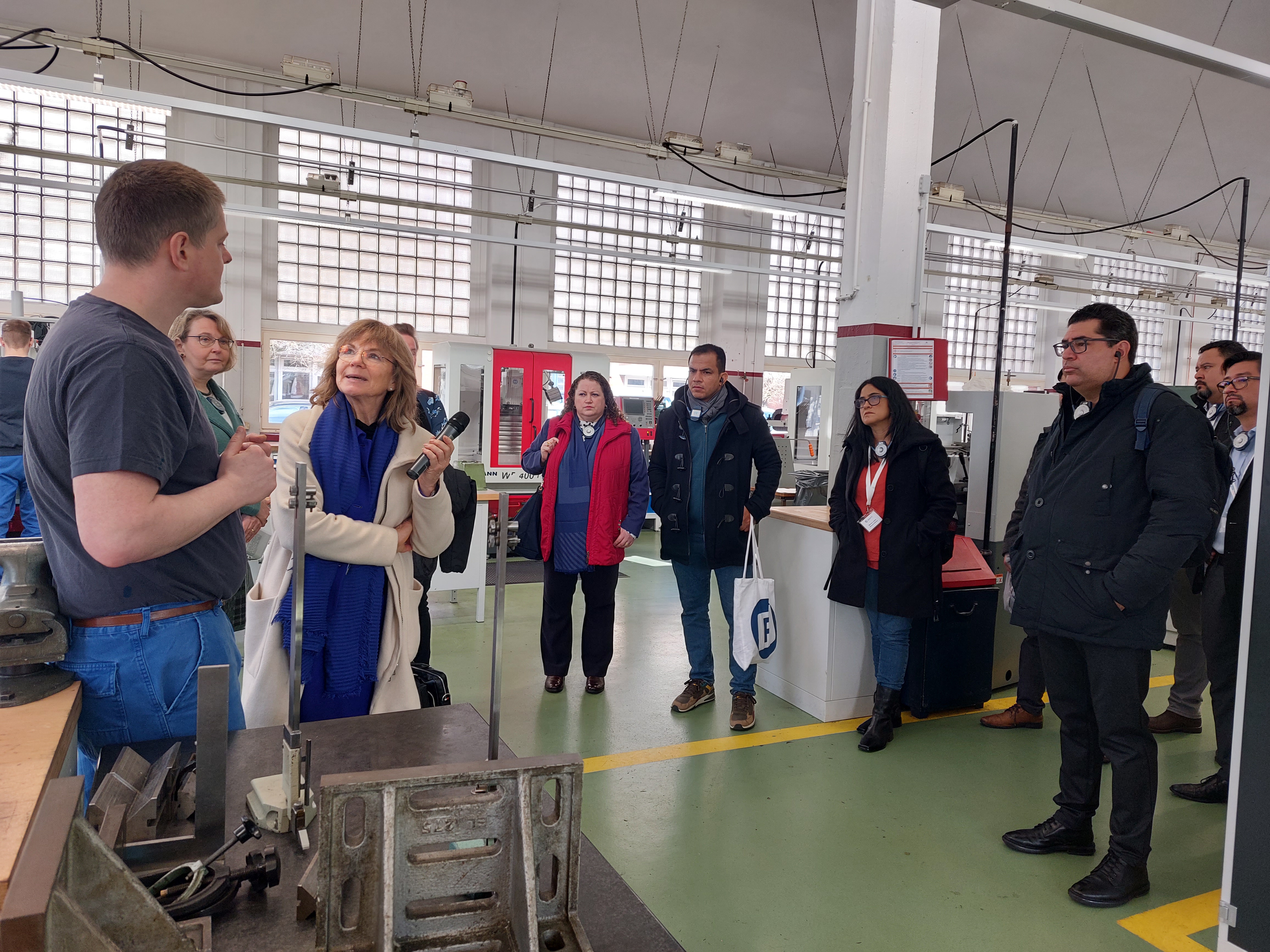
Having inclusion and diversity as our main topic, we welcomed a Central American delegation from Guatemala, El Salvador, Honduras, Costa Rica and Panama to Berlin and Potsdam in March 2023 to meet relevant interlocutors working in those fields.
Social inclusion has become a widely used term in Germany. The idea is that all people should have equal access to the various areas of society, such as education, the labour market and health. If a person is excluded, for example due to a physical impairment, the reason should not be sought in the people themselves, but in social barriers. These barriers must therefore be removed (accessibility).[1]
In Germany, at least 13 Million people have an impairment[2], around 8 Million having a severe disability. Even though this is a huge number of affected people, many parts in life and work are still not at all or not enough inclusive. People that are not affected or don´t know someone being impaired in any way might not see or understand the difficulties coming up, when movements are limited, hearing, speaking, the sight is impaired, or when psychological problems are affecting the daily life. Taking public transportation can be a huge obstacle, when escalators or elevators are not working, when signs are too small or not readable or when platforms are suddenly changing.

During the delegation visit, we met very interesting interlocutors from various fields. We were mostly agreeing that a lot has changed in Germany, but we are still quite far away from being an inclusive and diverse country. Nevertheless, the Central American delegation was very impressed and inspired by all the support for impaired citizens, comparing to their own situations and their work in Central America, where progress is still in its infancy and a lot of work and passion is needed.
Within the week, we discussed different topics, starting with the general understanding of inclusion and diversity, meeting inspiring and motivated speakers for impaired people, such as The Federal Government Commissioner for Matters relating to Persons with Disabilities.
We agreed during our talks that inclusion is a broader topic, also involving LGBTIQ+ rights, migrants, refugees, the possibility and ability to work and take part in daily life offers.
Thus, we met a representative of the State Office Senate Department for Justice, Diversity and Anti-Discrimination in Berlin and the Annedore Leber Vocational Training Centre for disabled young people with special needs, who are about to start their professional careers. We had an insightful tour through the center and met the trainers as well as some students. The training center is offering education in different fields, from administration to handcraft or technical knowledge.

We also had the chance to talk about the implementation and legal obligations for inclusion, equal opportunities and diversity in the labour market with the Confederation of German Employers' Associations. There are already many regulations, such as a compensatory levy, if a company with more than 60 employees is not employing at least 5% of them having a disability. However, the implementation is very often difficult for different reasons, e.g. from a few to no job applicants with disabilities to restraints in hiring them for the job position. The regulations and governmental financial aid are a good start, still the task is moreover to raise awareness and acceptance within the public to ensure that inclusion is a topic that concerns everyone.

Another important factor to diversify the labour market could be to include also refugees and migrants with their various experiences into the market, reducing the bureaucracy for work. This would be a good motivation and a commitment to work and support the labour market and thus the social system in Germany. This was an interesting discussion with the Berlin Advice Center for Migration and Good Work and the DSI Deutschlandstiftung Integration, who is working on a project to diversify governmental offices.

In Potsdam, we had the chance to visit the Oberlin Werkstätten, a workshop for persons with partially severe disabilities that offers them supervised work and a chance to earn small wages and be productive. It was a great experience and had a wow effect, not only because we had a wonderful spring weather and sun, but also because the workshop is located idyllic on a small island in Potsdam, with forest and water surrounding it. On the other hand, there is quite some open discussion about these workshops employing the people with a tiny salary and in the case of the workshop in Potsdam, the location is also considered as somehow excluding, as it is a bit remote. For the delegation, this was a huge surprise, as the workshop idea is new to their inclusion concepts and is therefore a success story. Thus, they were very astonished during the following talks with the Representative of the State Government of Brandenburg for the interests of people with disabilities, as she was also highlighting the critical points of these workshops.

“The equal participation of people with disabilities in working and professional life is an important social and labour market policy issue. Employers take this responsibility seriously and are actively committed to training, professional inclusion and the sustainable reduction of unemployment among people with disabilities. 1.1 million (BA 2018) severely disabled people in employment are proof of this. When deployed correctly, they are fully capable employees who are often particularly motivated to perform their tasks.”[3]
Overall, the delegation trip with the Central American group was an important, interesting and especially eye-opening week, with many insights into legal procedures and regulations in Germany and Central America and many great examples for inclusion and diversity. Germany has improved its regulations in the last years, but it is still clear that true inclusion needs the socio-political support and especially the full backing of the society.
We are on a good way.