New and Emerging Technology
The WSIS process: Defense of the Liberal Rules Based International Order

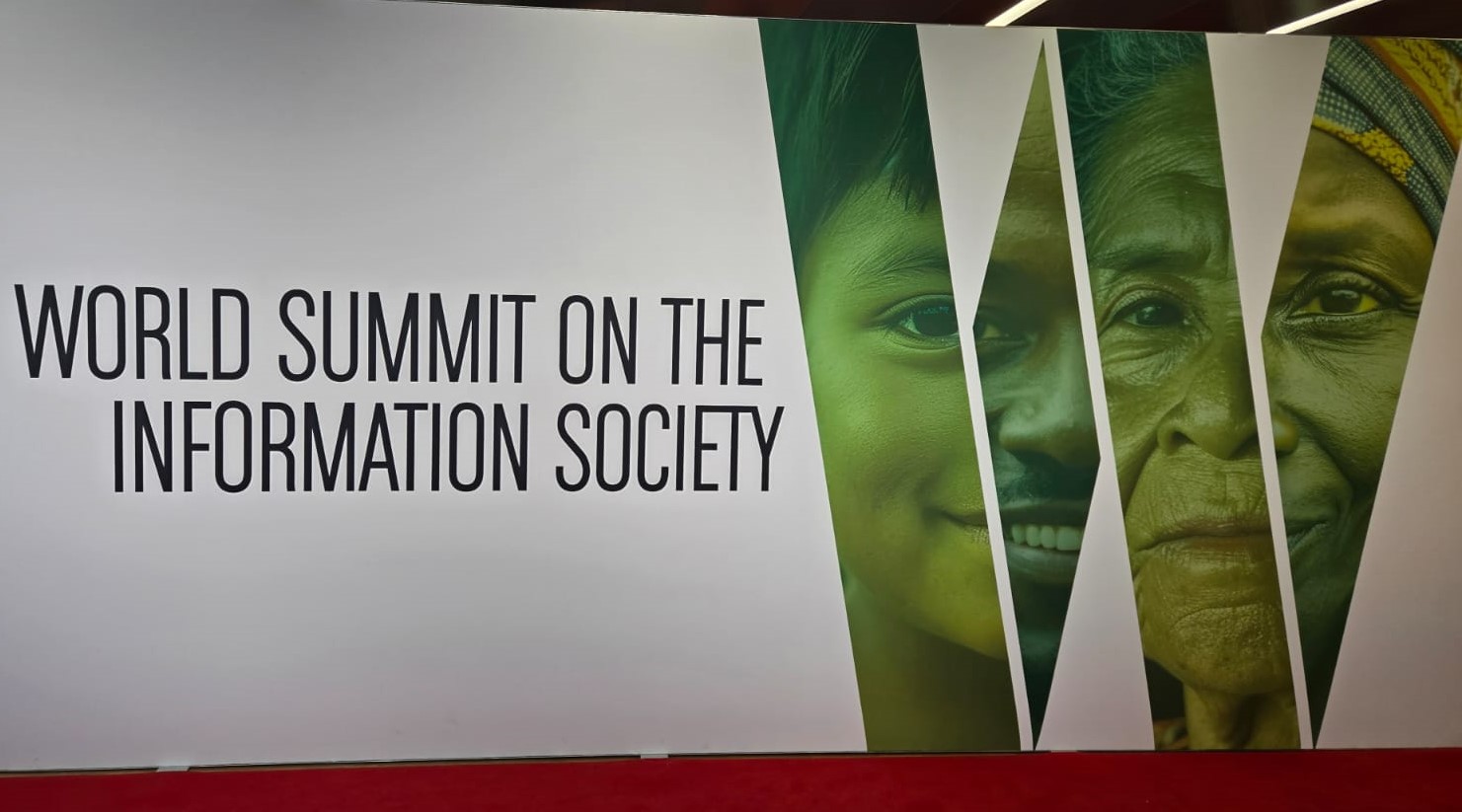
WSIS Logo at the WSIS+20 Review and AI 4 Good Summit 2025, Palexpo, Geneva.
© FNFIn the late 90s, when Information and Communication Technology (ICTs) had become prevalent, the states through the United Nations General Assembly (UNGA) decided to create a platform which should inform and guide the use, development and implementation of ICTs. The goal: build a people-centered, inclusive and development-oriented Information Society, where everyone can create, access, utilize and share information and knowledge.
Thus, the World Summit on the Information Society (WSIS) was created through Resolution 73 of the ITU Plenipotentiary Conference in Minneapolis in 1998. In this document, the ITU Council asks the UN Secretary-General to consider the question of holding a World Summit on the Information Society. The first UN General Assembly resolution, which started the preparatory process of the WSIS, was adopted in 2002.
In light of the – at the time – quite recent mainstreaming of ICTs, and the pressure to meet the objectives of the Millennium Declaration, governments recognized and acknowledged the urgent need for global frameworks and mechanisms to leverage and govern ICTs. As proposed in Resolution 1179 of the ITU Council 2001, the high-level summit was held in two phases: phase one in Geneva in 2003 and phase two in Tunis in 2005. The main objective of those conferences was to establish a global ICT governance framework. While human rights are not central to this undertaking, the outcome documents are derived from the Sustainable Development Goals (SDGs) and based on human rights.
The Backbone of ICT Governance
The results were the Geneva Declaration of Principles, the Geneva Action Plan, Tunis Commitment and Tunis Agenda. The Geneva Declaration of Principles identifies 11 key principles, which would allow the world to build an Information Society. The Geneva Action Plan formulates these principles into tasks to be implemented by the relevant actors. These 11 principles serve as the backbone of the WSIS Process until this day.
The Declaration states that (1) all stakeholders should work together to (2) improve access to ICT infrastructure as well as (3) information and knowledge; (4) build capacity; (5) increase confidence and security in the use of ICTs; (6) create an enabling environment at all levels; (7) develop and widen ICT application; (8) foster respect and cultural diversity; (9) recognize the role of the media; (10) address ethical dimension of the Information Society; and (11) encourage regional and international cooperation.
In 2005 in the Tunis Commitments, governments reaffirmed their commitment to democracy, the ‘universality, indivisibility, interdependence and interrelation of all human rights and fundamental freedoms’ and resolved to strengthen the rule of law nationally and internationally. In the Tunis Agenda, states laid out the first concrete steps regarding the implementation of the Geneva Action Plan. Most notably, the Tunis Agenda asks the Secretary-General to create a new forum for multi-stakeholder policy dialogue – the Internet Governance Forum (IGF). The main part of the Tunis Agenda remained the section on implementation and follow-up.
After the conclusion of phase two in Tunis in 2005, a review was scheduled to be held in 10 years time. Thus, in 2015, the ITU organized a WSIS+10 Review of the implementation of the WSIS outcomes. The outcome document of this review, A/RES/70/125, adopted by the UN General Assembly in 2015, noted that while some progress has been made and the WSIS Forum has proven to be a useful platform for sharing best practices and bringing various stakeholders to the table, a lot of challenges remain. Therefore, the UN General Assembly ordered another high-level review to be held in 2025, the WSIS+20 Review.
Beacon of Hope for the Liberal Rules Based International Order
Since 2005 – or even 2015 –, the world has changed a lot. ICTs have developed and become even more omnipresent in society globally. The digital economy has become a pillar of global economic activity through e-commerce, digital payments and online platforms. ICTs are becoming increasingly important in regards to the environment – be it through its rising environmental footprint or by supporting environmental sustainability.
Although considerable progress has been made, the objectives set in 2005 have not yet been met. For instance, the percentage of internet users has increased in the last 20 years but digital divides remain a central issue. Additionally, as evidenced by many Human Rights Council resolutions, human rights are increasingly being violated in the online space and there is a growing need to address these new forms of human rights violations.
The WSIS presents itself as the most fit-for-purpose, most effective and inclusive mechanism to act on these issues. It is also the most effective tool to follow-up on the implementation of the Global Digital Compact, adopted by the UNGA in 2024 as an annex to the Pact for the Future. It presents a key opportunity to align the implementation of numerous existing governance frameworks and anchor them within the WSIS vision.
WSIS has a track record of proven success of multistakeholder engagement. The list of activities initiated by the WSIS that have been successfully implemented and borne fruits is extensive. From national digitalization strategies to efforts of multilingualization of the internet, standard setting and the expansion of broadband coverage. All of these achievements involved the participation of many different stakeholders.
Given the current geopolitical climate and the UN finance and credibility crisis, this has become ever more important. While it can be observed that some states are disengaging from multilateral institutions such as the Human Rights Council, the WSIS generally enjoys a positive reputation as evidenced by the governmental support for the WSIS+20 Review and the strong language used in the outcome documents.
As the traditional UN human rights system is currently facing financial constraints and a credibility crisis, the WSIS might become an important avenue for human rights politics. The implementation of the human rights angle within the GDC for instance, will be followed up through WSIS. It offers an inclusive multistakeholder forum, which can be used by states and civil society actors alike to promote human rights online and offline.
In today’s digitally interconnected – and thus interdependent world, the WSIS offers a forum for multilateral diplomacy. For liberal democracies, this makes the WSIS one of the most important platforms to safeguard the liberal rules based international order and defend liberal and democratic values. As in Tunis, the world must reaffirm their commitment to democracy, human rights and the rule of law.
For the sake of multilateralism and the liberal world order, the mandate of the WSIS needs to be extended during the WSIS+20 Review in Geneva in July 2025.