Hungarian elections 2026
The Stakes in Hungary: The 2026 Parliamentary Election

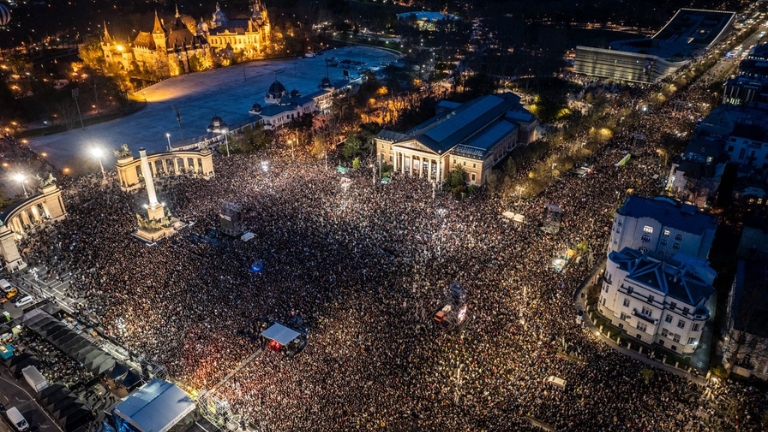
"Rendszerbontó” (“System Demolition”) concert held at Heroes’ Square (Hősök tere) in Budapest.
© Ferenc Isza, AFP (via 444.hu)Hungary’s 2026 parliamentary elections mark a historic turning point. After 16 years in power, Viktor Orbán and his Fidesz party have been decisively voted out of office. The following reflections, written in the days surrounding the election, capture the atmosphere on the ground in Budapest and the political dynamics behind an outcome few would have expected at this scale.
A more in-depth discussion of the election results and their implications for Hungary and the European Union is available in the podcast “Frei gedacht”, a new joint format of the Europäische Akademie Berlin and the Friedrich Naumann Foundation for Freedom, featuring Moritz Körner and Greta Kiss. The episode was recorded shortly after the elections. Listen to the episode here.
April 12, A milestone in Hungary’s history
16 years of absolute power under Viktor Orbán and his Fidesz party are over, and not by a narrow margin, but decisively. Péter Magyar’s Tisza party achieved a landslide victory.
Viktor Orbán conceded defeat relatively early last night, around 9:30 p.m., and congratulated Péter Magyar on his victory. Tisza secured a two-thirds majority with 138 seats, while Fidesz dropped to 55 (from 135) and the far-right party Mi Hazánk stays represented in the Parliament with 6 seats. This is historic, no party has ever won this many seats in Hungary.
With a record turnout of 79.5%, this election further stands out in terms of participation and mobilisation.
What makes this result even more striking is the system itself: Hungary’s electoral law was repeatedly reshaped under Fidesz to favour the strongest party and amplify its parliamentary majority. Ironically, the very same system that helped Fidesz dominate over the past decade has now worked against it and amplified its defeat.
Budapest was probably the happiest city in Europe last night. People were celebrating in the streets, singing in trams and buses, cars honking. I have never seen anything like it, and I was incredibly proud of my country.
Budapest was celebrating, but the election was decided in the countryside. And the countryside chose change as well. That the urban-rural divide has started to shift is something entirely new.

People hold up large portrait posters from atop a bus stop at night.
© Bődey János, Telex
Nighttime street celebration as a woman rises through a car sunroof.
© Hevesi-Szabó Lujza, Telex
Torn posters and litter around an advertising column at night.
© Bődey János, TelexApril 12, Election day in Hungary
Election day in Hungary has arrived. For the first time in my life, I did not vote in my home village in Northern Hungary, nor abroad, where I have been living for the past nine years.
Instead, I decided to stay in Budapest. I wanted to experience what this election day feels like here, after 16 years of Orbán’s government. What also surprised me over the past few days in Budapest was how openly people talk about the elections. In shops and everyday situations, strangers would ask whether I had come home to vote. I was genuinely surprised by how naturally conversations about voting - and hopes for political change in Hungary - came up.
Later today, I will head to a few election watch gatherings with friends, many of whom, quite ironically, also live in Brussels but came back home to experience this moment.
Voting itself went smoothly at my polling station. However, it was a designated station for voters who had re-registered to vote in Budapest from other constituencies, so I did not experience the long queues reported elsewhere. In several polling stations across Budapest, lines have been stretching for hours. Similar reports are coming from abroad, with waiting times of up to two hours in Stuttgart and more than an hour in Brussels.
What already stands out this afternoon is the turnout: it is now clear that participation will surpass the 2002 record of 73.5% (which was reached in the second round, a system that no longer exists today). By 3 p.m. today, turnout had already reached 66%, compared to 52.8% at the same time in 2022.
At the same time, an interesting dynamic is emerging: turnout is still rising in cities, which usually lean more towards the opposition, while in rural areas, typically stronger for Fidesz, it is no longer increasing as much.
Stay tuned for the results.

Long line outside a polling station.
© Telex, submitted by reader
Citizens line up as ballots are cast and counted at a polling station.
© Telex, Ránki DánielApril 11, New voices in Hungary’s election campaign
Hungary’s election campaign is no longer shaped only by politicians, but increasingly by voices that have traditionally stayed quiet or neutral.
In recent days, some of Hungary’s most prominent business figures, including György Wáberer and Levente Balogh - both among the country’s wealthiest entrepreneurs - have spoken out publicly and called on Hungarians to participate in tomorrow’s elections. Today, Wáberer has even offered 300,000 HUF (around 800 EUR) to anyone who identifies and can prove electoral fraud. They have emphasised Hungary’s belonging to the European Union and the need to return to its European and democratic core values. In addition, István Kapitány, one of the most successful Hungarians in global corporate leadership as former Global Executive Vice President at Shell, joined Tisza a few months ago as an economic expert and candidate, another notable signal from within the business community.
In recent months, several representatives of the cultural sector have also spoken out against Fidesz. Not only are well-known figures such as actor Ervin Nagy and opera singer Andrea Rost running as Tisza direct candidates in rural districts, but yesterday’s “system-breaking” (Hungarian: rendszerbontó) concert at Budapest’s Heroes’ Square also brought together around 50 performers, including some of Hungary’s most popular contemporary and established bands and artists. According to several sources, more than 100,000 people attended, and the event felt more like a music festival than a political gathering, filled with a sense of hope and readiness for political change.
At the same time, more and more influencers, including fashion and lifestyle influencers who usually avoid political positioning, are beginning to include political content in their everyday posts. Whether all of this will have a direct electoral impact remains to be seen. What is clear, however, is that this level of engagement from business, culture and public figures marks a notable shift and reflects how actively people are now engaging with politics ahead of tomorrow’s elections.

"Rendszerbontó” (“System Demolition”) concert held at Heroes’ Square (Hősök tere) in Budapest.
© Ferenc Isza, AFP (via 444.hu)April 10, When the silence breaks: Hungary’s whistleblowers shake the campaign
In the final days before Hungary’s parliamentary elections on 12 April, another dynamic is shaping the public debate: whistleblowers.
Over the past weeks, several insiders from security institutions have come forward, most prominently Bence Szabó, a former senior investigator with the Cybercrime Division of the National Bureau of Investigation, and Szilveszter Pálinkás, a captain in the Hungarian Defence Forces.
Szabó alleged that intelligence services had pressured a police unit working on child sexual abuse investigations to carry out operations targeting IT actors linked to the opposition Tisza Party, led by Péter Magyar. The information he disclosed has sparked a broader debate about the potential politicisation of law enforcement and intelligence structures.
A few days later, Pálinkás - until recently a visible figure within the Hungarian military and one of the most visible public faces of the Hungarian military’s recruitment campaign - shared his experiences of a deeply politicised armed forces, describing low morale and growing numbers of soldiers considering leaving the service. His remarks also touched on the planned Hungarian military mission in Chad, which has been surrounded by controversy. According to his account, preparations were closely linked to individuals in the Prime Minister’s immediate circle, including his son, Gáspár Orbán. Pálinkás further claimed that internal planning scenarios included potential casualty rates of up to 50%, highlighting the scale of risks being considered.
For the first time in a long while, individuals from within key security institutions are speaking publicly, challenging the image of unity and control that has long been part of the government’s narrative of strengthening national security. In a system where loyalty is often expected, even the appearance of dissent matters. Whether this will influence voters remains to be seen. But in the final days of the campaign, it raises a more fundamental question: how stable is a system when even those trained to follow orders begin to speak out and risk their entire careers in doing so?

Two voices on the Tisza investigation: an insider account and a military moral warning.
© telexApril 9, Foreign influence and the contradictions of Orbán’s campaign
Hungary is heading into parliamentary elections this Sunday, 12 April, and the final campaign week has already taken several international turns.
For the first time in nearly 20 years, a sitting US Vice President, JD Vance, has visited Hungary. This is particularly striking given the long-standing campaign narrative of the Hungarian government: rejecting foreign influence in domestic politics. Yet during his visit, JD Vance not only criticised “Brussels bureaucrats” for Hungary’s economic situation, but also openly stated at the official press conference: “But Viktor Orbán is going to win this election. Right?”
At the same time, reports have emerged about sensitive information exchanges between Hungarian Foreign Minister Péter Szijjártó and Russia’s Sergey Lavrov. In parallel, Prime Minister Viktor Orbán faces ‘false flag’ claims after Serbia reported explosives found near a pipeline carrying Russian natural gas to Hungary and beyond.
The contrast is hard to ignore: a government campaigning against foreign interference, while international actors appear increasingly present in its political campaign, and at times openly supportive.
Meanwhile, opposition leader Péter Magyar (Tisza) continues to campaign intensively across rural Hungary, a terrain traditionally dominated by Fidesz. It raises an interesting question why Viktor Orbán is not focusing more on mobilising his traditional voter base in rural areas, and to what extent JD Vance’s visit actually benefits him politically.
According to recent polls by Medián, Tisza could even reach a two-thirds majority. However, Hungarian parliamentary elections are largely decided in individual constituencies: 106 MPs are elected in single-member districts, while 93 seats are allocated via party lists.
A great deal can still shift in the final days of the campaign, but this election is already raising a deeper question: how much “foreign influence” is acceptable when it aligns with those in power?

Crossing Budapest’s Chain Bridge in the afternoon sun, with both the U.S. and Hungarian flags flying above the Danube.
© Gréta Kiss