ASEAN
ASEAN GOES BRICS

Indonesia has joined BRICS as a full member. Malaysia, Thailand and Vietnam have partner status. What drives ASEAN’s biggest countries towards BRICS?
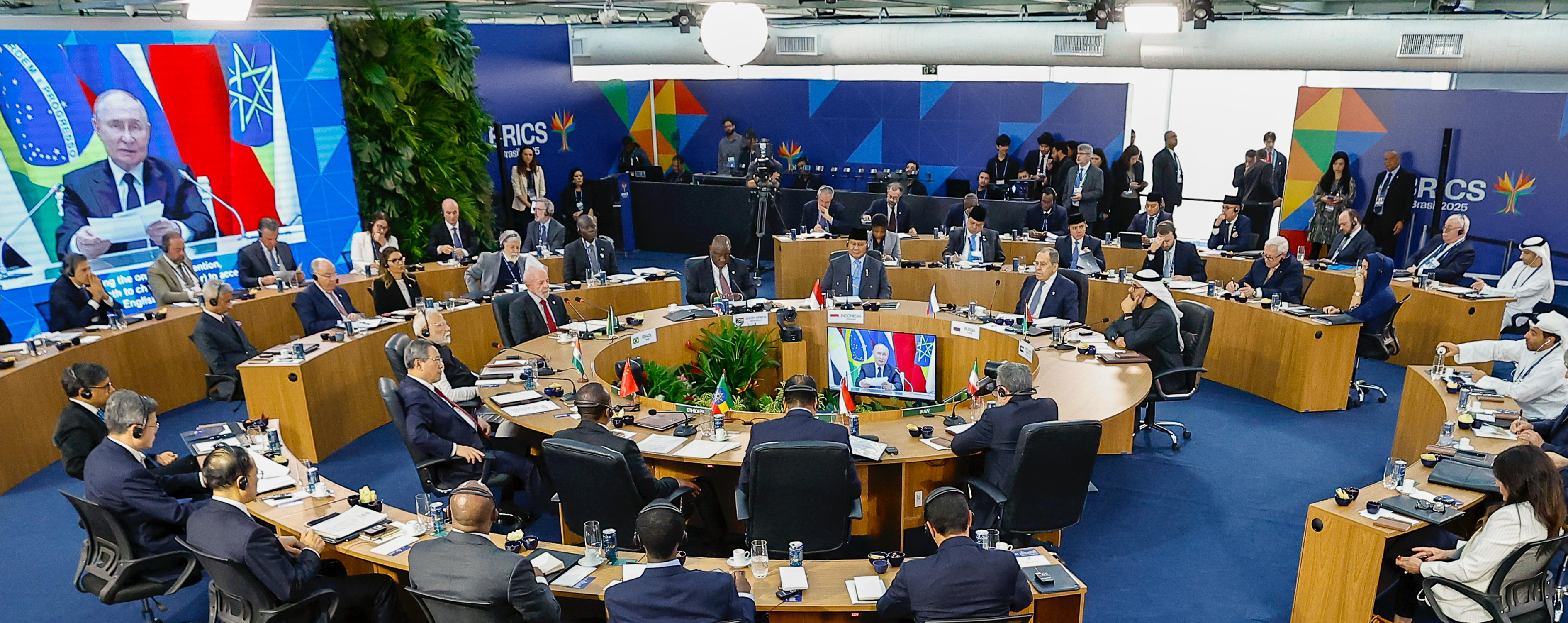
BRICS has evolved from a loose acronym of large emerging economies to a more visible platform for economic and political cooperation. In the West, BRICS is often perceived as a Sino-Russian-led project to reshape international norms and institutions. The expansion of BRICS to ten member countries and ten partner countries has added urgency to the question of why more and more countries are interested. When Indonesia, Thailand, Malaysia and Vietnam opened their economies in the late 1980s, foreign direct investment from and trade with liberal democracies like the US, Europe, Australia, Japan and South Korea were instrumental. Tens of millions were lifted out of poverty, developing countries turned into modern middle-income states with vibrant economies. Today, their ties with the West remain strong and friendly. At the same time, these four ASEAN states have turned to BRICS.
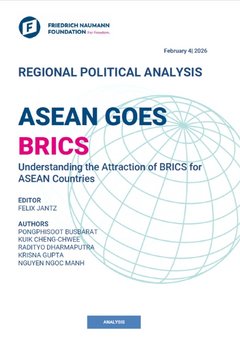
The Friedrich Naumann Foundation for Freedom has commissioned a paper – ASEAN GOES BRICS – which explores why Indonesia, Thailand, Malaysia and Vietnam have turned to BRICS. Experts from these four countries have each written a chapter.
Balancing, Growth and Status
Krisna Gupta and Radityo Dharmaputra from Indonesia argue that their country’s BRICS membership links hopes for economic diversification and market access with President Prabowo Subianto’s agenda to elevate Indonesia on the world stage. Malaysia’s Cheng-Chwee Kuik writes that Prime Minister Anwar Ibrahim’s BRICS bid is a hedge amid great-power rivalry, which also supports the domestic legitimacy of Anwar’s Unity Government. Pongphisoot Busbarat from Thailand sees the kingdom’s BRICS interest through the lens of “bamboo diplomacy” - a pragmatic balancing act that also aims to restore international visibility after a period of passivity in foreign policy. Vietnam’s Nguyen Ngoc Manh writes that his country’s BRICS partner status is aimed at boosting autonomy under Vietnam’s defence doctrine, deepening Global South ties and diversifying development finance.
None of our authors interpret their country’s BRICS engagement as a choice for a geopolitical camp. Instead, they frame BRICS affiliation as an avenue to expand options in an uncertain world. They see geoeconomic diversification, status- and voice-seeking in global governance, as well as domestic political legitimation as drivers of interest in BRICS. Our four authors argue that BRICS’ appeal in Southeast Asia lies primarily in its broad South-South agenda and the promise of economic opportunities. Another unifying element is the shared call for reform of global governance to amplify the voice of the “Global South”. While the accounts differ in how normatively or transactionally they frame BRICS’ potential, all view it as an additional venue to diversify economic and diplomatic partnerships.
Indonesia, Malaysia, Thailand and Vietnam want to strengthen strategic autonomy and increase representation on the international stage. BRICS’ weak institutionalisation means that engagement can be presented as low-commitment and non-exclusive, making it easier to argue that closer association does not entail an end to existing Western partnerships. In none of the four countries is BRICS seen as a substitute for established economic or security relationships with liberal democracies. Rather, BRICS is a hedge against great-power rivalry. The choice to engage is shaped as much by domestic politics and development narratives as by geopolitics.
All four authors reject the simplistic reading that joining BRICS means leaving Western partners and aligning with China and Russia. BRICS engagement is embedded in careful rhetorical hedging and a broader strategy of diversification. Indonesia, Malaysia, Thailand and Vietnam continue to deepen cooperation with Western partners and frameworks while widening ties with China and other BRICS members. Thailand and Indonesia, for example, have signalled interest in closer economic alignment with the West through their OECD applications. The overall picture in Southeast Asia is not one of abandoning the West, but of a region seeking to expand its options in a more contested environment. BRICS engagement is one symptom of this broader trend.
The West Should Strengthen Ties
Implications for Western partners such as Germany are clear: If Southeast Asian countries are compelled by a more polarised international order to engage in risk management and opportunity-seeking, the most constructive response is to strengthen mutually beneficial relationships. This means credible offers on development finance, technology cooperation and enhanced market access. The EU is well placed to do this, including by advancing trade agreements. Targeted industrial cooperation can complement improved market access, with German semiconductor companies’ investments in Malaysia being only one example.
That said, emerging defence-related cooperation under BRICS stands to complicate the picture. In January 2026, China led the “Will for Peace 2026” naval exercise off the South African coast, with participation from China, Russia, Iran, the United Arab Emirates and South Africa. Indonesia, among others, attended as an observer. The fact that India stayed away points to differences within the grouping. Western partners should consider these differences in their interactions with BRICS countries. If BRICS were to evolve from an economic and political forum into a platform for military coordination among states confronting the West, Western partners would need to fundamentally reassess how they interpret Southeast Asian BRICS engagement.
Please download our paper ASEAN GOES BRICS here.
*Felix Jantz is Program Manager at the Regional Office Asia of the Friedrich Naumann Foundation for Freedom in Bangkok, Thailand.