Hungary elections
Hungary's Election Campaign

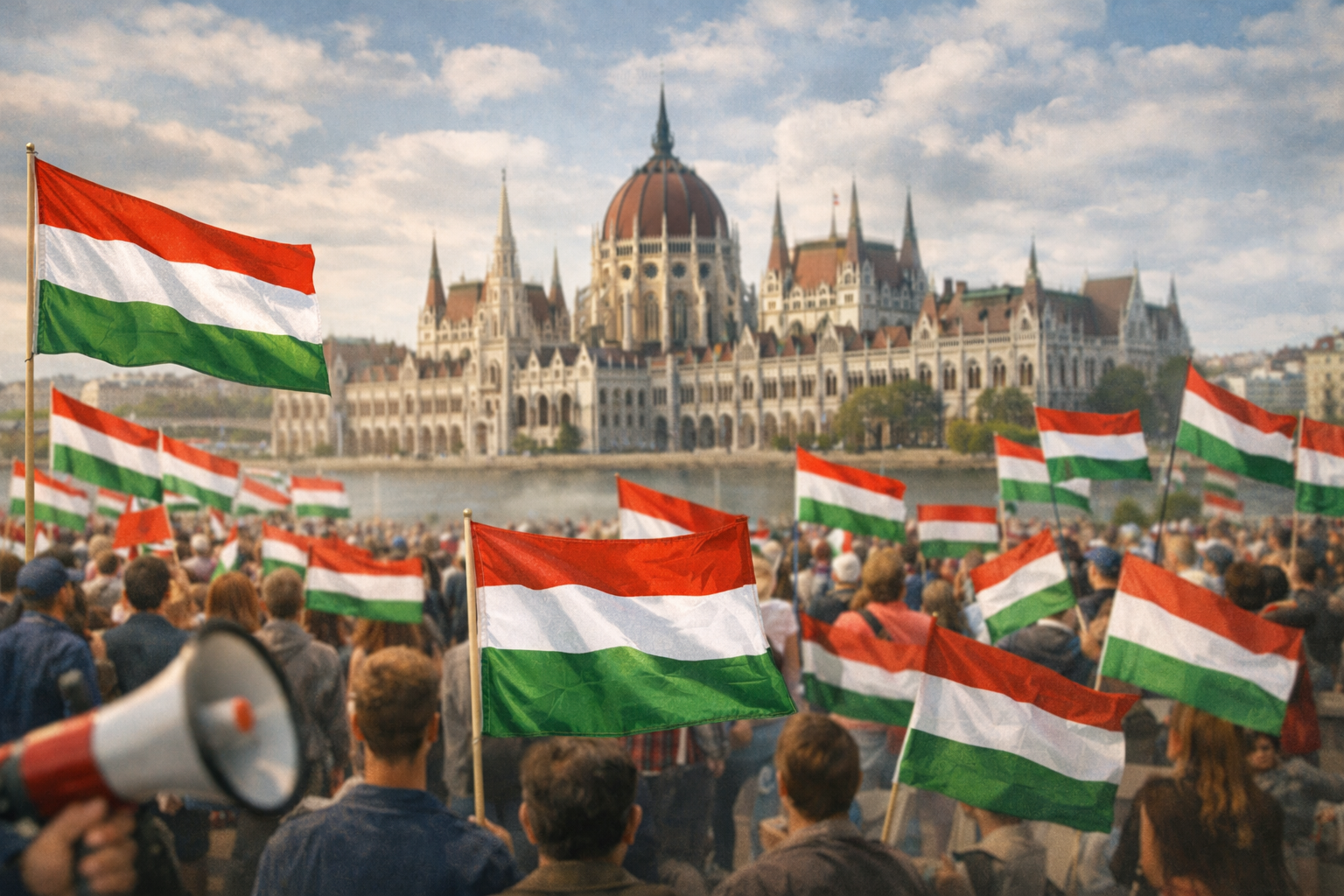
Am 12. April wird in Ungarn gewählt.
© Mit KI generiert.On 12 April, the Sunday after Easter, Hungary will elect a new parliament. The election campaign has now entered its hottest - or rather, boiling-hot - phase. Prime Minister Viktor Orbán, who has been in power since 2010, is seeking re-election for the fourth time at the head of his right-wing populist Fidesz party. He could fail. His challenger, Peter Magyar, lead candidate of the Tisza party, may well succeed in unseating the long-serving premier - at least if one is to trust the classic indicators, namely the polls and the mood in the country.
Although Magyar has been ahead in every poll for months, the election is of course far from decided. Orbán has three heavyweight allies: the electoral law, US President Donald Trump and Russia's dictator Vladimir Putin.
Number of seats in the parliament nearly halved
Orbán had the current electoral law tailored to his own needs. In 2010 he returned to power after eight years in opposition. In 2011 the electoral system introduced two decades earlier, after the fall of communism, was fundamentally overhauled. The number of parliamentary seats was cut from 386 by almost half, the run-off vote for constituency mandates was abolished, and the element of winner compensation was introduced.
Hungary now votes under a pseudo-mixed-member majoritarian system. Parliament consists of 199 seats. Each voter has two votes. Ninety-three seats are allocated via a national list under proportional representation. Any party that wins more than five per cent is taken into account in the allocation of seats according to the D'Hondt method. With the second vote, voters elect the candidate standing in one of the 106 constituencies. Here, the majority principle applies.
Constituency winners benefit twice
A special feature of the Hungarian electoral system is the compensatory vote. The party of the candidate who wins in a constituency is credited, on the list side of the system, with the number of votes by which that candidate is ahead of the runner-up and which are treated as surplus votes. Nor are the votes cast for the defeated candidate lost; they too are taken into account in the allocation of the 93 list seats. The constituency winner therefore benefits twice over: through the mandate won and through the crediting of surplus votes to the party on the national list. But the loser also benefits in one respect: the constituency may be lost, but not the votes won there.
If the opposition is fragmented and three, four or more candidates stand in a constituency, the chances are high that Fidesz will not only win the seat but also secure a large number of compensatory votes. In the last four elections - in 2010, 2014, 2018 and 2022 - Orbán won a two-thirds majority on each occasion. The present electoral system was first used in 2014. In 2010, frustration with the record of the then Socialist government had helped Orbán to a sweeping electoral victory. Since 2014, however, he has profited from an electoral law modified to his own specifications, which has repeatedly handed him a two-thirds majority in parliament even though his share of the list vote was in some cases well below that threshold.
Precisely placed images, gestures and words
This time, the opposition parties have joined forces, less out of enthusiasm for Magyar than in order to improve their chances of defeating Fidesz in the constituencies and thereby sending Orbán to the opposition benches. The liberal Momentum party has not stood at all. And yet the polls, which consistently show Magyar in the lead, reflect voters' intention to give their list vote to a particular party. Predicting the outcome in the 106 constituencies is virtually impossible, not least because of the difficult-to-calculate number of compensatory votes.
But Orbán is not merely the head of government of a medium-sized state in eastern Central Europe. In recent years he has also fashioned for himself the role of a figurehead of global right-wing populism. Small wonder, then, that he can count on support from both Washington and Moscow. For a long time there was speculation that Trump might pay his admirer in Budapest a visit at the moment most useful for campaign dramaturgy, thereby boosting him on the world stage through a few carefully deployed images, gestures and words. That has not happened. Yet one man who still intends to make it to the Danube before polling day is Trump's Vice-President, the self-styled defender of free speech, J.D. Vance. He is due to come to Budapest in the days after Easter. As for assistance from Moscow, it consists of a combination of open expressions of sympathy for the incumbent premier, intelligence activity, cyber-attacks, and the targeted injection of pro-Russian narratives into the media and social networks.
Intellectually pathetic propaganda narrative
The messages Orbán is spreading during the campaign offer little that is new. He divides the world into black and white, presents himself as the guarantor of stability, peace and national sovereignty, and as the apologist for a Christian-Western ideal of state, society and family that must, he claims, be defended against a decadent European Union - allegedly controlled by a Kafkaesque bureaucracy and a war-hungry Ukraine, and afflicted by sclerosis in matters of principle and morality. Four years ago the premier resorted to this intellectually threadbare propaganda narrative before. Even though it was essentially transparent even then, it resonated - above all because the start of Russia's full-scale invasion of Ukraine coincided with the hottest phase of the campaign.
By now, however, the crisis afflicting the Hungarian economy, as well as the education and healthcare systems, has reached a level against which Orbán's megalomaniac agitation is proving ever less effective. His challenger Magyar is focusing on the country's concrete problems. He accuses Orbán - whom he knows, for whom he worked, and with whom he has broken - of authoritarian leadership, corruption and a dangerous closeness to Russia. He is also venturing into the provinces, especially into areas where Fidesz has so far had its strongholds and where opposition politicians had previously scarcely dared to go.
Intensification of the EU stress test
This time, voter mobilisation is extraordinarily high. Mass demonstrations involving tens of thousands of participants on both sides have shaped the campaign, especially around Independence Day on 15 March. These rallies show just how deeply politically divided the country is. At the same time, opinion polls point to what could be a record turnout.
Orbán is doing much to ensure that he does not leave the electoral arena as the loser. Too much is at stake for him and for the network of loyalists who, over the past sixteen years, have occupied key positions in the state, public administration and the judiciary, as well as in parts of the economy and the media. An extension of his term by another four years would not only be bad news for Hungary. It would also mean a further intensification of the stress test for the EU created by Budapest's habitual troublemaker.
Without shots, drones, and bombs
But perhaps the Hungarians are about to make democratic history. If they were to vote Orbán out of office, they would prove something to themselves, to Europe and to the world that ought to be self-evident, but in times as turbulent as these seems to have been forgotten: that despots can be consigned to the annals of history by thoroughly democratic means, without a shot being fired, a drone taking off or a bomb being dropped.
Election Sunday, the Sunday after Easter, bears in the church calendar the resonant Latin name Quasimodogeniti - in English: Like the newborn children. Perhaps this word will prove a portent for Orbán, that supposedly so devout Reformed Christian. Perhaps, on 12 April, something genuinely new will begin for Hungary.