Position Paper
Future in Focus - Stability, Security, and Democracy in Central and Eastern Europe

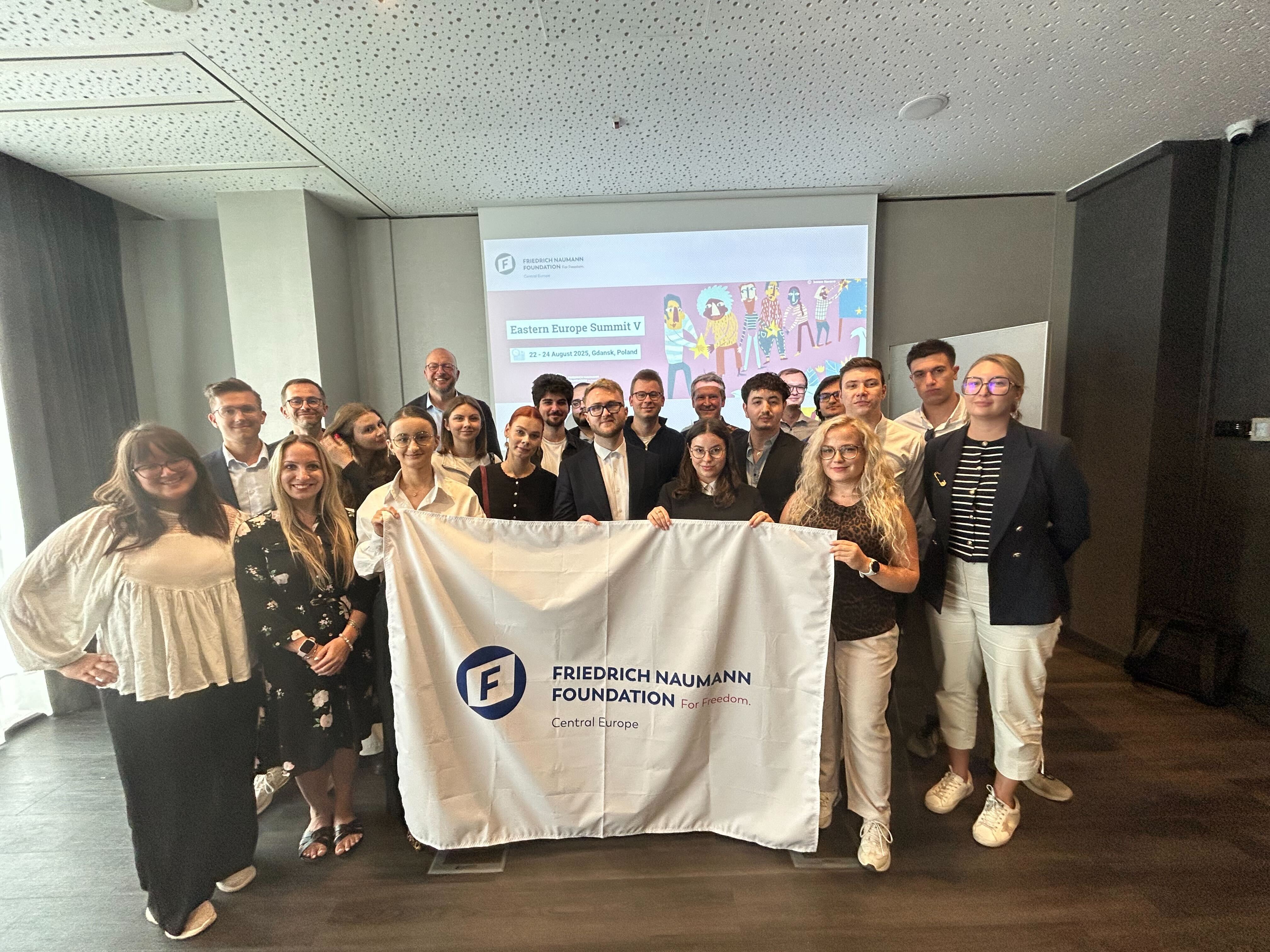
From August 22nd to 24th, the FNF Central Europe, in cooperation with the Junge Liberale (JuLis) and International Federation of Liberal Youth (IFLRY), held the fifth Eastern European Summit in Gdańk, Poland.
The Eastern Europe Summit was taking place in Gdańsk, the historic birthplace of the Solidarność movement, a powerful symbol of civic courage, democratic awakening, and resistance against authoritarianism. This location reminds us that the struggle for freedom, the rule of law, and human dignity is never complete, and each generation must carry it forward. Against the backdrop of growing geopolitical uncertainty, democratic backsliding, and hybrid security threats, the summit focused on three interlinked themes that are crucial for the future of the region: the role of youth and civil society in strengthening democracy and the rule of law; emerging security challenges in the Baltic Sea region; and Poland’s role as a pillar of stability in Europe. The results were elaborated in a new position paper.
These topics reflect the urgent need to empower young people as defenders of democratic values, to address the Baltic Sea’s rising strategic importance amid hybrid threats, and to recognize Poland’s responsibility as a key actor in ensuring regional security and European unity. By convening in Gdańsk, the summit sought to draw inspiration from the legacy of Solidarność — proving that collective action, solidarity, and civic engagement remain the strongest foundations of a free and democratic Europe.
The results of the discussions and expert inputs in Gdańsk were compiled in a joint paper. It contains the collective demands of 15 liberal youth organisations across Central and Eastern Europe. We strongly believe that its calls for action are essential in solving the aforementioned challenges.
The paper reflects the determination of young liberals across Central and Eastern Europe to safeguard democracy, stability, and freedom amid rising authoritarian pressures. It underscores the underrepresentation of youth in politics and calls for stronger civic education, sustainable funding for NGOs, and closer cross-border cooperation among youth movements. It also reflects concern over the spread of authoritarian influence and emphasizes the need for free media and civil society as pillars of resilience.
The paper reflects growing security challenges in the Baltic Sea, now viewed as a critical front in hybrid warfare. It highlights Russian sabotage of energy and communication infrastructure and calls for enhanced EU-NATO cooperation, major investments in maritime defense, and solidarity among regional actors. Maintaining the Baltic Sea as an open trade route, while effectively responding to hybrid attacks, is presented as vital for regional prosperity and stability.
Finally, the paper reflects recognition of Poland’s pivotal role as a pillar of stability in an uncertain Europe. It portrays Poland as a democratic leader and strong NATO ally, but warns that domestic polarization threatens its credibility. It calls for Poland to reinforce the rule of law, revitalize European cooperation mechanisms, strengthen the EU’s eastern security, and support Ukraine and EU enlargement. Overall, the paper reflects a shared vision that youth engagement, liberal values, and regional cooperation are indispensable to Europe’s democratic and secure future.