DISINFORMATION
Chaos of propagandists: hijacking traditions, armament blocking peace, and the invader deserving forgiveness


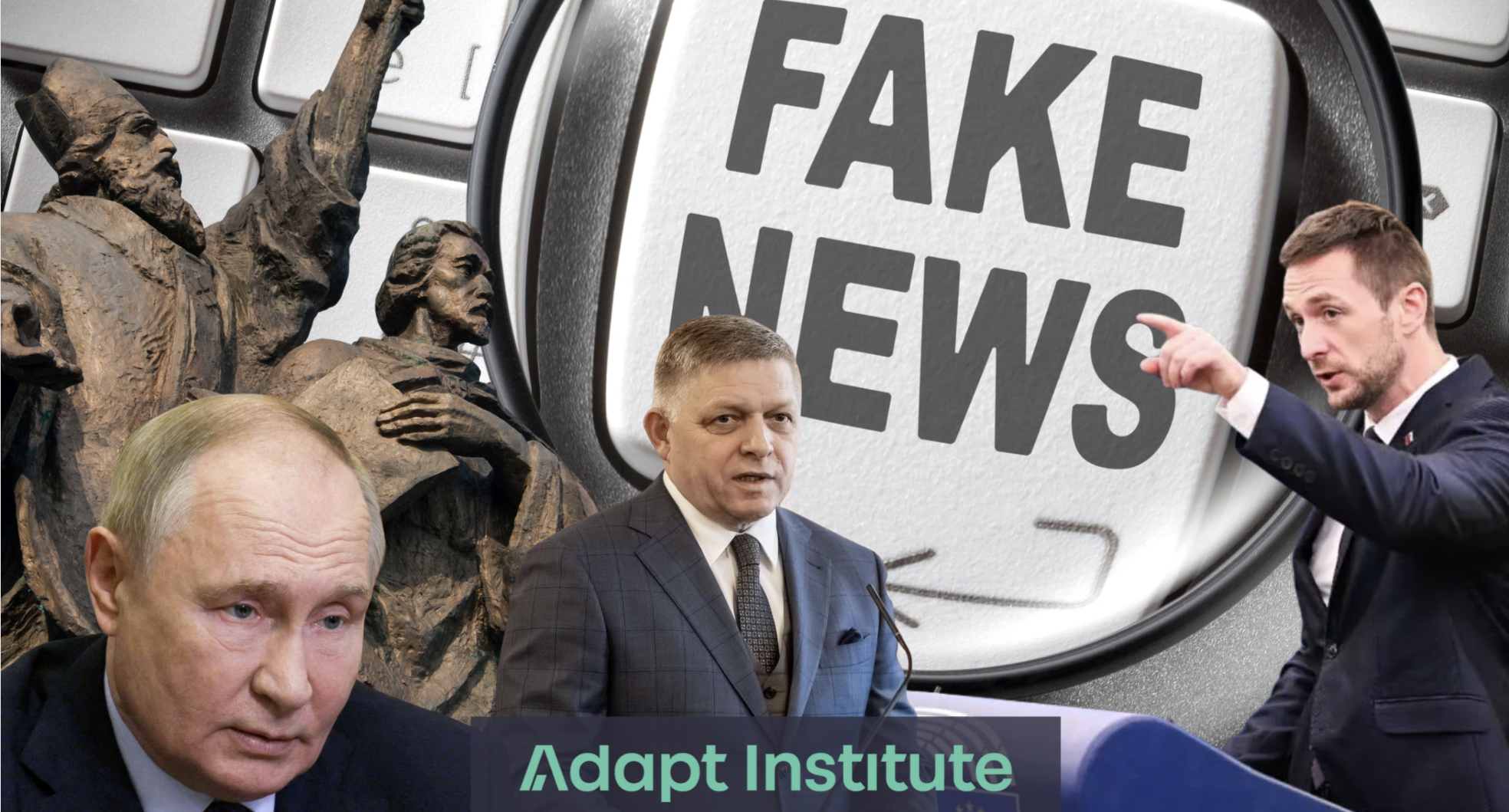
Adapt Institute provides an overview of disinformation trends that have been on the rise in the last two weeks:
- The topic of increasing defence spending remains on the agenda. Disinformers and propagandists are particularly bothered by the fact that armament is supposed to hinder peace negotiations. At least, that is how they try to present it. Russia, they say, no longer poses a threat, and we must seek ways to forgive its aggression. The so-called consideration of other solutions, such as Slovak neutrality, is still on the table.
- Another year, another celebration of traditional values and the arrival of missionaries at Devín castle. Under the guise of protecting Slovak identity, the ruling coalition has managed to communicate a tangle of tried-and-tested propaganda narratives. Slovakia is sovereign, unyielding and wants to reach out to Russia across the Iron Curtain for peaceful cooperation. While the West allegedly celebrates only bloody kings, Slovakia celebrates scholars. What does this imply? Merely mental shortcuts.
- The traditional far-right barrage against European Union (EU) institutions was also present. In addition to calling for Ursula von der Leyen's dismissal, MEPs from the Republika movement also exalted themselves with scaring people about the digital euro and the ban on combustion engines. They claim these are threats to freedom and normal men.
Handshake across the Iron Curtain
The increase in defence spending has been a thorn in the side of many disinformation actors and a significant part of the governing coalition since mid-June. In our previous report, we outlined narratives that questioned the need for rearmament and manipulated the image of an aggressive West. The disinformation scene continued to surf the waves stirred up by Robert Fico's statement on Slovakia's neutrality in the days that followed. NATO, for example, was no longer just an aggressive alliance, but a feudal empire actively blocking peace negotiations.
This is one of the reasons why we took another look at the topic of armament (not only) in Slovakia over the past two weeks using the Gerulata Juno analytical tool. We used it to analyse the most popular posts on Slovak Facebook that contained the keywords ”armament” or ”NATO”. We excluded posts that did not contain problematic narratives from the list. We then evaluated the posts based on the total number of interactions (the sum of all reactions, comments and shares).

The post with the highest number of interactions belongs to PM Robert Fico. In it, Fico talks about the failure of international mechanisms in adopting mandates for the use of military force. By this arbitrariness of the powers, he is probably referring primarily to the US attack on Iran. He states that such actions lead to ”an unprecedented deterioration of the security situation with a real risk of a new global military conflict". Despite his own words, Fico continues to reject armament, partly because it is allegedly discussed ”much more than peace”. According to the PM, armament is not a priority for Slovakia in the coming years, and he prefers to operate with the narrative that, as a member state, it should decide in the future whether “it will respect the obligations arising from membership or adopt a different solution in the future”. Fico is thus once again, this time in diplomatic language, hinting at Slovakia's withdrawal from NATO. He points to growing tensions in the international system, but offers no solution – unless we count empty platitudes about peace.
In a second post, also published by the Slovak PM, Robert Fico tried to defend his foreign-affairs minister. Juraj Blanár recently made a statement that Russia should be forgiven for the war in Ukraine. For Fico, this is a sovereign opinion and a joint rejection of the ”idea of an iron curtain”. Such rhetoric, which, among other things, completely undermines any efforts by Ukraine to defend its own sovereignty, is also a speculative move by the Slovak PM for the future, when the war in Ukraine ends: “We are already symbolically reaching out across the Iron Curtain.” In addition to reiterating his opposition to increased military spending, Fico adds that, unlike others, he also talks about the dangers of NATO membership. Questions such as "What will we do if NATO drags us into a senseless military adventure?" are, however, more of a Russian-style recipe for destabilising the unity of the alliance. If the PM is set to prepare the ground for Slovakia's withdrawal from NATO, it would not look any different..
The third post was published by the Slovanský výbor (Slavic Committee) page, which can boast a long history of importing pro-Russian narratives into the Slovak information space. This video, in which Vladimir Putin rejects numerous warnings from Western intelligence services about Russian armament and preparations for an attack on the West, is no exception. He claims that this is “the most absurd lie with which they are trying to convince the populations of Western European countries”. Needless to say, the page accepts the Russian president's statement and disseminates it without any criticism. Logically, they do not mention, for example, that very similar words were spoken by Putin before the invasion of Ukraine. He communicated messages resembling those throughout the winter of 2021 and 2022. Just a few weeks later, we were able to watch the attack on Kyiv and other Ukrainian cities live on television. The Russian president is simply not a credible partner for negotiations. Presenting the opposite image is nothing new. The same is true of narratives that Russia is just an innocent victim, unjustly surrounded and wrongly accused of preparing aggression. History shows that these warnings have been proven true.
Another post was published by the official profile of the SMER-SSD party. It shared a video by MEP Ľuboš Blaha, in which he accuses the EU of dictatorship, terror and fabricating corruption scandals. According to the MEP, the EU is trying to force small states into obedience, which leads to armament. Blaha contrasts the increase in spending with rising energy prices, for which he partly blames Brussels and the sanctions against Russia. According to Russian propaganda, these sanctions are ineffective and only hurt us. Blaha goes on to say that Brussels wants to "declare war" on Slovakia, literally. Allegedly for blocking sanctions against Russia. This is Blaha's response to an article published in the magazine EU Observer. Of course, the magazine has no institutional links to Brussels or the EU, but that does not bother Blaha or his audience. Brussels simply wants to declare war on Slovakia in this reality.
The last post in the list was published by Miroslav Heredoš. The unsuccessful politician and former candidate of the far-right Republika movement says in the video that "sensible citizens reject NATO, want to leave, want peace". With these words, Heredoš responds to Interior Minister Matúš Šutaj Eštok, who rejected speculation about Slovakia's withdrawal. According to Heredoš, Slovak citizens "refuse to remain in an aggressive alliance" that "is inciting war against the Russian Federation" and "is disproportionately arming itself to 5% of GDP". However, apart from obvious manipulation and well-worn narratives, there is nothing tangible in the post. The latest polls clearly show that Slovaks want to remain in NATO.
We seek peace, not armaments
In addition to the top posts, other regular figures on the disinformation scene also jumped on the bandwagon of increased military spending. Robert Fico's words were naturally and predictably supported by, among others, Ľuboš Blaha, who is ”all for an “alternative solution”” rather than respecting Slovakia's NATO commitments. Alongside narratives about “an anti-Russian jihad into which the raging West is pushing us” and “warmongering against Russia”, the MEP continuously espouses the idea of neutrality. However, he is perhaps one of the few who would openly admit that what he actually means is a return to Moscow's sphere of influence.
Slovakia must "open a serious discussion about its future", according to Eduard Chmelár. For the former advisor to the prime minister, today's NATO is a “feudal empire”. According to Chmelár, the increase in military spending was not "the result of negotiations or cooperation". On the contrary, he views it as “an open dictate with an ultimatum”. Chmelár naturally ignores the fact that the Slovak defence minister and president (along with other member states' representatives) voluntarily agreed to the spending. Similarly, he fails to mention that Slovakia will have relatively broad scope for increasing spending – in the context of dual-use spending, non-military investments (e.g. in infrastructure) will probably also be counted.
Chmelár similarly manipulates the facts in another post, this time working with theories that the “obsession with insane armament” is the work of a “network of lobbyists” from the arms industry. Without citing any sources, Chmelár uses rhetoric about the majority of “peace-loving citizens” who are against “absolutely senseless, unjustified and self-serving increases in military spending”. He thus creates a false analogy in which peace and armament are opposed to each other. He omits the factors of growing tension, Russian aggression and the logic of deterrence.
Blaha's party colleague Katarína Roth Neveďalová chose a slightly more diplomatic tone, calling in her post for us to give "a chance to negotiations" instead of "an arms race and preparations for a major global conflict". According to the MEP, it is time to "finally demand a ceasefire and real negotiations from Ukraine and Russia as well". Taken on their own, these words are essentially appropriate, but in the broader context of Neveďalová's rhetoric supporting Russia's vision of ‘peace’ (read: Ukraine's capitulation), they are yet another attempt to divert attention from the threat posed by Moscow. The West is not arming itself for no reason, and it cannot be said that it has not created opportunities for negotiation. It is just that there has been a lack of interest on the Russian side.
Milan Uhrík and his colleagues from Republika are trying to use the issue of armament primarily for two things: to create an image of themselves as protectors of the social interests of the people and to attack the ruling coalition, which they accuse of hypocrisy (saying one thing at home and doing another abroad). To illustrate this, in one of his posts, Uhrík contrasts armament with the social safety of the general population: “We want to live, not arm ourselves and spend huge billions on the purchase and production of weapons and constantly wage war.” Of course, neither Uhrík nor Slovakia will decide whether the war will affect them or not. This makes questioning the need for armament all the more reprehensible.
In his next post, Uhrík continued with a strong rejection of political interference "by Brussels in Slovakia's internal affairs". He described Slovak President Peter Pellegrini's promise that Slovakia would spend 5% on armaments as one of the absurdities that "our progressive and pro-war colleagues from the West want to impose on us".
Jozef Viktorín (also from Republika) used similar rhetoric, taking advantage of the situation to attack Ivan Korčok from the opposition Progressive Slovakia party. This time, healthcare was contrasted with armament. While Korčok pointed out that such discussions lead nowhere because "without defence and security, everything is nothing", Viktorín relied on a tried-and-tested false dilemma and the narrative that "bullets, tanks and missiles have never healed anyone, but on the contrary, they have always taken lives". He wanted to point out the ‘confused priorities’ and ‘misguided values’ of the opposition, which allegedly wants "to hand Slovakia over to Brussels and the West in general". However, Viktorín offers no answer to the fact that without armament, the victims of a possible attack on Slovakia would indeed be condemned to defencelessness and the deplorable state of the hospitals.
A brief note on the abuse of history and “traditional” values
After twelve months, the Devín castle hosted another celebration of the arrival of St. Cyril and St. Methodius (medieval messengers of faith), which cost the ruling coalition €750,000. A year ago, at the same place, PM Robert Fico announced his return to public life after an assassination attempt and declared a fight against progressivism and liberalism, which he described as a cancer or poison. This time was no different.
In his speech, Robert Fico spoke, among other things, about the threat of losing Slovak identity and values. These are allegedly threatened by “enemies of our own state” who “want us to have no national, cultural or spiritual identity.” Fico sought to use the historical legacy of the missionaries primarily to justify his own political decisions, which he claims are intended to protect the sovereignty of the Slovak nation and its traditions.
The prime minister wanted to apply this rhetoric, quite clumsily and forcefully, in foreign policy as well, saying that Cyril and Methodius united people and "did not build new iron curtains". Fico was, of course, referring to his long-standing narrative in which he accuses Western countries of aggressive policies and warmongering against Russia. In a similar vein, he continued with calls for Slovakia not to be submissive and obedient to Europe. An expression of sovereignty should also embody extending a hand "for peaceful cooperation" (with Russia) or trying to "understand partners" and "the motives behind their actions".
Of course, it would not be a speech by the Slovak PM if he did not include attacks on the opposition and the media, which he claims have no idea "what national pride, sovereignty and national interests are", but on the contrary know very well what "serving foreigners" means. Ľuboš Blaha also took advantage of this opportunity to claim that the opposition and the media hate Cyril and Methodius. Why? Because according to him they somehow prove that Slovaks are “a traditional Slavic, peaceful and educated nation that the West will never subjugate”. He continues with mental shortcuts about ”Western nations celebrate bloody kings and conquerors” and Slovakia celebrates ”scholars, because we are not about war, but about wisdom and education”. In doing so, he tries to draw a thick line between Slovakia and its allies.
Hence, not a thing new in Slovakia – behind a heavily embellished story about missionaries and the protection of traditions and values, Robert Fico is hiding his political moves, which are pulling Slovakia away from its partners. Statements such as “we have a different view of war, we want peace, we want to enshrine common sense [by which the prime minister means two genders] in the constitution” may be emotionally charged, but they are empty of content. They reek of the sulphur that Fico spews exclusively at the West, while pretending to be a mediator of peace.
Brussels, daily bread for disinformers
What kind of report would this be if it did not note attacks on EU institutions in the Slovak information environment? And what kind of two weeks would it be if MEPs from the far-right Republika movement were not the main agents in spreading these narratives? As in the previous report, the following posts are among the most successful in terms of interaction.
Milan Mazurek's post, in which he explains the digital euro project to his audience as “a tool for totalitarian control of our population, where unelected bureaucrats will determine how much of what we can buy”, received more than 45,000 interactions. The MEP for the Republika movement plays on fears of loss of freedom and likens cash to the last bastion of sovereignty.
Mazurek's party leader Uhrík takes a similar approach in his post. Through the narrative of protecting individual freedom of transport and the choice of car, he attacks EU projects such as the Green Deal in a typical way. He presents combustion engines not only as something untouchable, but also as the domain of “normal men”. He thus manipulatively creates two conflicting levels – combustion engines as something natural and worthy of protection, and the fight against climate change as something new and unwanted.
Uhrík also boasted about the planned dismissal of Ursula von der Leyen, whom he accused of destroying Europe "through migration and the promotion of a nonsensical green and rainbow agenda". Among other things, he managed to list topics that he gladly instrumentalises and abuses to score political points by this. The vote of no confidence in the President of the European Commission over the so-called Pfizergate scandal is scheduled for 10 July. It can be expected that this will be one of the dominant topics in the coming days.
Project is organized by Adapt Institute and supported by the Prague office of the Friedrich Naumann Foundation for Freedom. It continuously monitors the activities of both Slovak and foreign disinformation actors, but focuses mainly on the former. The project activities are built upon daily monitoring of emerging disinformation, hoaxes, and conspiracy theories in the online information space. This approach allows the analysts to identify disinformation posts and narratives that resonated with the public the most, as well as to find out where they originated, and how they spread and evolved on social media. The report takes the form of a bi-weekly summary of arising trends in the spread of malicious information content online. Based on that, Adapt Institute can inform the public about emerging and current trends in the field of disinformation, manipulation, and propaganda.