Disinformation
Celebrating peace in Beijing and exploiting death to spread hatred. Slovakia continues with its tried and tested methods


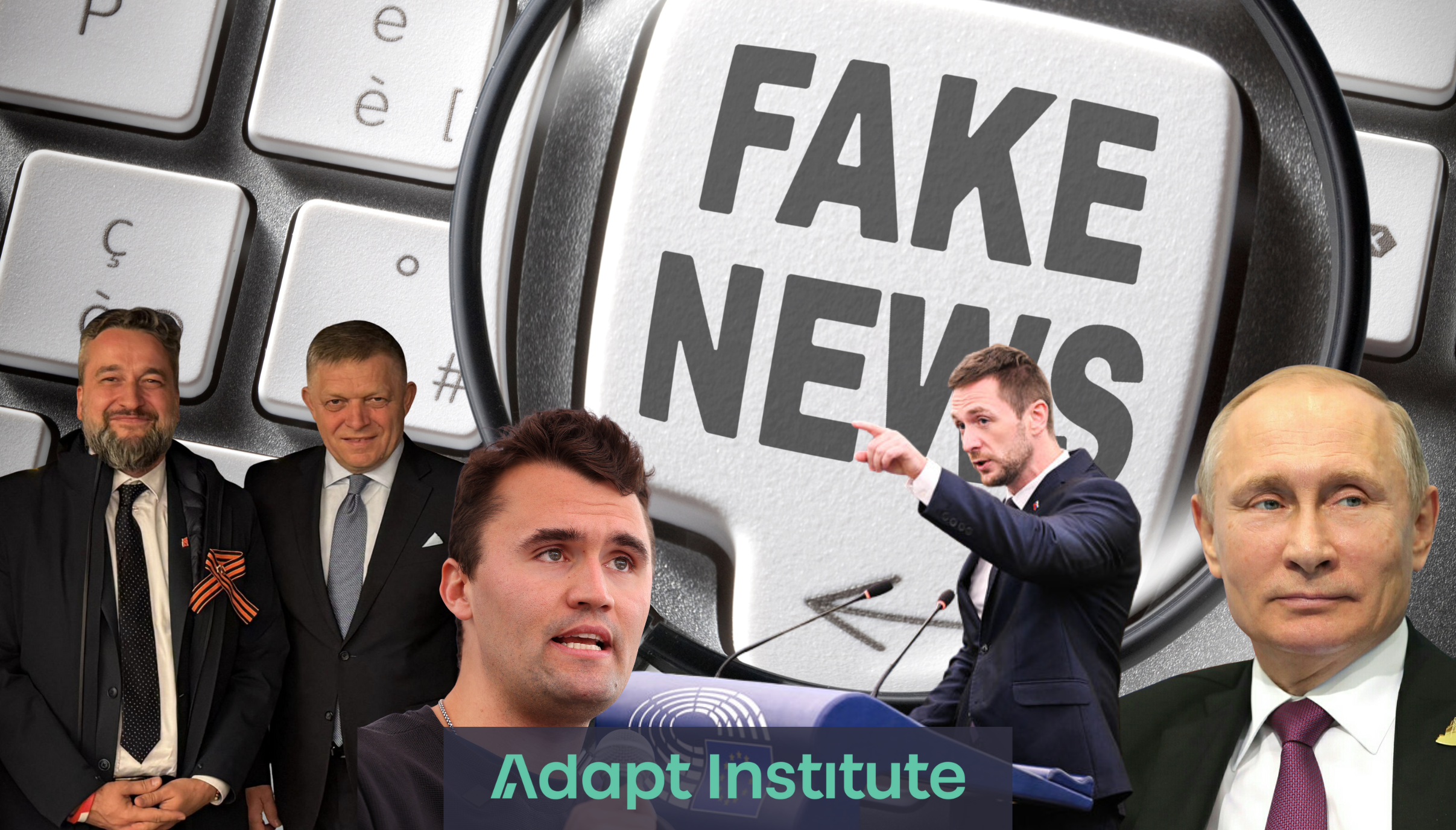
Adapt Institute provides an overview of disinformation trends that have been on the rise in the last two weeks:
- After another meeting between Robert Fico and Vladimir Putin, this time in Beijing, the pro-Russian strike force of government officials focused on glorifying Russia and China. The Slovak PM was presented as the only European leader who understood the new international order. The negotiations are said to be proof of the success of Slovakia's foreign policy, which is oriented towards all corners of the world, while the European Union (EU) has fallen behind the times.
- The death of American conservative Charlie Kirk provided an opportunity to stir up a spiral of hatred in Slovakia as well. Comparisons were made with the assassination attempt on Robert Fico and attacks on progressives and liberals (the media and the opposition), who were almost automatically blamed, resurfaced. Although an investigation was underway and information was lacking, this did not deter the disinformers.
- Some actors similarly tried to exploit the murder of Ukrainian migrant Irina Zarutskaya in Charlotte, USA. Representatives of the far right in particular spoke of the failure of Western society to adequately punish crime. They manipulatively linked the issue to racism and claimed that the media was deliberately silent on the subject.
In the company of dictators
Robert Fico met with Russian President Vladimir Putin for the third time over the last year. This time, at the celebrations marking the end of World War II in Beijing, he asked Putin how he was doing. He then continued with an analogy about frogs in a well – these are supposed to be Western countries and the EU with a limited view of world developments. Fico (unfortunately) continued with similar narratives in his subsequent statements.
The Slovak PM also praised the company of dictators from every corner of the world on his Facebook profile. He tried to show the gravity and significance of his participation through claims about carrying a "serious message for the Ukrainian president." Fico met with him just a few days after returning from China.
Regardless of the content of the closed meeting between Fico and Putin, and regardless of the PM's words that "as the head of a sovereign state, no one will tell him where he can and cannot travel," it is at least questionable why the PM of an EU member state is willing to deliver messages from Moscow to a victim of Russian aggression.
In addition, Fico used his visit to spread three narratives – the first of which was rhetoric about a so-called sovereign foreign policy in all directions. Once again, its eternal success (despite isolation in the West) was proclaimed, as evidenced by the PM's negotiations in China. Fico tried (and is still trying) to sell his audience and voters a reality in which Slovakia is participating in the shaping of a new world order. He attributes a key role in this process to Russia and China, which he continuously glorifies in his speeches. According to the PM, they bore "the greatest burden of World War II".
On the other hand, according to the PM, EU member states have made a big mistake by ignoring China's celebrations. He claims that this is even a sign of the EU's isolation, which, thanks to "its short-sightedness and conceit in world politics, is being relegated not to second place, but to third place." This claim forms the core of the second narrative, in which Fico, in addition to questioning the unity of the EU's direction, also aimed at further rapprochement with regimes that have little in common with democracy.
Fico specifically seeks to create an image that ignores Russian aggression or even China's approach to human rights (among other problematic issues). The Slovak PM tries to justify this Slovak rapprochement with the East by talking about China's all-around boom (which can't be ignored) and reviving the choice between peace and war. You guessed right that China is on the side of peace in this third narrative of Fico's rhetoric.
The claims attacking the EU were also taken up by State Secretary of the Ministry of Defense Igor Melicher. In addition to the expected praise for his party leader (Fico "as the only leader in the entire Union" who understands that the world order is changing), Melicher also repeated narratives about unelected officials who have missed the boat and are leading Europe to inevitable decline with their green policies. At the end of the post, which was also shared by the official SMER-SSD website, Melicher even recommended that the EU should "adopt Robert Fico's political view." We can probably understand this as an exchange of values for power.
As the icing on the cake, Melicher added in his post that the EU does not want to "abandon a war in which it has a hand." Ľuboš Blaha played on a similar note (attacks on Slovakia's living space and allies). In one of his posts, the SMER-SSD MEP repeated the fable about the frogs in the well. According to him, one of them is the EU, which "sees only a small part of the world, but would like to tell everyone what to do."
As part of his obligatory scaring of his audience, Blaha also claimed that the EU will "send our children to the Ukrainian front to fight against the Russians." In another post, Blaha criticized European leaders for "spreading theatrical hatred" against the Russian president for years. Indeed, this is how the MEP explains, for example, the EU's aid to Ukraine.
Playing with lives and hatred
Slovakian public learned of Charlie Kirk's death on the morning of September 11. For many readers, he was probably a completely unknown figure. His controversial views and vacillation between ultra-conservatism and the far right had not previously attracted much attention in Slovakia. However, his close relationship with Donald Trump and the significance of his (radicalized) voice in American discourse meant that the topic was easily exploitable for political gain.
Charlie Kirk died from gunshot wounds sustained in an attack on the Utah Valley University campus. Authorities announced the arrest of 22-year-old suspect Tyler Robinson. The motive for the murder has not yet been disclosed by the authorities. The FBI declined to discuss Robinson's background, political views, or possible motive, citing the ongoing investigation. Recently, however, he reportedly became more interested in politics.
Even without this information, part of the Slovak disinformation scene was quick to decide who was to blame. Narratives about the hateful left or progressivism and the persecution of other opinions were also taken up by political representatives. Comparisons with the assassination attempt on Robert Fico were not lacking, and there were also warnings of further political violence. In essence, the situation from May 2024 was repeated to a certain extent. Disagreement with an opinion should not, of course, lead to violence—but there are actors who, even after such unfortunate events, prefer to add fuel to the fire rather than calm passions.
That is why we also looked at this event using the Gerulata Juno analytical tool. We used it to analyze the most popular posts on Slovak Facebook that contained the keyword "Kirk." We excluded posts that did not contain problematic narratives from the list. We then evaluated the posts based on the total number of interactions (the sum of all reactions, comments, and shares).

The post with the highest number of interactions belongs to Milan Mazurek. In it, the far-right MEP attempted to portray Charlie Kirk exclusively as a conservative activist with non-mainstream views who had to face oppression. The hate campaign, as Mazurek probably calls normal criticism of some of Kirk's bigoted or nationalistic statements, was allegedly led by "progressives and all those global, liberal, mainstream media". Mazurek specifically attacks Denník N and its articles (e.g. here), which explained Kirk's activities and ideological background to readers. Allegedly, these articles justified why he "deserved to die". It probably goes without saying that every traditional media outlet in Slovakia (including Denník N), regardless of its ideological leanings, expressed strong disapproval of violence (or even assassination attempts) for political reasons. Mazurek simply tried to exploit Kirk's death to further label the media and the opposition, and further frighten his audience by saying that “progressives want to see us die”.
The second post was published by the Slovak PM. Robert Fico naturally tried to liken himself to Kirk after his ill-fated experience with the assassination attempt. He claims that if today “you don't have the one correct opinion that progressives or liberals require of you, then you should be shot”. However, for the PM, it was an unusually short post. Apart from the conspiratorial tone and accusations directed at progressives and liberals (Fico also uses these words as mental shortcuts to refer to the media and the opposition), the leader of the SMER-SSD party only praised the fact that “unlike Kirk, he was lucky by a millimetre”.
The third post was published by Michal Bartek. While others used Kirk's message directly, the Hlas-SD MP showed how a person's death can be used only secondarily, as part of a routine attack on one of the opposition parties. This time it was the Christian Democratic Movement (KDH), whose MPs he had debated on TA3 television. In the excerpt he decided to publish, Bartek reproached the KDH for cooperating with Progressive Slovakia despite their differing values. At the same time, he tried to securitise the issue of the assassination attempt on Robert Fico, behind which he again viewed so-called progressive ideology. It was here that Bartek used the death of Kirk, who was supposed to have fought very actively against “diseases such as transgenderism and the like.” The Slovak MP not only dehumanised a specific group of people in a completely hateful manner and labelled them as a disease, but also wanted to use the situation to hold up a mirror to Slovak conservatives who are not doing enough to protect traditional values. According to Bartek, KDH chairman Milan Majerský allowed himself to be “blackmailed by liberal parties and sold out his Christian values”.
Another post was published by Ľuboš Blaha. He praised the protests that took place in Berlin and London in early September. He said that people in Europe should gradually wake up and jointly reject “NATO, Western militarism and Russophobia”. It is difficult to say where the SMER-SSD MEP found these messages in the protests in question. One was against migration and the other was organised against the genocide in Gaza. In addition, Blaha vehemently tried to scare his audience, pointing to Brussels at night as a symbol that “something has gone terribly out of control in Europe”. He also invoked Kirk – his murder was supposedly downplayed because of the views he espoused. Blaha thus once again accused progressives of being so fanatical that a different opinion is “reason enough to murder us”. He claims that “any one of us could end up like Charlie Kirk”. Blaha thus attributes the reprehensible actions of a confused individual to an entire group of people. He continues in his craft, which he perfected during the assassination attempt on Fico, once again adding to the hatred and toxicity in society.
The last post in the series was published by Tibor Gašpar. The deputy speaker of parliament for SMER-SSD began his video with a clear statement that “progressive media hatred has struck again”. The culprit was clear even before information about the suspect and his arrest. Gašpar linked the situation to the assassination attempt on Fico. Both he and Kirk were supposed to have become victims because they spoke “about traditional values, about two genders” and opposed “progressive experiments”. Like his political colleagues above, Gašpar also frightened his audience with the return of violence to Slovakia – it is “only a matter of time before another Cintula appears”. The so-called progressive ideology allegedly “destroys the family, faith, and the nation” and draws society “into a spiral of hatred”. Once again, the same pattern is being applied – an entire group of people (with progressive or liberal ideology) is being blamed for the actions of a lone gunman who is calling for peace and a normal life for children. It seems that some Slovak politicians will not learn their lesson no matter how many opportunities they are given.
After its summer slumber, the far right is waking up
On August 22, a young Ukrainian woman, Irina Zarutskaya, was killed in Charlotte, North Carolina. She was stabbed to death on the subway by an attacker identified as Decarlos Brown, an African American with 14 prior convictions. Milan Mazurek, a far-right MEP for the Republika party, described the murder as "a total failure of Western society". He claimed that society allows dangerous criminals on drugs to move freely among people, which leads to incidents like this.
The attacker who fatally wounded Zarutskaya did indeed have a long criminal record, including armed robbery, theft, and burglary. However, the incident itself quickly became the target of manipulation by Republican politicians, including President Donald Trump himself. In line with his pre-election rhetoric, he suggested that the crime situation is radically worse in Democratic states than in Republican ones. A similar portrayal of unbearable crime rates appeared in Mazurek's speech, who, however, depicted it as a problem of the entire Western world.
In addition, the MEP tried to portray the situation as a consequence of racism or positive discrimination. According to the part of the video he used, none of the African Americans sitting nearby helped the victim of the brutal murder, and the case was later hushed up by the media because of this. A similar message appeared in a post by Eduard Chmelár, who stated: "...no one helped her, no one noticed her, no one reported her." These claims contradict media reports stating that other passengers bent over the victim and tried to help her, while one of the witnesses informed the police about the likely location of the attacker.
Mazurek manipulates his interpretation of the situation by contrasting it with the killing of George Floyd by police officers, which sparked mass Black Lives Matter protests in 2020. In the video, he misleadingly refers to Floyd as a career criminal and drug addict who allegedly died of a drug overdose and not as a result of police intervention. Chmelár also worked with the alleged element of racism. Although he distinguished himself from Mazurek in the same status as a "star of the far right," they clearly share some ideas.
At the end of his video, Mazurek returns to the false narrative that the media is silent about the case of the young Ukrainian woman Irina and pretends that everything is fine. According to him, the media has allegedly proven that "the lives of white working people are far less important to them than the lives of everyone else." That is why, according to him, they are "the worst, most insidious and despicable evil." In the US, only a few mainstream media outlets, such as CNN and ABC News, reported on the case. It is therefore true that coverage of the story was not extensive. However, it is not possible to draw the conclusions that Mazurek came to. He similarly targeted the judiciary and politicians, arguing that if we want such things [violence and murder] to stop happening, "we must get rid of progressive leadership in our states and progressive justice."
Progressivism was also a rallying point for Mazurek's party colleague and MEP Milan Uhrík, who, after the summer break, launched a fight against "the surveillance of private messages of decent people in the EU." This is a response to a European Commission regulation proposal, known as Chat Control, to combat child sexual abuse in the online space. The measure could allow governments and private companies providing messaging services to scan users' messages in order to prevent the spread of child sexual abuse material and help identify victims. However, some disinformation actors claim that the EU is planning to start scanning all messages immediately, sometimes even before they are sent. These concerns are premature and misleading.
Mazurek himself states that, according to the proposal, this would involve constant monitoring of private communications. In his view, this is extremely dangerous legislation, which could lead to content control applications being built directly into mobile phones. In another post, Mazurek also questioned the very reason for the proposal, saying that child protection is only a pretext: "It is only a matter of time before this mechanism is expanded and abused to monitor other 'extremist' speech. For example, 'disagreement with migration' or 'rejection of the rainbow agenda'..." Instead of monitoring online communication, he prefers "medieval punishments" for pedophiles to combat child abuse.
MEPs Uhrík and Mazurek have spoken out against European legislation and specifically against EC President Ursula von der Leyen in several posts. Mazurek referred to her as a "witch" and a "witch doctor," while Uhrík claimed that she should have been in prison long ago for destroying Europe. Her plans are allegedly a recipe for poverty and disaster, as she wants to strengthen armament at the expense of poor regions, push through nonsensical green measures, and expose countries dependent on Russian energy to danger.
In this spirit, the food import agreement, which the EU agreed with the MERCOSUR economic bloc at the end of last year, was presented. According to members of the Republika, the agreement is not advantageous and, in fact, its aim is "to flood our market with cheap, low-quality food from the other side of the world." Mazurek presented the agreement as von der Leyen's diabolical plan to destroy Europe. In reality, however, negotiations on its form have been going on for 25 years, far longer than von der Leyen has been in her current position at the EC. Despite its possible shortcomings or weaknesses, analysts also highlight its positives – for both the EU and Slovakia. Politicians once again seized on complex issues, which they tried to portray manipulatively with an emphasis on emotion and controversy.
Project is organized by Adapt Institute and supported by the Prague office of the Friedrich Naumann Foundation for Freedom. It continuously monitors the activities of both Slovak and foreign disinformation actors, but focuses mainly on the former. The project activities are built upon daily monitoring of emerging disinformation, hoaxes, and conspiracy theories in the online information space. This approach allows the analysts to identify disinformation posts and narratives that resonated with the public the most, as well as to find out where they originated, and how they spread and evolved on social media. The report takes the form of a bi-weekly summary of arising trends in the spread of malicious information content online. Based on that, Adapt Institute can inform the public about emerging and current trends in the field of disinformation, manipulation, and propaganda.