BRICS
Brazil Leading BRICS: What to Expect from its Presidency?

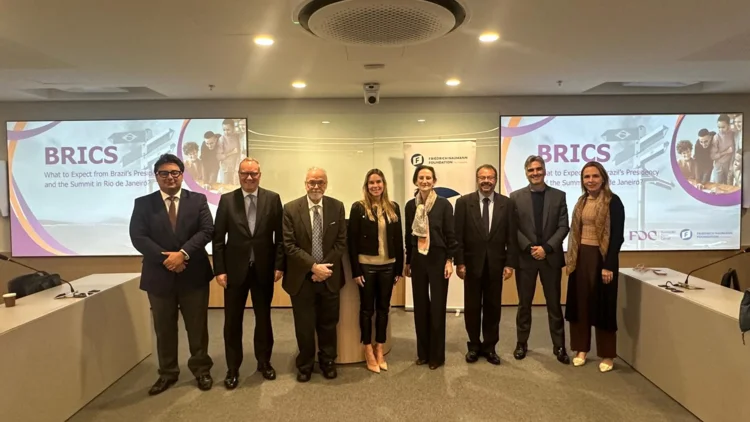
Representatives from the Fundação Dom Cabral and experts in the panel discussion on the future of BRICS under Brazil's presidency in São Paulo.
BRICS and Europe: A Strategic Response
Dr. Hans-Dieter Holtzmann, Director of the Friedrich Naumann Foundation for Freedom in Argentina, Brazil, Paraguay, and Uruguay, emphasize that Europe underestimate the growing influence of the BRICS countries. Their members countries represent more than half of the world's population and 40% of global GDP.
In light of this, the ratification of the agreement between the European Union and Mercosur presents an opportunity to maintain European relevance in Latin America. The agreement, which was ratified after 30 years of negotiations, will eliminate 90% of tariffs, thereby promoting trade and investment.
Leadership with Clear Priorities
In July 2025, Brazil assumed the rotating presidency of BRICS under the slogan “Strengthening Global South cooperation for more inclusive and sustainable governance.” This presidency reflects the continuity of a foreign policy guided by multilateralism, universalism, and pragmatism.
Almir Lima Nascimento, Director of the Institute for International Relations Research at the Brazilian Ministry of Foreign Affairs, presents that the Brazilian presidency is structured around six strategic priorities: global health; trade, investment, and finance; climate change; artificial intelligence governance; peace and security; and institutional strengthening of BRICS. This agenda is in line with the position that Brazil promoted during its leadership of the G20 and within the framework of COP30.

Dr. Hans-Dieter Holtzmann, Project Director of the Friedrich Naumann Foundation for Freedom in Argentina, Brazil, Paraguay and Uruguay, on his dissertation at the first panel.
© FNF
Internal Challenges and Pragmatism
Carlos A. Primo Braga, adjunct professor at Fundação Dom Cabral and former director of economic policy at the World Bank, argues that despite their expansion, the BRICS remain a diverse coalition with their own national agendas. The entry of new members, such as Iran, Ethiopia, and Indonesia, has strengthened their global influence but has also made joint decision-making more difficult.
André Godoy, director of the Brazilian Development Association, affirms that Brazil is adopting a pragmatic strategy. It seeks to benefit from strategic alliances in key sectors such as energy, agribusiness, and critical minerals. China is now its main trading partner, and the possibilities for cooperation in renewable energy and technology are enormous. Brazil's approach aims to strengthen its own value chains, advance in industrialization, and project itself as a regional leader, without renouncing constructive relations with the West.
A Climate Agenda with South-South Leadership
Lucas Carlos Lima, professor of international law at the Federal University of Minas Gerais and expert in environmental law, analyzes Brazil's role as a driver of an active climate agenda. Under its leadership, the BRICS have launched new initiatives, such as carbon markets, laboratories for sustainable trade, and green financing platforms.
Brazil also articulates a common position for the bloc in multilateral forums, based on climate equity, respect for differentiated responsibilities, and rejection of unilateral measures such as carbon adjustments. Although there are differences among members, the institutional progress of the BRICS on this agenda reinforces its role as a constructive counterweight to the traditional climate order dominated by the Global North.
We encourage you to read the policy paper!