News
Post Conflict Democracy Building

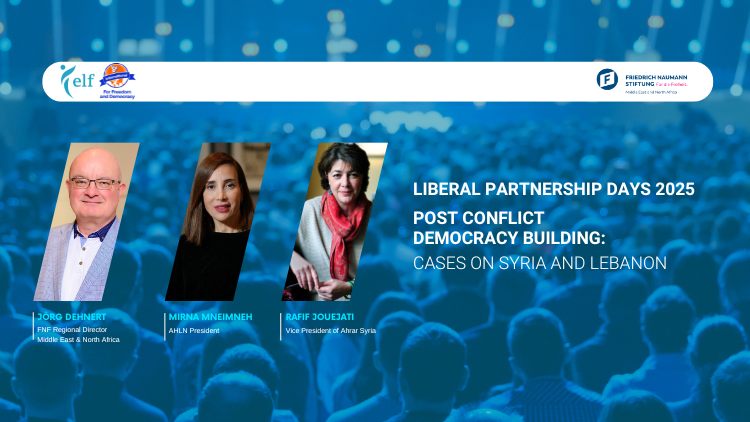
The Hague, Netherlands — 20 November 2025
During the Liberal Partnership Days
In a region long defined by volatility, shifting alliances, and protracted conflict, the question of whether genuine democratic systems can emerge in the aftermath of violence remains a defining challenge. This central issue anchored the high-level panel discussion titled “Post-Conflict Democracy Building: Cases on Syria and Lebanon – Q&A Session,” held in The Hague on 20 November 2025 as part of the Liberal Partnership Days. Bringing together regional political leaders, civil society actors, and international liberal partners, the session explored how post-conflict governance models can evolve amid contested sovereignties, fragmented institutions, and ongoing geopolitical pressures.


The event opened with keynote remarks from Jörg Dehnert, Regional Director of the Friedrich Naumann Foundation (FNF) for the MENA Region, who underscored the urgency of addressing political reconstruction in fragile states. “Democracy is built on much more than elections. You need the rule of law, a functioning constitution. Elections should come at the end of the process, not the beginning. That was a mistake made in other countries, assuming that holding elections automatically creates democracy. As we have seen, it does not.” His intervention set the tone for a conversation rooted in realism, acknowledging both the broader aspirations for democratic governance and the entrenched barriers preventing it.
Moderated by Gijs Felix, Political Advisor to the Deputy Prime Minister of the Netherlands, the discussion placed Syria and Lebanon side by side—two countries bound by history, geography, and shared structural crises, yet radically different in their post-conflict trajectories. Felix emphasized the importance of examining democratic rebuilding not as a linear process but as a negotiation between internal reform forces, external actors, and societal expectations.

Democracy in the Shadows of Conflict: The Syrian Case
Representing the Syrian perspective, Rafif Jouejati, Vice President of Ahrar Syria, offered a detailed assessment of how a future democratic order in Syria remains contingent upon the resolution of overlapping conflicts and the withdrawal of foreign military influence. Drawing on years of activism and strategic engagement in opposition networks, Jouejati highlighted the difficulty of constructing democratic institutions in a context where territorial fragmentation persists, and communities continue to experience displacement and trauma. “The transition we seek must be a true transformation toward democracy and meaningful reform. When it comes to minorities and women’s rights, the issues they are facing have not been sufficiently emphasized. However, with the upcoming parliamentary elections, and even though Parliament has not yet been appointed, there is a promise by President Al-Sharaa of the 70 seats that will be appointed directly, a 20% quota for women has been pledged. This we see as a positive step.”
While the defeat of the so-called Islamic State reshaped aspects of the security landscape, Syria remains divided between regime-controlled areas, Kurdish-led autonomous regions, and territories under the influence of various external powers. These divisions have hindered the emergence of unified governance structures. Political analysts note that without a comprehensive conflict settlement that includes accountability mechanisms, inclusive political participation, and constitutional reform, Syria risks entering a prolonged period of authoritarian stagnation rather than democratic transition.

Lebanon: A System Under Strain
From Lebanon, Mirna Mneimneh, President of AHLN and International Secretary of the Future Movement, provided an in-depth look at how a once-promising consociational democracy has been undermined by entrenched sectarianism, corruption, and the collapse of state institutions. “In Lebanon, the European Union has long been a reliable partner to the Lebanese people, and we regard European countries as true friends. They have consistently supported us, especially in times of crisis, often stepping in to facilitate dialogue and mediation. Most recently, for example, France has played an active role in mediating efforts to achieve a cessation of hostilities in southern Lebanon.”
Lebanon’s post-war system—designed to balance power-sharing among religious groups—has increasingly proven unable to respond to national crises. The 2019 uprising exposed deep public frustration with elite networks, while the 2020 Beirut port explosion revealed the catastrophic consequences of systemic dysfunction. Despite calls for reform, political paralysis continues, exacerbated by economic collapse, mass emigration, and the expanding influence of non-state actors.
Mneimneh argued that while Lebanon has democratic foundations absent in Syria—including electoral cycles, political pluralism, and civil society vibrancy—the structural obstacles to reform are significant. For Lebanon to reclaim its democratic potential, she suggested, the country must renegotiate the social contract, strengthen judicial independence, and reduce the influence of armed groups operating outside state authority.
A Shared Regional Dilemma
Throughout the session, comparisons between Syria and Lebanon illuminated broader regional patterns: weak state institutions, external interventions, competing national narratives, and generational demands for political accountability. While the contexts differ sharply—Syria in the grip of ongoing conflict and Lebanon trapped in systemic collapse—both cases point to a central truth: post-conflict democracy building requires more than elections; it requires legitimacy, trust, and the restoration of state authority.
Participants also emphasized the importance of international partnerships. European states, including the Netherlands, continue to support democratic actors in the region through capacity-building, political advocacy, and civil society engagement. However, panelists cautioned that without local ownership and inclusive political processes, external support alone cannot deliver sustainable change.
Conclusion
As the session concluded, speakers agreed that the paths to democracy in Syria and Lebanon remain long, complex, and uncertain. Yet the conversation also revealed a shared conviction: despite fragmentation, conflict, and crises, the demand for accountable governance persists across both societies. The panel underscored that while the international community can play a supportive role, the real drivers of democratic transformation will come from within—through resilient civil society actors, renewed political leadership, and long-term reform strategies.
In an increasingly turbulent region, discussions like this remind us that post-conflict reconstruction is not simply about rebuilding institutions; it is about rebuilding trust, identity, and the social fabric that allows democracy to take root.