Kenya
Making global trade work for SMEs

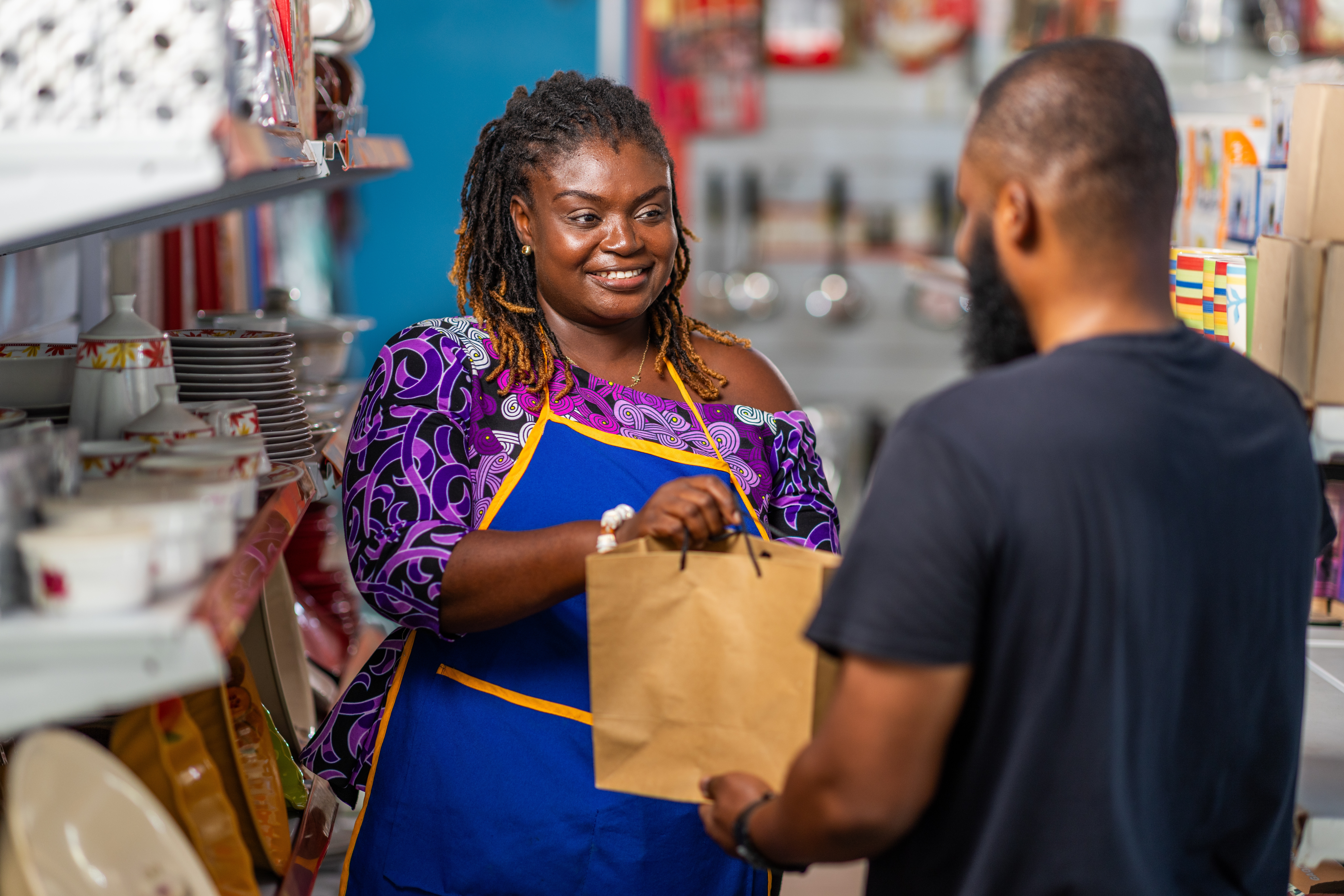
Sustainable shopping, African businesswoman serves a customer with an eco-friendly brown paper bag in her supermarket
© ShutterstockKenya’s political good will for trade with Europe is at an all time high. On paper, the macro-frameworks from President William Ruto’s high-level visit to European capitals for trade and employment opportunities have never been stronger. The EU-Kenya Economic Partnership Agreement is active and recently, Germany backed the African Trade and Investment Development Insurance with KES 4.13 billion, signaling a shift from traditional aid to de-risked investments.
While the larger scale businesses, especially those in tea, coffee and cut flowers stand to gain from duty free market access and relatively easier entry into the European market, the Small Medium Enterprises (SMEs) lag behind. This missing link is as a result of a silent combination of strict regulatory compliance and a deep-seated information asymmetry. Africa has the largest number of entrepreneurs, with about one in four working adults either starting a business or working in one to earn a living. In Kenya, small businesses form a larger part of the economy. According to Kenya National Bureau of Statistics, micro and small businesses make up about 90% of all private businesses and they employ over 14 million Kenyans.
Honestly speaking, talking about international trade to tiny businesses and informal enterprises who form about 92% of the SMEs would be unrealistic. Instead, the magic lies within the 7% of growth stage, structured businesses with the muscle to grow and the urge to scale. When this group is prepared to tackle compliance walls for global trade, a domino effect is created. They in turn are able to build and rely on the micro-businesses by buying raw materials and improving employment rates.

Building Kenyan green enterprises through targeted support on governance and compliance for global trade.
© Friedrich Naumann Foundation for FreedomThere is a specific target group that has a unique advantage; green enterprises. Understandably this has become a buzzword however, it is the companies making money while solving environmental issues. Think of the electric boda bodas, agricultural waste into energy, or recycling plastic into building materials. They have a headstart because under environmental laws German companies face heavy fines if their overseas partners pollute. Thanks to climate and green economy agreements such as the Climate and Development Partnership and Green Hydrogen Initiative, our local eco-businesses can offer a lifeline to German corporations trying to survive the European environmental laws.
Trust in international trade is a two-way economic street, and currently, there is a persistent deficit. For the European market, Germany specifically, is legally bound to look at everything down to the fair wages, carbon footprint and chemical usage during a trade. For them, lack of documented verification is an immediate risk. This means that for a small sized enterprise in Kenya, they would need to prove labor traceability, demonstrate safe chemical and pesticide usage, and increasingly account for environmental footprints. In a lean operational team, there may be insufficient resources to be foolproof, especially without a guaranteed market linkage, causing many to hit an operational stop before they even start.
This structural disconnect is where the trust deficit deepens. As captured in the recent Westerwelle Germany-Africa Report, there has been a flow of German capital by 534% driven by a shift toward smaller, catalytic capital in the last decade. However, the primary barrier for deeper investment is ‘information asymmetry’. German buyers have minimal information about local enterprises to trust their operational ability. On the other hand, Kenyan entrepreneurs are missing out on key trade agreements due to lack of a roadmap to clear the compliance threshold.
To bridge this gap, Kenya’s Ecosystem Support Organizations need to evolve readiness strategies to include market-specific interventions for global trade. As a practical blueprint, our upcoming enterprise readiness program is strengthening institutional foundations, governance systems, and compliance capacity of growth-stage green enterprises for the German SME frameworks. By translating complex legal frameworks like the German Supply Chain Due Diligence Act into actionable business checklists and providing direct access to German advisory circles, the Kijani Enterprise Cooperation Lab serves as a critical proof of concept.
Granted, from a scale point of view, supporting a few enterprises may seem like a drop in the ocean. However, structured interventions like these help in shifting the power of the needle and balancing the scales of global trade.