Romania/Moldova
Union between Romania and the Republic of Moldova: Common Memory and European Destiny (part I)
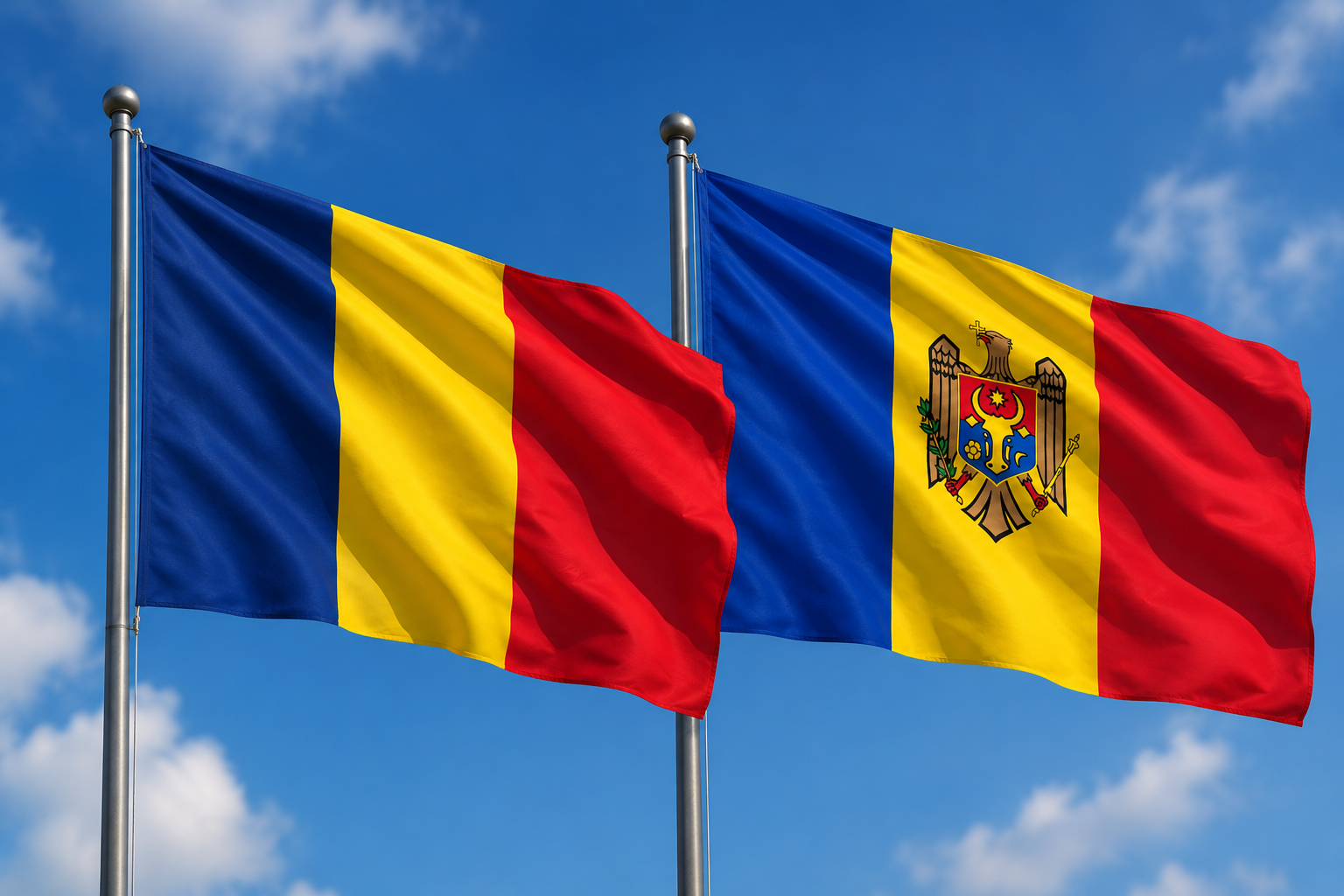
Flags of Romania and the Republic of Moldova.
© AI generatedRomania and the Republic of Moldova have a common, turbulent and complex history. Today, relations between Bucharest and Chisinau are very good, at least at the governmental level. Both share common national symbols (such as the colors of the flag), a language, and many economic and human ties, to the point that in each country, there is an aspiration for unification between the two countries (44% in the Republic of Moldova, more than 71% in Romania, according to a poll from ATES Research Group, March 2026). The pro-European Moldovan President Maia Sandu recently declared to be a supporter of unification on a personal level on the British podcast The Rest is Politics on January 12, 2026. However, this subject remains very tense, and neither this debate on unification nor the relationship between the two can be explained without going back to history.
19th-20th centuries: Bessarabia, disputed between Russia and Romania
The principality of Moldova existed for several centuries straddling the two present-day countries. In 1812, during the peace treaty between the Ottoman Empire, and the Russian Empire, the Prut River was defined as a border, despite the Romanian-speaking populations living on both banks. Later, when the Danubian principalities of Wallachia and Moldavia united in 1859 (what would later become the Kingdom of Romania), most of the territory of the current Republic of Moldova was not included. This also poses problems of terminology: Moldavia, which also refers to the north-east of present-day Romania, is not the same thing as the Republic of Moldova, which at that time was part of the Russian Empire. At the end of the 19th century, the Kingdom of Romania was therefore a first political entity for the Romanian nation, but did not include all the Romanian-speaking populations of the region. After the First World War and the Paris Peace Treaties, Romania obtained a very large territory, which included Bessarabia (which corresponds more or less to the current Republic of Moldova and a part of southern Ukraine). This region, which stretched as far as the Dniester River, was taken back from Russia, which then became the USSR. The entire Romanian territory of the interwar period is called "Greater Romania", and this concept is still widely used by Romanian nationalists.
In 1940, Romania was forced to cede land to its Hungarian, Bulgarian and Soviet neighbors. It had to withdraw to the Prut River and thus abandon Bessarabia to the Red Army. The USSR then created the Moldavian Soviet Socialist Republic (MSSR), and imposed the "Moldovenist" ideology in the region, consisting of promoting the development of a Moldovan identity, distinct from the Romanian nation. The language spoken in the region was classified as "Moldovan" and no longer "Romanian". In the meantime, the fascist Romania of General Ion Antonescu, allied with Nazi Germany, attacked the USSR as part of Operation Barbarossa, and recaptured Bessarabia. This period was marked by the atrocities against the civilian population, the massacres and deportations to Transnistria of 120,000 Jews and 10,000 Roma by the Romanian army. When the Red Army retook these territories in 1944 and brought down Antonescu, it once again imposed its Moldovenist ideology, and imposed a very hostile narrative towards Romania in the Moldavian SSR, associating any unionist impulse with a return to fascism and the horrors of the Second World War.
Soviet period: an attempt to suppress Romanian identity in Moldova
After 1944, the USSR carried out purges of the intelligentsia and parts of the peasantry in the Moldavian SSR, and deportations to Central Asia of hundreds of thousands of people, which completely overhauled the demography of the MSSR. Ukrainians and Russians came to settle there, to the point of representing 27% of the population. Russian replaced Romanian as the administrative language, the latter was considered "Moldovan" and had to be written in Cyrillic. More than 80% of the new political and academic elites came from non-Romanian-speaking populations. For the next 47 years, Romania and the MSSR lived separate trajectories. Romania, as member of the Warsaw Pact but independent of the USSR, took a national-communist turn under Nicolae Ceausescu. The MSSR was subject to a nationalities policy imposed by Moscow, favoring the Russification of the elites. Circles in favor of reunification with Romania were repressed by the KGB.
How the end of the Soviet Union reshaped the region
In 1988, like other SSRs, Moldovans demonstrated, first in support of Mikhail Gorbachev's perestroika, then to oppose the Politburo's stranglehold on the MSSR. In particular, they were calling for the replacement of Russian by Romanian as the administrative language and free elections. These took place in 1989-1990, and the political movement Frontul Popular proclaimed the independence of the Republic of Moldova in 1991. Romania was the first country to recognize it, and accepted its independence. But in Moldova, the non-Romanian-speaking populations, notably from Russian settlers and the Gagauz Turkic minority, who entered into armed conflict with Chisinau. Russian political leader in Moldova Igor Smirnov proclaimed the Pridnestrovian Moldavian Soviet Socialist Republic (now called Transnistria, i.e. 'beyond' the Dniester) and seceded from the Moldovan government. A war broke out in March 1992 between the secessionists and the Republic of Moldova. The armed forces of the Russian Federation entered the conflict and imposed the ceasefire, more to the benefit of the Transnistrian separatists. The conflict was frozen, and Transnistria was considered de jure Moldovan, but de facto independent. The Republic of Moldova adopted a constitution in 1994 that guarantees its neutrality. In fact, the Republic of Moldova remained economically dependent on Russia, Russian military bases were established in Transnistria, and pro-Russian leaders even came to power in Chisinau. During this period, Moldova was seen as very far from integration into the EU, and from a rapprochement with Romania.
However, Romania, which has been in the EU since 2007, is gradually becoming a relay between Moldovans and the EU. Indeed, the government granted the possibility of having a Romanian passport to all descendants of the inhabitants of Greater Romania between the two world wars. This means that the vast majority of the inhabitants of the current Republic of Moldova are eligible for Romanian citizenship, and therefore for an EU passport.
Moldova’s pro-European turn
In June 2009, the Communists lost their absolute majority in the Moldovan Parliament, and pro-European politicians took office. Among them were Mihai Ghimpu (acting President between 2009 and 2010) and Dorin Chirtoacă (then Mayor of Chisinau) of the Liberal Party, who had supported union between their country and Romania since the end of the USSR. Several politicians began to voice their ambition for unification during those years. The unionist idea did not emerge only recently, but has also been present within different mainstream political parties. Maia Sandu came to power (as Prime Minister in 2019, then as President in 2020), and benefited from a political landscape that was already more receptive to pro-European and unionist ideas.
Since the war in Ukraine in 2022, the country has taken a very clear pro-European turn and is facing hybrid threats from Russia. In the face of this threat, the popularity of the unionist project is growing, and is even seen by some as an alternative to the traditional EU accession process, which began in 2023.
Today, the idea of a union between Romania and Moldova is gaining ground, against a backdrop of geopolitical tensions. While this project has reappeared in the debate in both countries, is this idea feasible, and what would be its consequences?
About the author: Martin de La Garanderie is a specialist in European affairs and international relations. He is a graduate of the College of Europe in Natolin, Poland; the Faculty of Political Science at the University of Münster in Germany; and Sciences Po Lille in France. He has worked at the European External Action Service (EEAS) in Brussels and with several think tanks. He is currently an intern at the Friedrich Naumann Foundation for Freedom in Romania and the Republic of Moldova.