HUNGARY ELECTIONS
Hungary’s Political Earthquake: The End of Orbán and the Rise of Magyar

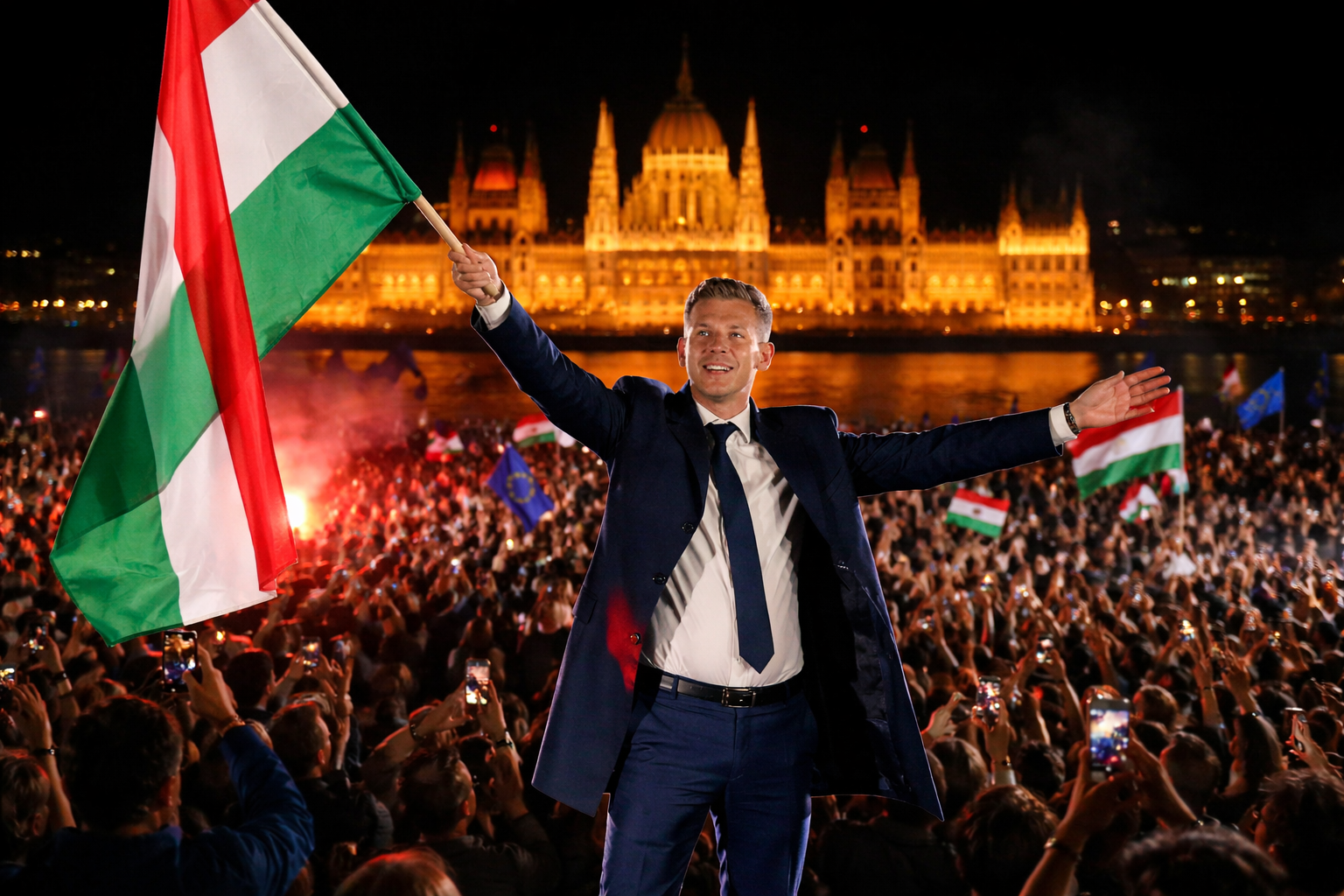
The 2026 Hungarian parliamentary elections mark one of the most consequential political turning points in Central Europe since the democratic transitions of the 1990s. After 16 years in power, Viktor Orbán - arguably the most influential proponent of “illiberal democracy” within the European Union - has been decisively removed from office. The victory of Péter Magyar and his Tisza movement signals a potential reorientation of Hungary toward the European mainstream. At the same time, it raises fundamental questions about the resilience of hybrid regimes, the future of populist governance, and the strategic implications for key EU member states, including Germany.
According to preliminary results with more than 98% of votes counted, Magyar’s Tisza party secured around 138 of 199 parliamentary seats, compared to 55 seats for Orbán’s Fidesz and 6 for the far-right Mi Hazánk (Our Homeland), with turnout reaching over 79%, the highest in Hungary’s democratic history. This result delivers a two-thirds constitutional supermajority, comfortably above the 133 seats required, granting the incoming government the institutional capacity to enact far-reaching reforms. The same constitutional leverage that Orbán used to consolidate power is now in the hands of his successor.

The Collapse of an Illiberal Model
Orbán’s system was a hybrid model combining electoral legitimacy with structural distortions: media capture, politicized institutions, and patronage networks. For over a decade, this model proved remarkably resilient, even as it drew sustained criticism from EU institutions and liberal actors. The European Parliament had already described Hungary as a “hybrid regime of electoral autocracy,” while critics increasingly pointed to captured institutions, weakened judicial independence, and a media environment tilted decisively in the government’s favour.
The 2026 election demonstrates, however, that such systems remain vulnerable when their underlying social contract deteriorates. Orbán’s legitimacy increasingly depended on economic performance and the promise of stability. By the time of the election, both had weakened. Rising costs of living, stagnating growth, and declining public services eroded trust, while long-standing concerns about corruption became politically decisive. Orbán’s defeat is consistently linked less to ideology than to governance fatigue: economic stagnation, crony enrichment, deteriorating healthcare and education, and the broader impression that the Hungarian state was no longer functioning in the interests of ordinary citizens. Crucially, Orbán misread the electorate. His campaign strategy remained focused on external threats such as Brussels, Ukraine, and migration, while voters prioritized domestic governance failures. This disconnect allowed the opposition to reframe the election as a referendum on state functionality rather than identity politics. In that sense, Orbán’s defeat reflects not only political fatigue but a structural failure to adapt.
The Significance of Magyar’s Victory
Péter Magyar’s political trajectory is central to understanding the outcome. As a former insider within the Fidesz system, he was uniquely positioned to challenge Orbán. Magyar’s campaign strategy combined national rhetoric with a reformist agenda focused on anti-corruption, institutional renewal, and economic governance. This allowed him to build a broad electoral coalition that extended beyond traditional opposition voters and into segments of Fidesz’s own base. His appeal was not primarily ideological in a left-right sense. Rather, he presented himself as a credible national alternative who could restore competence, accountability, and dignity to public life while avoiding the image of a cosmopolitan opposition disconnected from Hungarian realities.
The electoral numbers reflect this shift. Winning 138 seats - far above a simple majority - indicates not only opposition mobilization but also significant voter realignment, including among rural and working-class voters who had previously supported Fidesz. The result, therefore, represents not just alternation in power, but a reconfiguration of Hungary’s political landscape. Record turnout strengthens this interpretation. This was a mass mobilisational moment in which unusually large numbers of Hungarians appeared to have treated the election as a decisive opportunity to end the Orbán era. For many younger voters in particular, this election carried the significance of a generational rupture, often compared to the transformative moment of 1989.
From a liberal perspective, an important lesson emerges: effective challenges to entrenched illiberal systems may require actors capable of operating within national political narratives while advancing democratic reform. Magyar’s success illustrates the growing relevance of such hybrid political positioning. At the same time, liberal actors should avoid romanticising him. Magyar is better understood as a reformist, pro-European, anti-corruption conservative than as a classical liberal. He appears more constructive than Orbán on the EU, NATO, Ukraine, judicial independence, media pluralism, and corruption control, but not necessarily liberal across all policy questions, especially migration and certain sovereignty-sensitive issues.
Implications for the European Union
For the European Union, Orbán’s defeat removes one of the most persistent obstacles to collective decision-making. Hungary under Fidesz repeatedly used its veto power to block or dilute EU policies, particularly in relation to Ukraine, sanctions against Russia, and rule-of-law conditionality. This dynamic strained EU cohesion and exposed institutional vulnerabilities.
Magyar’s government is likely to adopt a more cooperative approach. Early signals suggest a willingness to reset relations with Brussels, pursue judicial reforms, and unlock frozen EU funds. Magyar has pledged to travel to Brussels and seek the release of up to €17 billion in frozen EU funding, which had been withheld over corruption concerns and failures to safeguard judicial independence. He has also committed to joining the European Public Prosecutor’s Office, a significant symbolic and practical break with Orbán-era resistance to external anti-corruption scrutiny. This could restore Hungary’s position as a constructive, if still assertive, member state.
However, a full realignment should not be assumed. Magyar has already indicated caution on sensitive issues such as military support for Ukraine and EU enlargement. Hungary may shift from being a disruptive veto player to a pragmatic negotiator, but it will continue to defend national interests within the EU framework. Budapest may “cautiously” move back into the European mainstream, not transform overnight into a frictionless partner. Migration policy, in particular, may remain contentious.
A Blow to Illiberal International Networks
Orbán’s defeat also has broader geopolitical significance. For years, Hungary served as a reference point for illiberal and nationalist movements across Europe and beyond. The election result challenges this narrative. It shows that even entrenched systems can be overturned through democratic means when opposition forces adapt, and voter dissatisfaction reaches a critical threshold. It is also a symbolic setback for Orbán’s international allies, including Donald Trump and Vladimir Putin, both of whom had invested political capital in his continued rule. Rather than rescuing Orbán, it underlined his dependence on international ideological allies at a moment when Hungarian voters were increasingly preoccupied with domestic decline.
It also shows, however, that the defeat of an illiberal incumbent does not by itself amount to the defeat of populism as a broader European phenomenon. Even in Hungary, far-right Mi Hazánk remains present in parliament with 6 seats, and elements of Orbán’s political vocabulary will likely survive him.
What It Means for Germany
For Germany, the implications are both immediate and strategic. In the short term, Orbán’s departure simplifies EU decision-making. Berlin has often found itself constrained by Hungary’s obstructionism, particularly on Ukraine-related policies and budgetary issues. A more cooperative Hungarian government could facilitate progress on key dossiers, including financial support mechanisms and institutional reforms. This matters particularly for Berlin’s efforts to preserve EU unity on Ukraine, strengthen rule-of-law conditionality, and reduce the capacity of single governments to paralyse strategic decision-making from within.
More importantly, however, the Hungarian election offers lessons for Germany’s domestic political landscape. The success of Magyar’s movement reflects a broader trend: voters are increasingly responsive to actors who combine systemic critique with credible reform agendas. Traditional party structures, particularly those perceived as technocratic or disconnected, are vulnerable to disruption. For German liberals, this is a significant lesson. Democratic and pro-European politics are strongest when they are tied not only to abstract values but also to visible competence, anti-corruption credibility, and tangible improvements in everyday life.
From a liberal perspective, this raises important questions. Germany’s political system has thus far resisted the kind of rapid realignment seen in Hungary or other countries. However, rising dissatisfaction with economic performance, governance capacity, and political responsiveness could create similar openings. The Hungarian case suggests that such openings may not be filled by established liberal actors, but by hybrid figures capable of bridging ideological divides. Orbán lost not because Hungarian voters suddenly became uniformly liberal, but because many concluded that his model no longer delivered prosperity, fairness, or functioning institutions. That is an important distinction for the German debate. Defending liberal democracy cannot rely solely on normative arguments; it must also address material concerns such as economic security, public services, and institutional effectiveness. The Hungarian election demonstrates that voters tend to prioritize these issues over abstract geopolitical narratives.
The Challenge of Democratic Reconstruction
The final and perhaps most important question concerns what comes next. Magyar’s supermajority provides him with the institutional capacity to enact far-reaching reforms. He can restructure the judiciary, address media concentration, and dismantle elements of the patronage system.
Yet this power also carries risks. Rapid institutional change can destabilize governance if not carefully managed. Moreover, Orbán’s system is deeply embedded, both formally and informally. Resistance from entrenched actors is likely, and the line between necessary reform and perceived political retribution will be closely scrutinized. Even with 138 seats, democratic reconstruction will not be automatic. The formal parliamentary majority is only one part of the equation; entrenched elites, loyal officeholders, and patronage networks built over 16 years will not disappear overnight.
The success of Hungary’s democratic renewal will depend not only on what is dismantled, but on what is built in its place. Re-establishing checks and balances, ensuring media pluralism, and restoring trust in public institutions will require sustained effort beyond electoral victory. That means restoring checks and balances without reproducing majoritarian overreach in a new form. The key test of post-Orbán Hungary will not only be whether it can undo the old system, but whether it can build a more pluralist and rules-based one in its place.
Conclusion
The 2026 Hungarian elections mark the end of an era and the beginning of a complex transition. The scale of Magyar’s victory with 138 seats to 55, and a record turnout of 79,5 percent, signals a decisive rejection of the Orbán system. Yet it also opens a new phase in which the direction and sustainability of democratic reform remain uncertain.
For the European Union - and for Germany in particular - the result offers both opportunity and warning. It opens the door to greater cohesion and policy alignment, but also signals the need for adaptation in the face of changing voter expectations. It is a major defeat for one of Europe’s most influential illiberal leaders, but not an automatic victory for liberalism in its pure form.
For liberal actors, the central lesson is clear: democratic resilience depends not only on institutional safeguards and normative commitments, but also on the ability to respond effectively to citizens’ everyday concerns. Hungary’s political transformation illustrates both the risks of neglecting this dimension and the potential for renewal when it is addressed. In that sense, the Hungarian election is not only about the fall of Orbán. It is also about the conditions under which liberal-democratic politics can regain relevance in societies shaped by fatigue, polarisation, and institutional decay.