Democracy
Democratic Resilience in the Age of AI

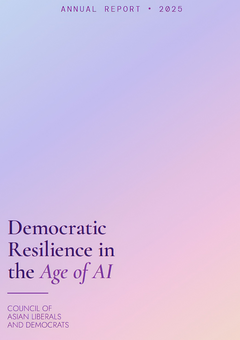
Drawing on speeches and discussions by political leaders across Asia, the Council of Asian Liberals and Democrats (CALD) has published its annual report, which emphasizes that democracy does not sustains itself - constant political and institutional reforms are needed. One important strategy is broadening the social base that supports liberal democracy by encouraging greater participation of women and youth in politics. The report highlights that CALD promotes a community, where leadership is seen not as a solo endeavor, but as a shared responsibility built on trust and mutual support.
“Leadership is entrusted rather than owned, and we have worked to build pathways for others to follow”, CALD Women’s Caucus Chairperson Jaslyn Go noted. CALD Youth Chair Jeremiah Tomas emphasized that young people must help build “an Asia where democracy delivers, where freedoms are defended, and where young people shape their own destinies.”
The report stresses that in the age of AI, electoral systems and democratic institutions must evolve to counter information manipulation and disinformation. Using the Philippines as an example, CALD recommends that schools and public education systems should incorporate stronger civic and electoral education. Citizens shall better understand democratic procedures and participate more effectively in elections. The report pinpoints growing disengagement among youth in Asia by citing Singaporean youth leader Aqmal Haris. He points out that nearly half of the Singapore youth remained undecided on their political stance. This illustrates the urgent need to encourage youth participation in politics, beginning at the local educational level.
The report maintains an optimistic outlook despite these challenges. During the Youth Political Academy held in Taipei in August 2025, CALD Secretary General Francis 'Blue' Abaya stated: “We choose optimism not out of naivety, but out of conviction.” He argued that democratic change must be actively shaped by citizens themselves rather than passively awaited.“We believe in progress, in people, and in the power of ideas to create real change. As liberals, we hold a simple but powerful belief: there is always a turning point—always a moment when things can shift for the better. And it’s up to us to lead that change.” To defend democracy, responsibilities rests in the hands of not just youth and women but all politically active people. “You may not be interested in politics, but politics is always interested in you,” noted Haris from the Singapore Democratic Party.
In an AI-driven environment misinformation is becoming more effective when combined with existing biases – even among progressive groups. CALD points to the experiences of Leni Robredo. She has been a target of AI-manipulated videos often, which have damaged her reputation in public through distorted political narratives. Despite being a frequent target of digital disinformation, Robredo argued that the solution is not to suppress AI, but to guide its development responsibly. “This is precisely the right time to act. Not to suppress AI, which is impossible at this point, but to steer its use and development toward human centric goals,” said Leni Robredo.
Abhisit Vejjajiva, the party leader of Democratic Party in Thailand, warned that democracy would be endangered if AI encourages societies to value only outcomes while ignoring democratic processes and accountability. Former CALD Chairperson Mardi Seng emphasized that liberal democrats must recognize AI as a double-edged sword and adapt it for social progress. He argued that CALD must remain innovative, think beyond traditional frameworks, and stay receptive to new ideas amid rapid technological and societal transformation.
CALD´s report expands responsibility beyond politicians. Journalists, educators, activists, and civil society actors are also called upon to adapt to algorithm-driven platforms while maintaining ethical standards in reporting and public communication. Technological adaptation, therefore, must be accompanied by integrity, media literacy, and responsible storytelling.
Last but not the least, CALD´s annual report highlights regional cooperation as essential for sustaining democracy across Asia. Whether addressing disputes in the South China Sea, Russia’s war against Ukraine or growing pressure on Taiwan, CALD emphasizes that authoritarian actors increasingly cooperate across borders to advance their geopolitical objectives. In response, liberal democrats must strengthen their solidarity and work collectively to defend democratic norms and national sovereignty.
Ultimately, CALD´s report presents democratic resilience as a combination of institutional reform, technological adaptation, and international cooperation. In doing so, it argues that sustaining liberal democracy in Asia will require not only defending democratic institutions, but also adapting them to confront the political and technological changes of the AI era.
Read this CALD annual report 2025 here.
*Hnin Wint Naing is the Regional Communications Officer at the Asia Office of the Friedrich Naumann Foundation for Freedom