Hybrid Warfare
From the European Front to Latin America
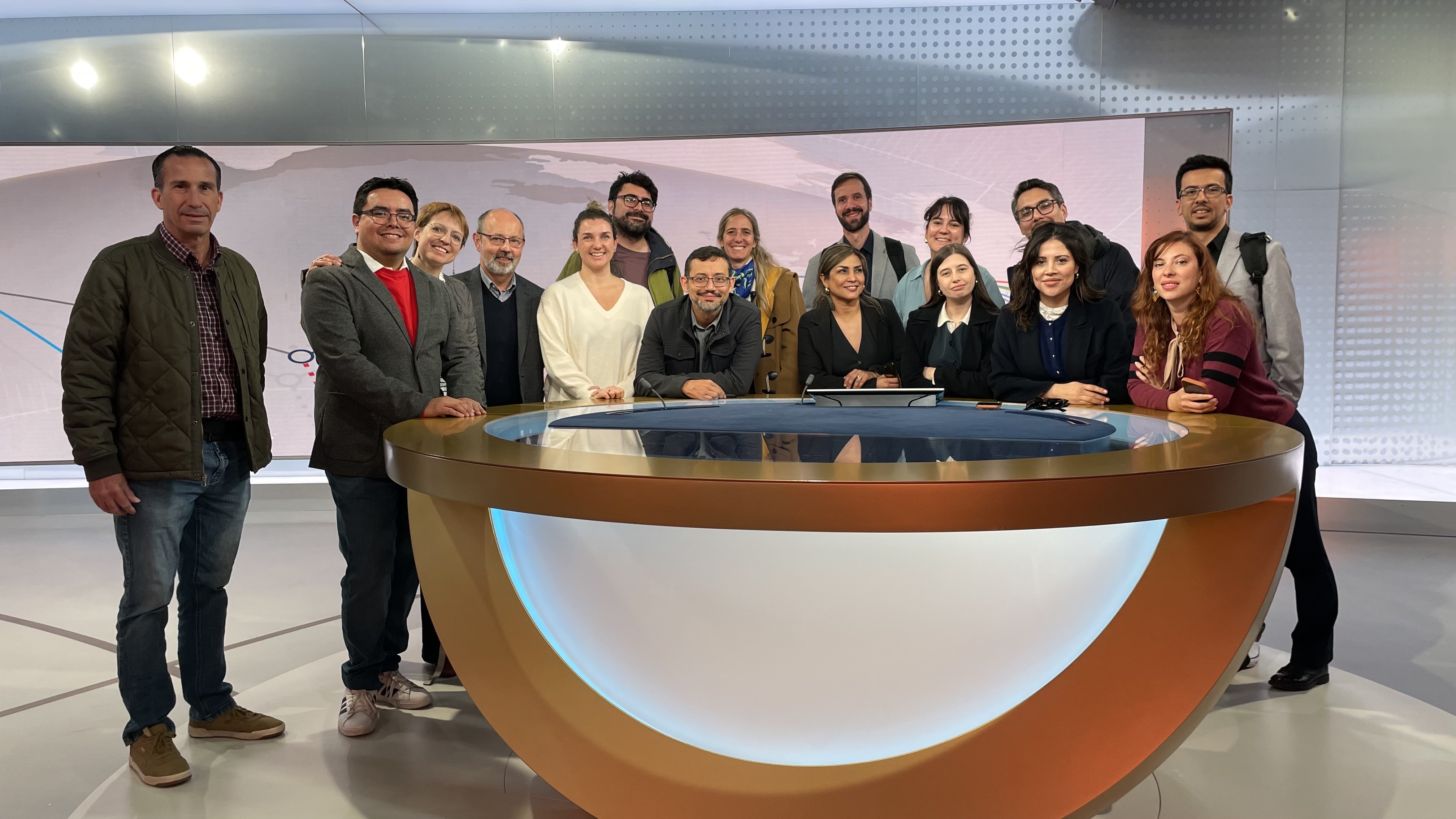
Latin American Journalists visited the Deutsche Welle
© FNF Latin AmericaText by: Fabricio Vitorino Journalist, PhD candidate in International Relations, MA in Russian Culture
A group of Latin American journalists arrived at Madrid airport as individuals and, ten days later, left as a system. What they discovered along the way is precisely the model Europe has developed to survive Russian disinformation.
The group brought together profiles that, at first glance, seemed merely diverse: Mexican investigative journalists who know the drug trafficking routes better than any intelligence report; Argentinians who document what happens when political and economic pressure on newsrooms does the work that formal censorship would have done; Chileans who track, almost alone on the continent, how China operates within Latin America's information space; Central Americans accustomed to covering what occurs when the concept of sovereignty is weaponised to shield power from its own citizens; and Brazilians navigating the most sophisticated, most pervasive and most fiercely contested disinformation and AI ecosystem in the Americas.
The diversity was not ornamental. From the first days it became clear that each trajectory was a piece that fitted into the others: knowledge of obscure cartel financing found common vocabulary with those who had mapped how that money migrates into digital influence campaigns; those who had lived through the silent erosion of independent media in Argentina recognised, in the words of journalists exiled in Berlin, an accelerated version of a process they knew intimately; those who had observed right-wing extremism in Chile found, in a German professor's research on popular culture and manipulation, the explanation for something they had long observed without being able to name. The group joked that they were doing an MBA in ten days — but what was happening was more precise than that: it was Hutchins' "distributed cognition" in the technical sense of the term — each individual body of knowledge amplifying the others rather than merely adding to them.
Madrid: when detection alone is not enough
The first lesson from Madrid was an uncomfortable one, because it contradicted the conventional wisdom on the subject: fact-checking does not resolve the problem of disinformation. Maldita.es, an internationally recognised verification organisation, did not arrive at this conclusion as a defeat, but as a working hypothesis that reorganised its entire operation. Coral García, who leads the disinformation team, explained that the model had evolved from reactive fact-checking to narrative mapping: what matters is not the specific lie, but the ecosystem that produces it, distributes it and renders it immune to correction — because those who consume it do not consume it as information, but as identity.
This distinction is the point at which the technical question becomes philosophical, and at which verification journalism encounters its structural limits: if the lie functions as a sense of belonging, the truth must offer something equivalent in order to compete — and that is a problem no fact-checking methodology, however rigorous, resolves on its own. EFE Verifica, with nearly a century of institutional history, faces the corporate version of the same dilemma, and Sergio Hernández García, who runs the operation, has no definitive answer; what he has is process, editorial discipline and the awareness that the question must be asked aloud every single day. The group left Madrid without an answer, but with the question formulated with a precision that was, in itself, already progress.
Berlin: when the past is the present's manual
Berlin demands a specific disposition from its visitors: the willingness to accept that what appears new may not be. In a city that holds within its stones the memory of two distinct totalitarianisms — and that survived both without thereby becoming immune to a third — speaking of disinformation as a phenomenon of the digital age sounds, to anyone who knows the local history, like well-intentioned naivety. The techniques developed by the Stasi and Soviet propaganda did not disappear with the Wall: they migrated, adapted to digital platforms and found global audiences that no twentieth-century apparatus of control could have imagined reaching.
Professor Wolfram Gernot's research was the most unsettling revelation of the journey, because it relocated the problem to where it actually occurs: not in editorials, not in fact-checks, but in playlists, in television series, in fan communities, in the aesthetics that people adopt before they adopt any political position. Contemporary extremism does not recruit through arguments, but through belonging, through aesthetics, through an offer of identity that arrives before any explicit ideological content — and Latin America, with its intense cultural production and its historically proven vulnerability to collective identity narratives, is fertile ground for precisely this kind of operation.
It is no coincidence that Jenny Erpenbeck — the German writer awarded the International Booker Prize in 2024 — offers, unwittingly, a precise example of this mechanism. In her novel about East Germany, Erpenbeck suggests that the GDR did not fail for lack of freedom, but for its inability to compete with the pressure of Western consumerism. As she has put it, "in the end, it was the pressure of consumption, more than the pressure for freedom, that prevailed." It is a legitimate literary reading, aesthetically sophisticated and historically grounded. It is also, structurally, the very argument that Russian narrative uses to present liberal democracy as consumerism dressed up as freedom — and to sell the authoritarian alternative as an emancipation project that the West sabotaged. Erpenbeck is no one's agent. But the effect of her narrative, on a continent where the wounds of colonialism render any critique of the Western model emotionally palatable, is precisely the terrain that disinformation needs in order to take root.
Former Ambassador Mathias Sonn, drawing on his experience of the Kremlin from the inside, completed the picture: Russia does not project power in spite of culture, but through it, in a calculated fashion, with political objectives that purely military analysis cannot capture.
Vilnius: resilience as collective architecture
Lithuania has fewer than three million inhabitants, shares borders with Russia and Belarus, and has decided — as a matter of state policy, but also as a civic culture that precedes and exceeds the state — that it cannot afford the luxury of naivety. What the group found in Vilnius was not organised paranoia, but something far harder to build and far easier to lose: the collective awareness that a war is under way and that every sector of society bears responsibility for it. "Putin, The Hague is waiting for you," we read on the side of a building near the city hall, less than fifteen minutes after leaving the airport.
On the Saturday, 30,000 people filled Cathedral Square to defend the public broadcaster LRT against budget cuts — not because the government called them out, but because civil society recognised that independent media is not a service like any other, but democratic infrastructure: when it disappears, what follows is not simply its absence, but something actively worse.
Meetings with the Armed Forces StratCom, the National Crisis Management Centre and the Ministry of Foreign Affairs confirmed that Lithuanian resilience is systemic: it has a military layer, a civil layer, a media layer and a community layer, all coordinated without any one of them having to subordinate its logic to the others. Agnė Eidimtaitė, an information environment assessment analyst with the armed forces, presented the Russian narratives currently in circulation with the precision of someone monitoring a real enemy — because that is exactly what she does. Without having spoken to them directly, the Lithuanian "Elves" embody the model: a voluntary network of citizens who counter-narrate disinformation without centralised funding, without hierarchy and without waiting for any governmental instruction — the same principle that Ukraine demonstrated under existential pressure, and that the group itself had involuntarily replicated over the course of ten days.
The Trojan Horse that Latin America prefers not to see
Latin America is not vulnerable to Russian disinformation despite its history — it is vulnerable because of it, and any analysis that ignores this distinction produces incomplete diagnoses. The continent carries centuries of colonialism and decades of documented foreign interventions, many of them North American, and this history is not abstract or overcome: it is living memory, a political wound available to any narrative that presents itself as an alternative to the Western order. The discourse of multipolarity — which sounds like genuine emancipation to those who have been historically subjugated — functions as a sophisticated Trojan Horse because it uses the vocabulary of liberation to delegitimise the institutions that, for all their real flaws, protect precisely the most vulnerable against the arbitrary concentration of power.
Venezuela, Cuba and Nicaragua are not Moscow's allies by accident: they are regimes that share the structural interest in shielding their architectures of power against democratic pressure, presenting that shielding as sovereignty. Brazil is the case of greatest urgency: with the world's largest WhatsApp ecosystem, a polarisation that amplifies any narrative regardless of its origin, and a tradition of information consumption that dissolves the boundaries between entertainment and politics, the country functions as a global laboratory for disinformation operations — and what is tested there appears in other countries within months.
Latin America still has time
Latin American journalism does not start from scratch in this battle — it has a solid investigative tradition, proven courage and field knowledge that no academy produces. What is missing is the analytical framework that connects the specific to the systemic: seeing the local narrative as part of a global operation, recognising in the WhatsApp meme the tip of an ecosystem with funding, strategy and precise political objectives.
Europe has not solved the problem — it is, in many respects, losing important battles. What it has is the awareness that this is a war, and that wars require every sector of society to know that they are in one.
Latin America still debates whether the problem exists. It still treats disinformation as a matter of fact-checking rather than democratic security. It still believes that press freedom is defended in courtrooms — without realising that the adversary has changed strategy and now prefers the press to exist, so long as no one believes it. The answer, as the Lithuanian Elves and Ukrainian society have shown, will not come from above: it will come when every layer of society decides that it bears a share of that responsibility — and acts before anyone needs to ask.