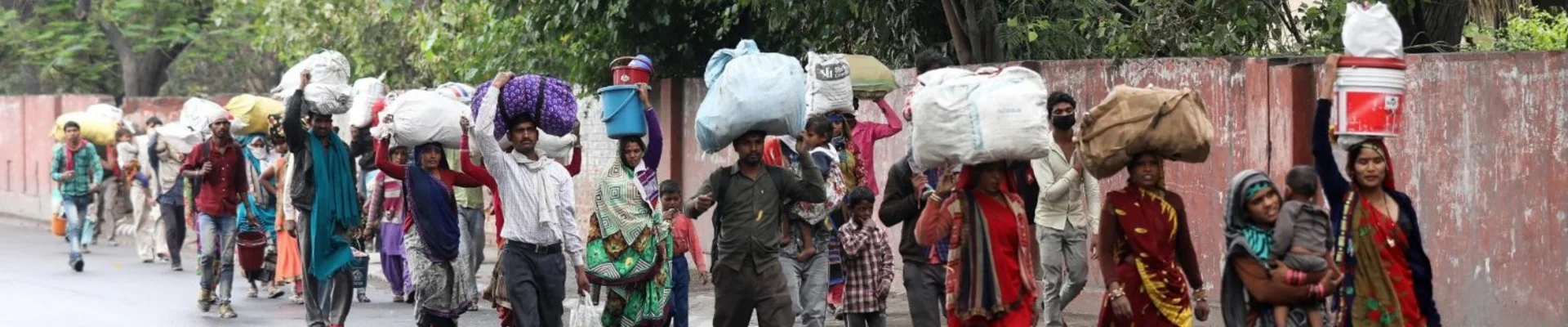
SRI LANKA: PROFILE OF MIGRATION
-
This policy brief explores the complex story of migration from Sri Lanka—shaped by history, conflict, economic hardship, and global labor demand. With nearly 3 million Sri Lankans living abroad, labor migration remains the driving force, contributing almost 10% to the nation’s GDP through remittances. The study highlights gender and age patterns in migration, rising student mobility, challenges of irregular migration and trafficking, as well as the economic and social costs of brain drain. It offers forward-looking policy recommendations to make migration safer, fairer, and better aligned with national development.
AFGHANISTAN'S MIGRATION CRISIS: REPATRIATION REALITIES AND THE PATH FORWARD
-
The policy paper “Afghanistan’s Migration Crisis: Repatriation Realities and the Path Forward” (FNF South Asia, June 2025) examines Afghanistan’s decades-long displacement crisis, now intensified after the Taliban’s return to power in 2021. With over 8 million Afghans displaced in recent years and 6.4 million registered as refugees—mostly in Iran and Pakistan—the report highlights the historical roots of forced migration, host countries’ increasingly restrictive policies, and the grim realities of repatriation. It stresses that Afghanistan remains unsafe, especially for women, minorities, activists, and former security personnel, given human rights abuses, economic collapse, and political instability. The study calls on Pakistan, Iran, Turkey, and European states to halt forced deportations and prioritize humanitarian protection, while urging the Taliban to form an inclusive government, end persecution, and ensure dignity for returnees
THE FUTURE ABROAD: TRENDS AND IMPACTS OF INTERNATIONAL MIGRATION OF BHUTAN’S WORKING POPULATION
-
The policy paper “The Future Abroad: Trends and Impacts of International Migration of Bhutan's Working Population” (FNF South Asia, June 2025) examines how rising numbers of Bhutanese—especially youth—are seeking education and employment opportunities abroad. While migration supports households through remittances and global exposure, it also creates risks of brain drain, labor shortages, and growing dependence on foreign economies. The study highlights Bhutan’s unique challenge of balancing its small population with aspirations for global integration, noting social impacts such as changing family structures and cultural ties. It urges policymakers to develop strategies for skills training, safe migration frameworks, and reintegration programs to harness migration benefits without undermining Bhutan’s long-term development.
EMIGRATION FROM BANGLADESH AND ITS IMPACT ON THE ECONOMY
-
The policy paper “Emigration from Bangladesh and Its Impact on the Economy” (FNF South Asia, June 2025) analyzes how large-scale labor migration has shaped Bangladesh’s development over the past decades. With remittances making up a major share of foreign exchange earnings and contributing significantly to poverty reduction, migration has become an economic backbone for millions of households. However, the study also warns of vulnerabilities—workers often face unsafe conditions abroad, recruitment malpractices, and limited reintegration support on return. It stresses that Bangladesh’s overdependence on migration risks economic imbalance, while domestic job creation and skills development remain underprioritized. The report calls for stronger governance, fair recruitment practices, and investment in sustainable employment at home to balance migration’s benefits with long-term economic stability.
MIGRATION IN AND FROM THE MALDIVES AND ITS IMPACT ON THE ECONOMY
-
The policy paper “Migration in and from the Maldives” (FNF South Asia, June 2025) explores how the Maldives, despite its small population, is deeply shaped by migration. The country relies heavily on foreign workers—especially in construction, tourism, and domestic work—making migrants central to its economy but also raising concerns about exploitation, rights protection, and social integration. At the same time, Maldivians themselves migrate abroad for education and professional opportunities, creating both benefits through skills and remittances, and risks of brain drain. The study highlights the challenge of balancing economic dependence on migration with sustainable development, urging better labor governance, protections for migrant workers, and stronger policies to support Maldivians abroad and on their return.
INTRA-SOUTH ASIAN MIGRATION AND ITS ROLE IN REGIONAL INTEGRATION AND ECONOMIC GROWTH
-
The policy paper “Intra-South Asian Migration” (FNF South Asia, June 2025) examines the movement of people within South Asia, one of the world’s most mobile yet least integrated regions. Migration across India, Bangladesh, Nepal, Bhutan, Sri Lanka, Afghanistan, and the Maldives is driven by geography, culture, trade, and labor demand, often blurring the lines between formal and informal flows. While remittances and labor mobility fuel livelihoods and regional economies, migrants frequently face weak legal protections, exploitation, and political tensions between states. The study emphasizes that despite shared histories and interdependence, South Asian governments lack cooperative migration frameworks. It calls for regional dialogue, fair labor standards, and stronger cross-border agreements to turn migration from a source of friction into an engine for shared growth.
MIGRATION IN FOCUS: NAVIGATING SKILLED AND HUMANITARIAN MIGRATION FLOWS FROM SOUTH ASIA TO GERMANY
-
The policy paper “Migration in Focus: India” (FNF South Asia, June 2025) highlights India’s dual role as both a major source of emigrants and a significant host for migrants within South Asia. Millions of Indians migrate abroad for work, especially to the Gulf, sending back vital remittances that support families and boost the economy. At the same time, India attracts migrants from neighboring countries, creating opportunities but also sparking political and social tensions. The study underscores challenges such as exploitation of workers, lack of legal protections, and weak reintegration policies for returnees. It calls for comprehensive migration governance—balancing economic needs with humanitarian protection and regional cooperation—to ensure migration contributes positively to India’s growth and stability.
CLIMATE MIGRATION IN SOUTH ASIA: CHALLENGES, IMPACTS AND POLICY RESPONSES
-
The policy paper “Climate Migration in South Asia: Challenges, Impacts and Policy Responses” (FNF South Asia, June 2025) analyzes how climate change is driving large-scale displacement in one of the world’s most vulnerable regions. Rising sea levels, floods, droughts, and extreme weather events are already forcing millions to move within and across borders, with Bangladesh, India, Nepal, and the Maldives especially at risk. The report highlights how climate-induced migration deepens poverty, disrupts livelihoods, and threatens regional stability, while governance gaps leave affected communities unprotected. It stresses the urgent need for adaptive policies, disaster preparedness, and regional cooperation—arguing that without proactive measures, climate migration could become South Asia’s defining humanitarian and security challenge.
EMIGRATION FROM NEPAL AND ITS IMPACT ON THE ECONOMY
-
This report explores how increasing emigration from Nepal has
multifaceted impacts on its economy and human development.
Considering that 1.67 million Nepali citizens emigrated in 2024 and that
remittances account for nearly 25% of its GDP, emigration presents
opportunities as well as challenges. On one hand, remittance inflows
from abroad have bolstered household incomes, shored up foreign
exchange reserves and expanded access to education and healthcare;
on the other, the predominance of remittance-funded consumption
over productive investment threatens to entrench an unsustainable
economic dependence on migration earnings. Concurrently, severe
brain drain has depleted critical sectors like health and education,
while labor shortages and abandoned farmland are undermining
agricultural productivity. The report advocates that Nepal must
prioritize economic diversification and structural reforms. Current
policies, largely focused on facilitating labor export, fail to address the
urgent need for domestic job creation, skilled workforce retention and
reduced vulnerability to remittance fluctuations. Without strategic
intervention, the country risks perpetuating a cycle of emigrationdriven
stagnation.