Venezuela
Venezuela after the earthquakes
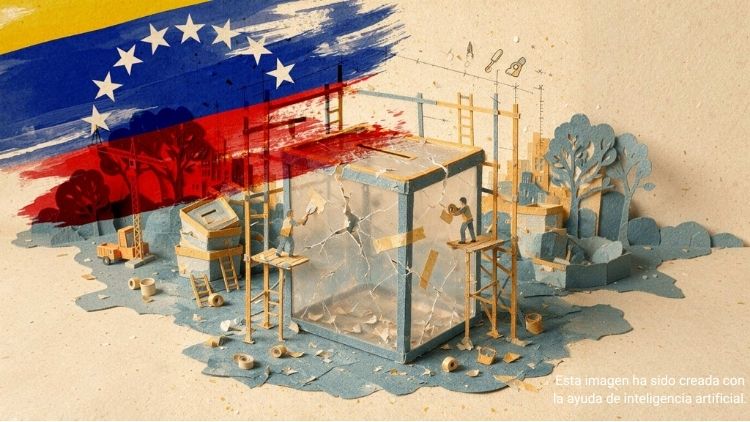
Earthquakes, Transformation, and Transition
By Roberto Casanova
Economist, professor, and writer – https://robertocasanova.net/
Research associate at CEDICE Libertad (Venezuela).
This article was written for RELIAL.
Beyond the humanitarian emergency, the twin earthquakes of June 24 exposed the structural weaknesses of the Venezuelan state. This article analyzes how the country’s reconstruction requires not only material resources but also institutional transformation and a democratic transition capable of restoring public capacity and citizen trust.
As the days have passed, numerous accounts of loss and painful experiences have emerged, revealing—beyond the statistics—the human dimension of the twin earthquakes of June 24. It is morally imperative to begin by expressing condolences and solidarity with the thousands of Venezuelans who lost family members, suffered injuries, or saw their homes destroyed.
The blow was sudden and devastating. That initial gesture of condolence, however, falls short in the face of the immense dedication that so many Venezuelans have demonstrated in every sphere—a generosity that brings honor to the country.

1. Earthquakes: State Incompetence and Civic Capacity.
For years, national and international studies warned of the high probability of a severe earthquake along the faults in the northern part of the country.
The Venezuelan Foundation for Seismological Research (Fundación Venezolana de Investigaciones Sismológicas, FUNVISIS) recommended reinforcing buildings and updating codes; foreign technical missions confirmed the vulnerability of coastal cities and areas of Caracas. Nothing was done. The deterioration of building materials, expansion into high-risk areas, and the disappearance of a culture of preparedness turned vulnerability into public policy by omission.
The two consecutive earthquakes—of 7.2 and 7.5 degrees on the Richter scale—took everyone by surprise. La Guaira accounted for the highest number of casualties; in Caracas, neighborhoods such as San Bernardino, Altamira, Los Palos Grandes, and Bello Campo suffered severe damage. Other cities across the country also reported significant damage, particularly in urban and peri-urban areas with vulnerable housing. The available figures—which are always provisional in a regime lacking reliable information systems—indicate nearly 5,000 deaths, more than 17,000 injured, around 20,000 displaced, some 200 collapsed buildings, and more than 1,000 structures with severe damage. There remains widespread confusion regarding the number of missing persons: there are no official figures, and independent estimates vary widely, though they agree that the number is in the several thousand.
The gap between the government, the public, and the international community became immediately apparent. The dismantling of public capabilities was laid bare in critical areas such as civil protection, healthcare, and seismic monitoring. There were exceptions, such as the more effective and well-communicated response by the Chacao Mayor’s Office, but its scope was necessarily limited given the general deterioration of the government’s capacity.
Faced with the weak official response, citizens acted quickly. Without centralized coordination—which would have been impossible in an emergency of this scale—an emergent order took shape: collection centers, distribution networks, apps for reporting needs, and motorcyclists delivering supplies to places where they were “needed.” This was complemented by initiatives from bussinesses and NGOs. There was no prior planning, but a functional system did emerge that made it possible to aid thousands of people and temporarily fill the void left by the State. The tragedy revealed the erosion of public trust, but also a social capacity that springs into action even under adverse conditions.
International aid arrived immediately: rescue teams, search units, and medical personnel from more than a dozen countries. Internal lack of coordination diminished the impact of this aid; while shortages persisted in critical areas, field hospitals set up in Caracas reported little activity. As the days passed, humanitarian organizations such as Caritas began to organize the flow of donations, and multilateral agencies established oversight mechanisms in response to the lack of trust in government management.
The disaster was not a natural one: it was a natural event turned into a humanitarian tragedy by a lack of foresight, incompetence, and, in many cases, corruption. The emergency revealed an institutional framework incapable of anticipating risks and protecting lives, but it also revealed a level of civic capacity that constitutes an essential resource for the transformation and transition the country needs.

2. Transformación: adoptar un nuevo paradigma
Estimates of the losses caused by the June 24 earthquakes vary depending on the methodology and scope considered. The World Bank estimates direct physical damage at around $19.6 billion USD and projects reconstruction costs that could reach between $40 billion and $50 billion USD, including debris removal and structural improvements. Preliminary assessments by the UNDP put direct damages at around $6.7 billion USD, noting that the total impact is typically between 1.5 and 3 times that figure. Meanwhile, studies by the UN Office for Disaster Risk Reduction estimate damages to infrastructure and buildings at nearly $37 billion USD. These differences reflect varying approaches: some estimate only direct damages, others include critical infrastructure, and still others project the full costs of reconstruction.
What matters is not the exact figure, but the approach: reconstruction cannot be limited to filling shortcomings, because that paradigm perpetuates vulnerability. A truly transformative strategy is needed, one aimed at generating wealth and rebuilding public capacities that have been dismantled over the years: civil protection, emergency health care, urban management, technical oversight, and land-use planning. Physical, institutional, and civic reconstruction is essential, but it is insufficient unless the way the country conceives of and manages its problems is changed. Two areas illustrate this clearly: the economy and the management of the cities.
Transforming the economy requires clear rules, well-defined property rights, and appropriate incentives that allow private investment—both local and international—to unleash its creative potential. Port and airport concessions, transparent land allocation, and the launch of strategic projects are not merely complementary mechanisms: they are tools for stimulating value creation and employment. Without this framework, reconstruction will be slow and fragile.
In urban matters, the traditional paradigm—demolish, repair, build—is insufficient. The city cannot be treated as a collection of physical structures that are replaced after every disaster. The contemporary challenge is to build cities that learn from themselves, capable of anticipating risks and coordinating responses before an emergency erupts. This involves combining technical knowledge with residents’ experience, understanding how the city behaves under pressure, and organizing local networks that can act quickly in a emergency scenario. This is not technology for the sake of technology: it is the difference between perpetuating vulnerability and building a city that protects its people.
This approach contrasts with the regime’s traditional logic, centered on managing precariousness as a political resource. In the new reality—marked by devastation, international pressure, and the need for effective reconstruction—that approach reveals its limitations. The regime attempts to prolong its usual mechanisms of control, relying on donations and civilian volunteerism, requesting external resources without the capacity to manage them, and shifting structural problems to the private sector. In urban areas, the response boils down to demolishing, repairing, and building—repeating practices that have already proven to be failures. It is a vision that rebuilds what has been destroyed without learning anything and turns vulnerability into routine.
The state’s proven inability to manage resources transparently and effectively has forced actors outside the state apparatus to take on part of the management of funds from abroad and donations. Multilateral organizations such as the Andean Development Corporation (CAF) are creating their own mechanisms to channel and oversee these resources, while partnerships between the private sector and civil society organizations are developing their own channels for support and oversight. This shift demonstrates that reconstruction requires public institutions capable of coordinating, regulating, and ensuring that resources reach those who need them. Without that capacity, transformation remains incomplete and vulnerability persists.
There can be no transformation under those who made the destruction possible, because reconstruction demands institutions capable of anticipating risks, protecting lives, and managing resources responsibly. For this reason, political change is not a slogan or a wish; it is the indispensable condition for the republic to rise again and for transformation to cease being mere rhetoric and become a sustainable reality.
3. Transition: Ensuring the Republican Foundations of Reconstruction.
3. Transition: Ensuring the Republican Foundations of Reconstruction.
Faced with the new situation, the three key actors—the regime, the democratic sectors, and the U.S. government—have responded according to their own political logic. The regime is attempting to turn the emergency into a political asset: it seeks to postpone elections, centralize reconstruction, and capitalize on international aid. Its goal is to remain in power, even at the cost of further exacerbating the country’s vulnerability.
We in the Venezuelan democratic sectors see the regime’s departure as the only path to regaining sovereignty and truly beginning reconstruction. The country has a clear popular mandate, expressed on July 28, 2024 but that mandate could not be translated into real authority because the regime is usurping power from Edmundo Gonzalez and Maria Corina Machado, and then blocking the institutional transition. That is why it will be necessary to hold a new, free, and fair presidential election, so that a mandate with recognized legitimacy both within and outside the country may emerge. The transition is the prerequisite for rebuilding public capacities and establishing an institutional order capable of sustaining the reconstruction. The accumulated democratic strength—expressed in citizen mobilization and in the social leadership of María Corina Machado, who articulates the will of the majority—is an indispensable asset for steering the transition. Social rejection of the regime is widespread and growing; the instability facing the country is social, not electoral.
The U.S. government's interpretation of these events as a source of instability that undermines its strategy focused on security and economic recovery. Recognizing that the regime’s incapacity hinders any stabilization plan, it has pushed for formal political negotiations to ensure a framework that allows progress toward an orderly transition and prevents a power vacuum.
However, it cannot be ruled out that stabilization might become a mechanism to freeze the conflict and recycle the regime as an indispensable actor—albeit under stricter international supervision. This possibility is by no means insignificant: as Adam Przeworski points out, democracy is a system of institutionalized uncertainty. Reducing that uncertainty amounts, to say the least, to neutralizing democracy. Stabilization that preserves the regime would not pave the way for transition—it would block it.
In any case, as an outcome of these negotiations, the creation of a parliamentary body was announced, composed of democratic representatives from the National Assembly elected in 2015 and representatives of the regime from the 2024 process—the results of which were never audited. Its scope cannot yet be assessed: it could serve as a bridge toward transition or as a mechanism to prolong the regime’s control.
Today, the democratic task is threefold. First, to sustain public pressure and civic mobilization to demand a new presidential election with guarantees—the only way to establish an effective mandate. Second, to act with clarity in the negotiation forums and within the newly created parliamentary body, without losing autonomy or confusing dialogue with a renunciation of the democratic demand for a free election. Third, to respond to the humanitarian emergency: politics cannot be conducted in isolation from suffering. The devastation has generated an immediate social demand that requires a presence and the capacity to respond. Discontent needs a political outlet; without it, it dissipates or becomes radicalized. Democratic leadership must simultaneously sustain these three fronts, because together they foster the legitimacy necessary to steer the transition.
A necessary step is to shape the government of national unity that will take the helm: agreeing on basic principles, defining reconstruction priorities, and establishing verifiable commitments. The transition requires a shared narrative and mechanisms for citizen participation to guide and monitor its implementation. Reconstruction will not be the work of a single political group, but of an entire society; therefore, the government leading the transition must be established with rules, checks and balances, and a framework for cooperation.
The transition is not a sudden event: it is a political, institutional, and moral process. It is the path to regaining sovereignty, rebuilding our shared home, and opening up a future that is not defined by vulnerability and authoritarian isolation. Without transition, there will be no transformation. With transition, transformation becomes possible.