Entrepreneurship
Berlin Talks: Migration as an Engine for Innovation and Entrepreneurship

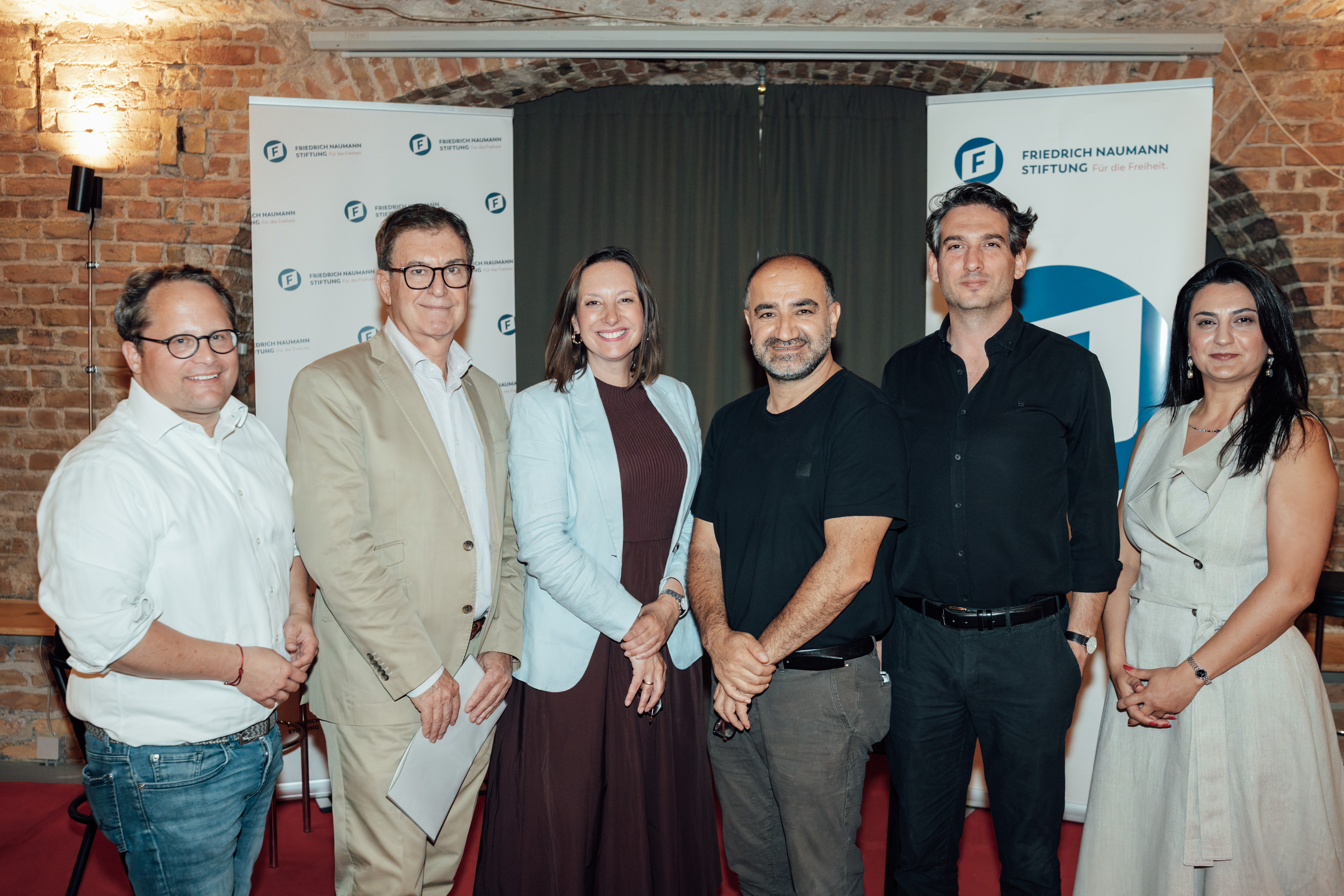
Panel der Veranstaltung mit Christoph J. Stresing, Dipl.-Ing. Nihat Sorgec, Dr. Maren Jasper-Winter, Özcan Mutlu, Ferhat Engel und Nalan Sipar
© Milena RadatzBerlin thrives on diversity and entrepreneurial spirit. Entrepreneurs with a migration background have made a decisive contribution to the capital's economic development for decades. But how can politics, business, and society ensure that this potential is used even better in the future?
The event 'Berlin Talks,' organized by the Turkey Office and the Capital Office of the Friedrich Naumann Foundation for Freedom in cooperation with the Bundesverband Deutsche StartUps e.V. (German Startups Association), addressed these questions. The discussion was moderated by journalist and founder Nalan Sipar, who has followed the development of the German start-up and business scene for many years.

Dr. Maren Jasper-Winter, Mitglied des Vorstands der Friedrich-Naumann-Stiftung für die Freiheit
© Milena RadatzStart-ups as an Engine of Berlin as a Business Location
Dr. Maren Jasper-Winter, board member of the Friedrich Naumann Foundation for Freedom, opened the discussion with a clear commitment to Berlin as a hub for innovation. The start-up scene, she said, is "the engine of our city." To compete internationally for talent and innovation, an open society is needed, one in which ideas are evaluated independently of the origin of their founders. People with a migration background start businesses almost twice as often as people without one. Berlin benefits directly from this dynamic, she said, calling it a genuine economic advantage for the capital. What matters is not where someone comes from, but where they want to go.
For more good ideas to turn into successful companies, better framework conditions are needed: less bureaucracy, faster administrative procedures, and a more open culture of entrepreneurship.
Entrepreneurship, she noted, is still too rarely conveyed as an opportunity in Germany. It therefore needs to be more firmly anchored in schools, particularly to inspire women and people with a migration background to pursue self-employment. Jasper-Winter also called for closer cooperation between universities, start-ups, and established companies, so that innovations can be translated into successful business models more quickly.

Christoph J. Stresing, Geschäftsführer des Bundesverbands Deutsche Startups e.V.
© Milena RadatzDiversity as a Factor for Economic Success
Christoph J. Stresing, Managing Director of the Bundesverband Deutsche Startups e.V. (German Startups Association), built on this assessment. He noted that around a third of all unicorn founders have a migration background. Many of them are above-average educated and particularly strong at founding companies. Instead of focusing on deficits, he argued, Germany needs to make these success stories more visible. Openness, he said, is a decisive competitive factor for the country as a business location.
At the same time, differing responsibilities among immigration authorities, lengthy visa and recognition procedures, and excessive bureaucracy make it harder to compete as a location. While Germany has excellent research, he noted, it still too rarely manages to translate scientific findings into successful company formations.
Özcan Mutlu, a former member of the German Bundestag, likewise emphasized the economic significance of migration. Many people, he said, now come to Germany specifically to found companies and invest. As a symbol of successful migrant entrepreneurial culture, he cited the döner kebab, whose success story is now marketed worldwide under the term "Berlin Döner."

Ferhat Engel, Co-Founder des Engelnest
© Milena RadatzBureaucracy Remains the Biggest Obstacle to Founding a Business
"Ferhat Engel, founder of Engelnest, reported that his coworking concept initially met with skepticism when it was founded. Precisely as an entrepreneur with a migration background, he said, it was difficult to gain social recognition for innovative ideas.
Engel was particularly critical of bureaucracy. Slow administrative procedures, he said, significantly complicate the process of starting a business. Engelnest therefore supports founders with organizational assistance, really just a pragmatic workaround for structural problems. His wish for policymakers was a markedly leaner administration. At the same time, he appealed to the start-up scene to recognize new business models regardless of the origin of their founders.

Dipl.-Ing. Nihat Sorgec bei der Veranstaltung "Berlin Talks"
© Milena RadatzNetworks as the Key to Success
Dipl.-Ing. Nihat Sorgec, chairman of the Verband der Migrantenwirtschaft (Association of the Migrant Economy) and managing partner of the BWK BildungsWerk, illustrated the importance of networks for successful business founding. Many founders, he said, have too few contacts with chambers, associations, or funding institutions, and some still encounter prejudice. What's needed, therefore, is more advisory support, stronger networking, and educational offerings geared to the demands of a modern working world.
Dr. Maren Jasper-Winter added that women often have significantly harder access to investors and venture capital than their male counterparts. Networks, she said, therefore need to form as early as university level, so that female founders can build contacts early on and successfully develop their ideas.

Die Veranstaltungslocation Engelnest: Ein Coworking Space in Berlin-Schöneberg, der Selbstständige, Teams und kreative Köpfe in einer inspirierenden Gemeinschaft zusammenbringt.
© Milena RadatzOpenness as a Strategy for the Future
How much bureaucratic processes can exacerbate the skilled labor shortage was illustrated by a firsthand account from the audience. Physician and FDP candidate Batuhan Temiz described his attempt to bring a doctor from Turkey to Germany. Simply securing an appointment at the German consulate had taken eleven months, he said, and the recognition of her professional qualification then took a further three years, even though her documents were complete and Germany urgently needs medical staff. The example illustrated how lengthy procedures hold back qualified professionals and potential immigrants.
Özcan Mutlu likewise criticized lengthy visa and recognition procedures. Anyone seeking to attract international skilled workers and entrepreneurs, he said, must make it significantly easier for them to come to Germany.
The panel agreed that diversity is far more than a socio-political guiding principle. It is a decisive factor for innovation and competitiveness. For Berlin to make even better use of this potential in the future, less bureaucracy, better educational offerings, and stronger networks between politics, business, and academia are needed.
The Friedrich Naumann Foundation for Freedom has been dedicated to the topic of entrepreneurship and migration for several years. Together with the Startup-Verband (Startup Association), it has published the Migrant Founders Monitor for several years now, most recently in 2025.